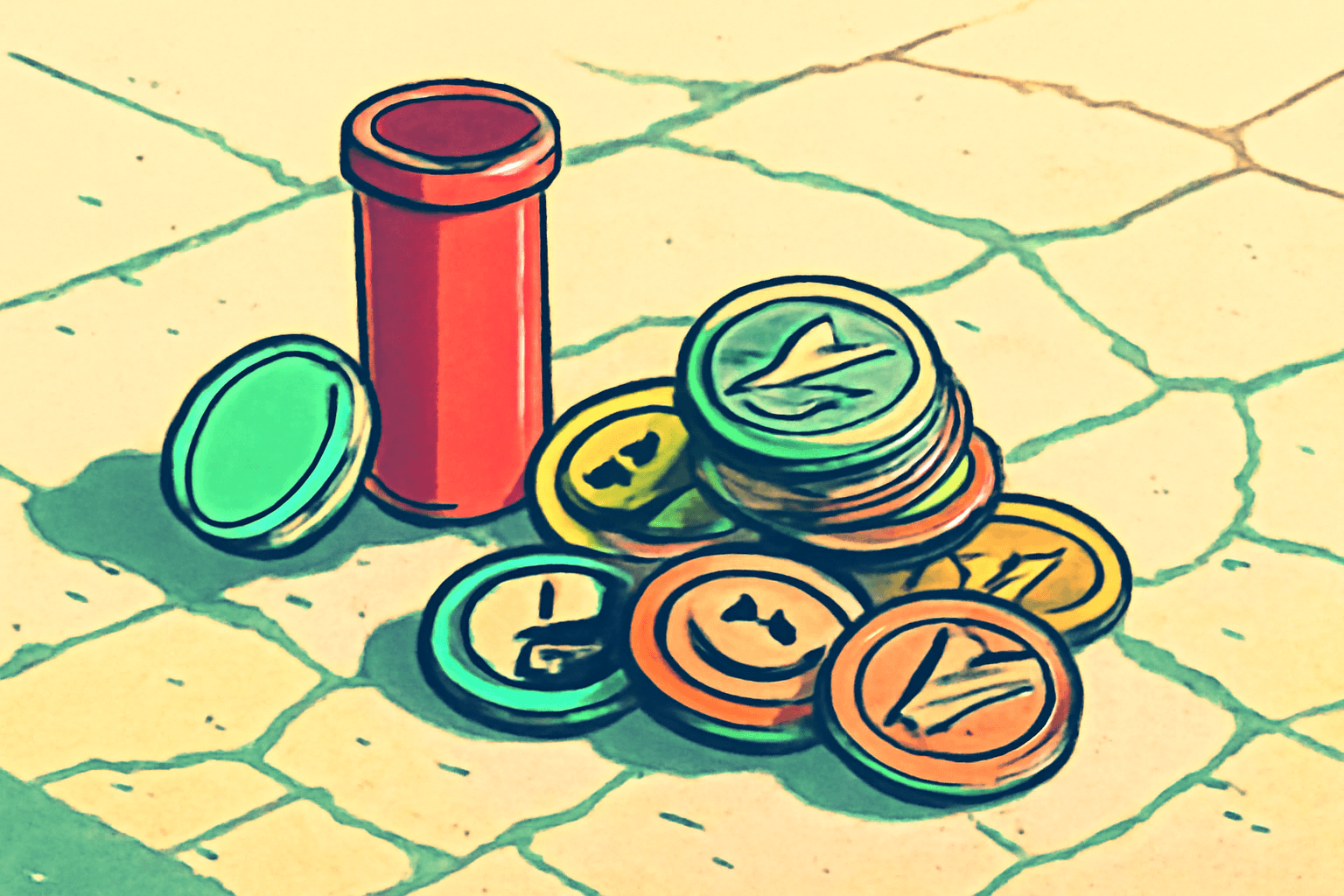
Somebody on the blacktop had a tube. Red plastic, clear-topped, the size of a can of Pringles if Pringles were too short. Inside the tube, a stack of cardboard circles, face down. Sitting separate on top, the thing you really wanted - the slammer. Heavier. Metal, usually, or a plastic disc molded around a washer to give it weight. It caught the sun differently than the pogs did. It was not cardboard. It was, we all understood without ever quite saying it, the actual product.
The game was called pogs. The game was not really about the pogs.
The Discs Were the Cheap Part
Pogs were milk caps. Literally. The name came from a passionfruit-orange-guava juice from Hawaii - P.O.G. - whose lids kids had been playing with since the 1970s because they were free and stackable and roughly uniform. By the time the craze hit the mainland in 1993 and 1994 the caps were still cardboard, but they were no longer free. They came in tubes, in cereal boxes, in gas station impulse racks, in the checkout line at Fred Meyer. You'd get one with a Happy Meal. You'd get one at the dentist. Your cousin had a binder full of pogs from a promotion at Chevron, all of them with the same Chevron car mascot on them, and for some reason he kept them anyway.
The designs ranged from actually cool to a corporation made this. Skulls. Yin-yangs. 8-balls. Smiley faces. A marijuana leaf that got confiscated. A Taco Bell mascot. A local AM radio station's logo. None of this mattered much. What mattered was how many you had, and whether any of them were holographic.
Holos were the currency. A regular cardboard pog was a cent. A holo was maybe a dollar, if you could find someone willing to trade. The holo designs themselves were usually lame - some corporate logo in foil - but the foil was the point. It caught light. It was different. You kept them in a separate sleeve, the way someone in an old movie keeps cash in a second wallet.
The Slammer Was the Real Economy
Here's the thing nobody outside the game understood. A pog was cardboard. A slammer was not. A slammer was a weighted metal or plastic disc, two or three times the thickness of a pog, ten or twenty times the cost. You did not get slammers in cereal boxes. You went to a store and you bought one. A good slammer - one with a skull etched into it, or a chrome finish, or weighted so perfectly that it tipped the whole stack on impact - was a capital investment.
The cheap thing was what you played with. The valuable thing was what you played with it.
This was the inversion that made the whole economy work. You could walk around with a pocket full of cardboard and it meant nothing. You pulled out your slammer and people noticed. Kids would ask to see it. They'd weigh it in their hand. Is it real metal? They'd test-drop it against their palm. Then they'd hand it back, carefully, because you were about to use it to take some of their pogs, and they wanted to know what they were up against.
The Rules Depended on Who Brought the Most
The canonical version went like this. Stack pogs face down in a neat vertical tube. Slammer dropped, no - slammed - down onto the stack from a reasonable height. Whatever flipped face up, the slammer-thrower kept. The rest went back in the stack for the next player. Play continues until the stack is empty.
That was the canonical version. In practice, the rules were decided at the beginning of each game by whoever had brought the most pogs, and they got renegotiated halfway through if that kid was losing. For keeps was a live negotiation. Some schoolyards claimed keeps wasn't allowed and you just flipped pogs for the fun of it, which was a lie told by adults to children. Every game of pogs ever played was for keeps. The kid who said otherwise was ten minutes from crying into a fanny pack full of losses.
There were also, depending on which older sibling had last weighed in, seventeen secondary rules. The slammer had to hit flat. No. The slammer had to hit at an angle. No. You had to call your drop. No. You got three tries. No, one. You couldn't use the same slammer twice in a row. Yes you could. Pogs on the ground count. Pogs on the ground do not count. Pogs stuck to the slammer are a re-do. The ruleset was whatever got us past the argument fastest so we could get back to the actual slamming.
The Ban
Every school in America banned pogs between 1994 and 1995. Not all at once, but close to it. The reason was always the same: the district's lawyer had decided that for keeps play was gambling, and gambling among minors was a problem the principal did not want to solve. Kids were bringing prized holos to school and losing them. Kids were crying. Kids were fighting. A second-grader in Orange County allegedly stabbed a classmate over a slammer, and whether that actually happened or was the plot of a legend that moved from playground to playground via older siblings doesn't matter, because the legend itself is what got pogs banned in your district, too.
Our principal announced the ban over the intercom on a Tuesday. No pogs on campus. No slammers. No milk caps of any kind. Tubes went back into our backpacks and then into our closets, and then into the specific drawer where we all kept the artifacts of a thing we were not allowed to do anymore.
And then, almost immediately, we lost interest on our own.
The Half-Life
That's the part that's hard to explain now. The ban was in 1995. By 1996, nobody wanted them anyway. The craze didn't fight the ban. It just deflated. We all, somehow, collectively, on roughly the same week, decided we were done. Our older siblings had already moved on. Our younger siblings never quite caught up. The tubes sat in closets. The slammers rolled around in desk drawers. One day you pulled out your binder of pogs and realized you hadn't thought about them in six months, and you closed the binder and put it somewhere, and that was it.
The ban didn't kill pogs. We killed pogs. The ban was the excuse we needed to let go of a thing we were already tired of.
I don't think I ever had a real conversation about pogs again until I was an adult writing about pogs. Which is a sentence that tells you something about the shape of a craze. It arrives as the most important thing in the world, occupies your full attention for eighteen months, and then exits so quietly that you can't remember when it stopped being a thing you thought about.
What We Were Actually Doing
It took me years to figure out that pogs were not really about the pogs. The pogs were an excuse to stand in a circle with other kids on the blacktop. The slammer was an excuse to have a specific thing that belonged to you and said something about you. The rules were an excuse to negotiate. The collection was an excuse to sort and arrange and re-sort and re-arrange, which is what kids love to do when the rest of their lives are being arranged for them.
You could have replaced the pogs with literally any small flat object. Bottle caps. Buttons. Little paper fortune catchers folded out of notebook paper. We would have done it. The craze was not about the craze. The craze was about the game beneath the craze, which was: can we agree on a set of rules, and then negotiate them, and then fight about them, and then make up, and then play again tomorrow.
The craze ended when we got tired of the cardboard part. The rest of it - the circle, the negotiation, the shared ritual of pulling something out of your backpack and saying want to play - we kept doing, just with different objects. Yu-Gi-Oh cards. Pokemon cards. AIM screen names we agonized over. Forums. Comment sections. We never stopped playing pogs. We just stopped using pogs.
I found my old tube last year. Red plastic, clear top. Maybe forty pogs inside, mostly cardboard, a couple of holos that had gone cloudy and lost most of their rainbow. The slammer was at the bottom, under everything else, the way the heaviest thing in any container eventually is. I took it out.
It really was a nice object. Small, dense, deliberate. Some cast alloy with a skull etched into it by a machine that probably stamped out thousands of them an hour for two years and then sat idle forever. I don't know where my pogs went, exactly. I don't remember losing them, or trading them away, or throwing them out. I just have the slammer. Which tracks.
Cardboard was always going to fade. The heavy thing is what you keep.