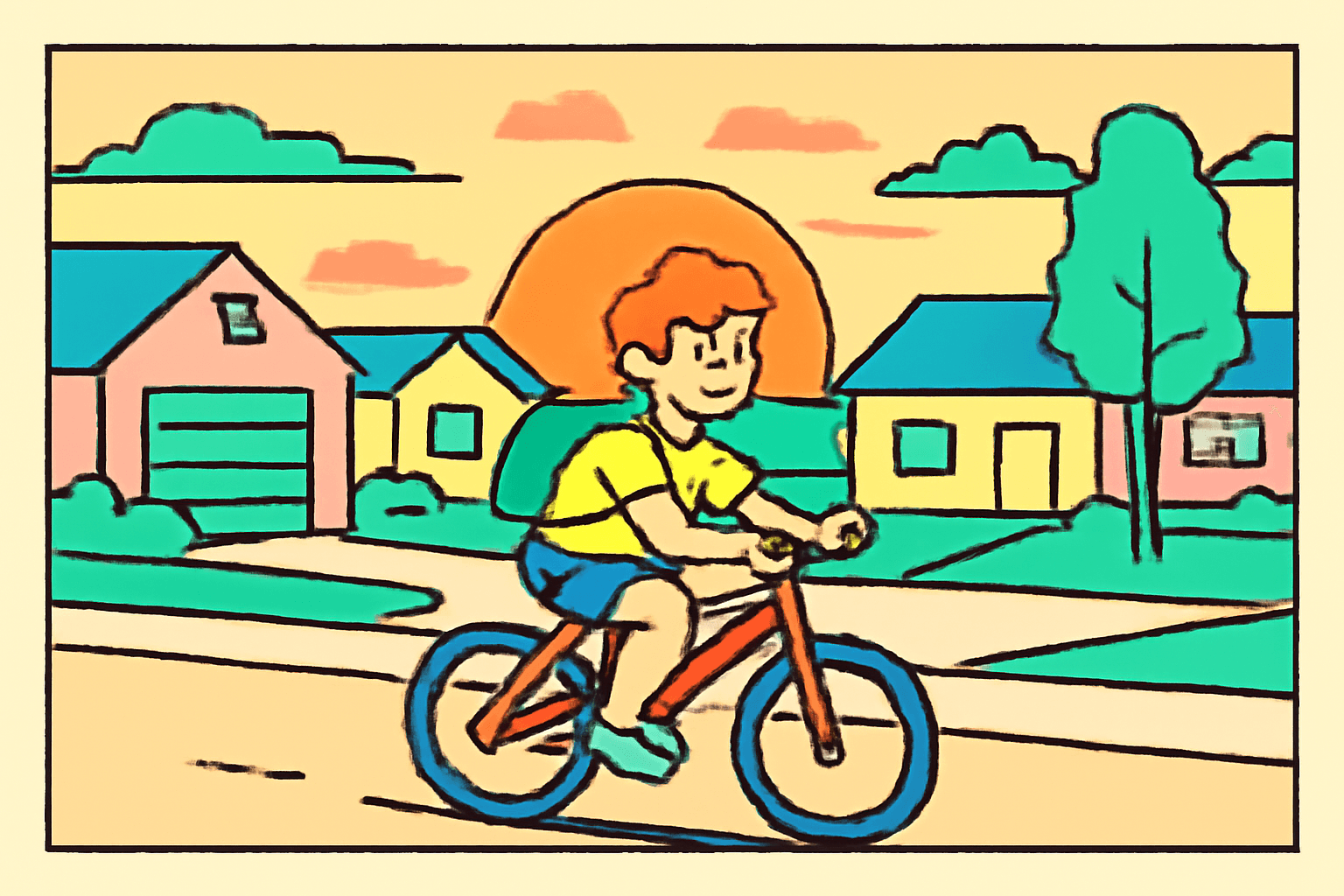
The screen door slammed behind you at 9:14 in the morning and nobody asked where you were going. You said "out" or maybe "Kyle's" and that was enough. Your mom was on the phone with the cord stretched around the corner into the pantry and she waved a hand that meant either "okay" or "stop talking to me," and both interpretations worked in your favor. You grabbed your bike from the side of the garage and you were gone.
Just gone.
The Rules Were Simple
Every household had some version of the same three commandments. Be home when the streetlights come on. Don't cross Route 9. Don't do anything stupid. That was it. That was the entire parenting framework for a Tuesday in July. No GPS coordinates. No check-in texts at noon. No Life360 pinging your location to a phone in your mother's purse. You left the house and you entered a world where no adult could reach you, and honestly, no adult was trying to.
Be home when the streetlights come on. That was the entire parenting framework for a Tuesday in July.
The streetlight rule was genius because it was self-enforcing. You didn't need a watch. You didn't need a reminder. The sky did all the work. You'd be deep in whatever you were doing - catching crawdads in the creek behind the Hendersons' place, or trying to jump the drainage ditch on your Huffy - and then the light would shift. That golden hour light that made everything look like a Spielberg movie. And you knew. You had maybe forty minutes. The streetlights weren't on yet but they were thinking about it, and you could feel the day winding down the same way you could feel a Sunday night before school.
The Bike Was Everything
Your bike wasn't transportation. It was sovereignty. A ten-speed - or in my case, an eighteen-speed that definitely only had about twelve working gears - turned a kid with a two-block world into a kid with a two-mile world. That's not a small difference. That's the difference between knowing four kids and knowing forty.
I rode a green and silver Mongoose that I got for Christmas in '94. The handlebars had foam grips that were slowly disintegrating into black crumbs. The chain slipped if you shifted too fast going uphill. One of the reflectors was gone and the other was held on with electrical tape. It was perfect.
- A baseball card in the spokes (aesthetic and acoustic)
- A water bottle cage that held no water bottle, ever
- A bike lock I lost the combination to within a week
- A bell that broke off going over a curb on Elm Street
- Handlebar streamers (briefly, before dignity intervened)
With that bike I could get to the 7-Eleven on Parker Ave in about seven minutes. I could get to the good park - not the one with the rusty swings, the one with the wooden castle structure - in twelve. I could get to my friend Danny's house, across the neighborhood and past the church, in about nine if I cut through the Albertsons parking lot. I had a whole mental map of time-distances, measured not in miles but in minutes of pedaling. That map was my freedom.
The Hours Nobody Tracked
Here's what I think about most. Between leaving the house and coming back, there were six, seven, sometimes eight hours that were completely unaccounted for. Nobody knew where you were. Not your parents, not your school, not the government. You were just out there, a free agent in cargo shorts, and the world was structured around the assumption that this was fine.
And it was fine. Mostly.
We built a fort out of pallets behind the strip mall off Davidson Road one summer. It took weeks. We found the pallets stacked behind the grocery store and carried them one by one to a patch of trees that we were certain no adult knew about. The fort had two rooms and a piece of plywood that served as a door. It smelled like pine sap and dirt. We kept a coffee can in there with some baseball cards and a lighter that nobody admitted to owning.
None of this was coordinated through a group chat. There was no thread. Someone just showed up at someone else's house, knocked on the door, and said "you wanna go to the fort?" and then you went. Or you rode around until you found where everyone was, because on a summer day, the other kids were always somewhere. You just had to look. At the basketball court. At the creek. At the cul-de-sac where the Kowalski twins had a half-pipe their dad built.
The Thing About Being Unreachable
There's a specific feeling I don't think anyone born after 2000 has ever experienced. It's the feeling of being a kid, miles from home, with no way to call anyone and no way for anyone to call you. And being completely okay with it. Not scared. Not anxious. Just free in a way that felt so ordinary you never thought to name it.
If you wiped out on your bike and skinned your knee, you dealt with it. You pressed your palm against it for a minute, said a word you weren't allowed to say, and kept going. If you got thirsty, you drank from a garden hose. If you needed to use the bathroom, you went to whichever friend's house was closest and hoped their mom was in a good mood. Every problem had a kid-sized solution because kid-sized problems were all there were.
Every problem had a kid-sized solution because kid-sized problems were all there were.
The adventures happened because no one was watching. You explored the drainage tunnel that ran under the highway because no parent was there to say "absolutely not." You climbed the tree behind the Methodist church - the one so tall you could see the roof of the school - because the only risk assessment happening was your own, and at ten years old your risk assessment was basically "seems fine." You ate a popsicle that some kid's older sister sold you for a quarter out of their garage freezer and you didn't ask about the sell-by date.
What It Built
I don't want to get all Tough Guy Nostalgic about this. I'm not saying we were tougher or better or that adversity builds character and kids today are soft. That's boring and mostly wrong. But I do think something specific happens to your brain when you spend years navigating the world without a lifeline to an adult. You develop an internal compass. Not just a directional one - though that too - but an emotional one. A sense of I can figure this out that gets baked in through repetition.
You learned to read situations. Which dogs were friendly and which weren't. Which teenagers at the park would ignore you and which ones might be a problem. Which shortcuts were actually faster and which ones just felt faster. You learned to manage your own time, your own hunger, your own boredom. Nobody was coming to solve those things for you, so you solved them, and after a while you stopped thinking of them as problems at all.
The Contrast
I watch parents now and I get it. I really do. The world feels different, even if statistically it isn't much more dangerous than it was in 1995. But I see a nine-year-old with an iPhone and a location tracker and I think about what's missing from that arrangement. Not the phone itself - that's just a tool. What's missing is the blankness. The hours of pure unmonitored nothing. The space where a kid gets to be a person without anyone checking in.
My parents didn't let me roam because they were negligent. They let me roam because that's what every parent on the block did, and before that, every parent on their block had done the same thing. It was a consensus. An unspoken agreement that childhood included a certain amount of disappearing, and that the disappearing was the point.
The streetlight on our corner was a sodium vapor lamp that buzzed when it came on. It threw this amber glow across the end of the driveway that meant the day was over. You'd come pedaling up the street with your shadow stretched out long behind you and that buzzing light was like a bell ending a round. You dropped your bike in the yard. You came inside. Your mom asked if you had fun and you said yeah. She didn't ask where you'd been. You didn't offer.
Somewhere between the screen door slamming in the morning and that sodium light buzzing at night, you'd had an entire life. A whole unrecorded day. No photos. No texts. No evidence at all except the grass stains and the sunburn and the feeling - quiet, bone-deep, unnamed - that you could handle being out in the world.
That was the gift. We just didn't know it yet.