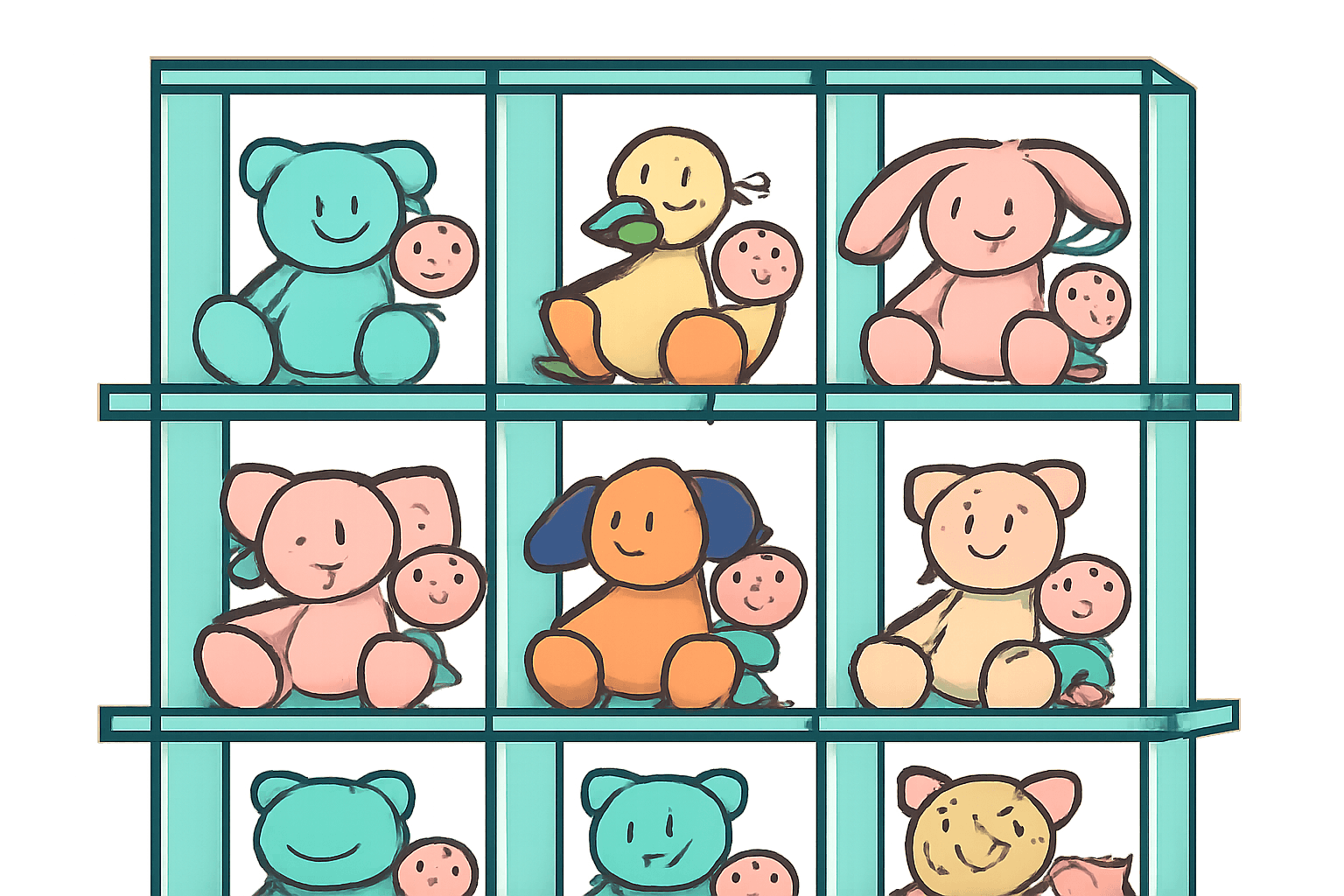
My aunt had a guest room and in that guest room was a twin bed, and on that bed sat twenty-seven Beanie Babies in a row, each one inside its own individual plastic heart-tag protector, arranged by rarity according to a three-ring binder she kept on the nightstand. You were allowed to look at them. You were not allowed to touch them. And under no circumstances were you allowed to bend the tag, because a bent tag, she explained with the grave sincerity of a hostage negotiator, could knock seventy-five dollars off the resale value.
I was eleven. I nodded like I understood. I didn't. But I understood that something serious was happening here, because grown adults were acting like this.
The Premise
Ty Warner started making Beanie Babies in 1993. Little understuffed plush animals, floppy and beady, about the size of a softball. They cost five bucks at Hallmark stores and gift shops, which was a weird place to sell toys but exactly the right place to sell whatever this was going to become. They weren't marketed to kids, not really. They were marketed to collectors, a word that in the nineties still had a patina of sophistication, like you were one step away from a monocle.
Each Beanie Baby had a name. Patti the Platypus. Peanut the Elephant. Chocolate the Moose. Each one had a little poem on the red heart tag, four lines of the kind of verse that wins nothing but lives forever. And each one had a style number, a birthdate, and a date of retirement - though the retirement dates were unknown, and that was the whole trick.
Ty never told you when a Beanie Baby was going to retire. They'd just announce it on the website, at which point the one sitting on your aunt's guest bed became, in theory, worth a hundred times what she paid.
The Scarcity Engine
Ty would pull a Beanie Baby from production without warning. No clearance sale, no last-call email - just a quiet update on ty.com, which was one of the first websites a lot of middle-aged women ever bookmarked. The retirement announcement was the moment the speculation started. Prices on the secondary market would spike overnight. A Humphrey the Camel that cost five dollars in 1994 was, briefly, listed for six hundred.
This was not normal. This was not a thing stuffed animals did. Beanie Babies were behaving like tech stocks, and the collectors were behaving like day traders, except the day traders at least had Bloomberg terminals. These people had a laminated price guide from the grocery store checkout and a lot of faith.
There were magazines. Mary Beth's Bean Bag World Monthly. I am not making that up. It had cover stories. It had price charts. It had interviews with Ty executives as if they were federal reserve chairs.
The McDonald's Incident
And then in April of 1997, McDonald's started putting miniature Beanie Babies in Happy Meals. Teenie Beanies. A set of ten. They sold one hundred million Happy Meals in two weeks, which is a sentence that does not describe a functioning society.
Drive-thru lines backed up onto highways. People ordered Happy Meals twenty at a time and threw the food away. Adults with no children walked into McDonald's and ordered Happy Meals with a straight face and left with a tiny plush elephant. My neighbor's mom, a forty-something woman who taught middle school science, drove to three different locations in one afternoon looking for Chocolate the Moose. She found it. She framed it.
- Patti the Platypus: The headliner, the one everyone wanted first
- Pinky the Flamingo: Aggressively pink, somehow the rarest for a week
- Chops the Lamb: Retired fast, appreciated faster
- Chocolate the Moose: Beloved for no articulable reason
- Goldie the Goldfish: Perpetually shiny, perpetually available
- Speedy the Turtle, Seamore the Seal, Snort the Bull, Quacks the Duck, Lizz the Lizard: The supporting cast, equally hoarded
McDonald's extended the promotion. Then ran out. Then had to apologize. A customer filed a lawsuit. Franchisees were hiding Teenie Beanies in the back and selling them to regulars for ten bucks each under the counter, which is genuinely something that happened in American fast food restaurants.
The Tag Protectors
Here is how you know a collectible market has lost its mind. Somebody invents a product whose sole purpose is to protect the cardboard tag on another product. And people buy that product. And the tag protectors have their own sub-market, because some tag protectors are better than other tag protectors, and the expensive ones are rigid plastic with a hinge, and the cheap ones are just clear plastic sleeves that bend in humidity.
My aunt had the hinged ones. She'd slide each heart tag inside, snap it shut, and align it at a precise forty-five degree angle from the Beanie's body. The tag could not be creased. The tag could not be folded back. The tag could not be removed, obviously, because a Beanie without its tag was worth roughly nothing, a piece of information that created a strange inverse logic: the attached piece of cardboard was worth more than the plush animal it was attached to.
The attached piece of cardboard was worth more than the plush animal it was attached to. This is a sentence about the nineties that explains most of the nineties.
Princess
When Princess Diana died in August 1997, Ty released a purple bear called Princess in her memory. Proceeds were supposed to go to her charitable foundation. Stores got one or two in stock. Fights broke out. Literal, pushing-and-shoving fights in Hallmark stores. I watched a woman at the mall tell another woman that her husband was in the hospital just to guilt her into handing over the last Princess bear on the shelf. I don't know if the husband was actually in the hospital. I know the bear changed hands.
The Princess bear, incidentally, is now worth about fifteen dollars on eBay. Which is roughly what it cost new. Adjusted for inflation, it lost money.
The Divorce
In 1999, a couple in Las Vegas filed for divorce. They couldn't agree on how to split their Beanie Baby collection. The judge ordered them to divide the stuffed animals in open court. There is video of this. Two adults, on their hands and knees on a courtroom floor, taking turns picking a Beanie Baby from a pile while a judge watched. They did this for their entire collection, one at a time, like a toy draft for the saddest fantasy league ever run.
This is when it should have been clear. This is the scene that should have woken everyone up. It did not.
The Crash
The market peaked in 1999 and collapsed by 2000. Ty retired every Beanie Baby on December 31, 1999, then un-retired them, then retired some, then released new ones, and the whole narrative of scarcity dissolved into noise. Collectors who had spent thousands discovered that "rare" meant nothing if nobody else wanted them, and nobody else wanted them because the people who would have wanted them had the same boxes in their own basements.
The guest room at my aunt's eventually got rearranged. The Beanie Babies went into a Rubbermaid tote in the garage. Then into a donation pile, maybe a decade later. The tag protectors probably ended up in a landfill, which is a funnier ending than it should be.
What I remember is not the toys. It's the seriousness. A whole country of adults had decided, briefly, that a stuffed pig with a heart-shaped tag was a legitimate financial instrument. Not as a joke. As a plan. They were going to sell these in twenty years and send their kids to college with the proceeds.
Their kids went to college anyway, with loans, like everyone else. The pigs are in a box in the garage. Someone's garage. Probably yours.