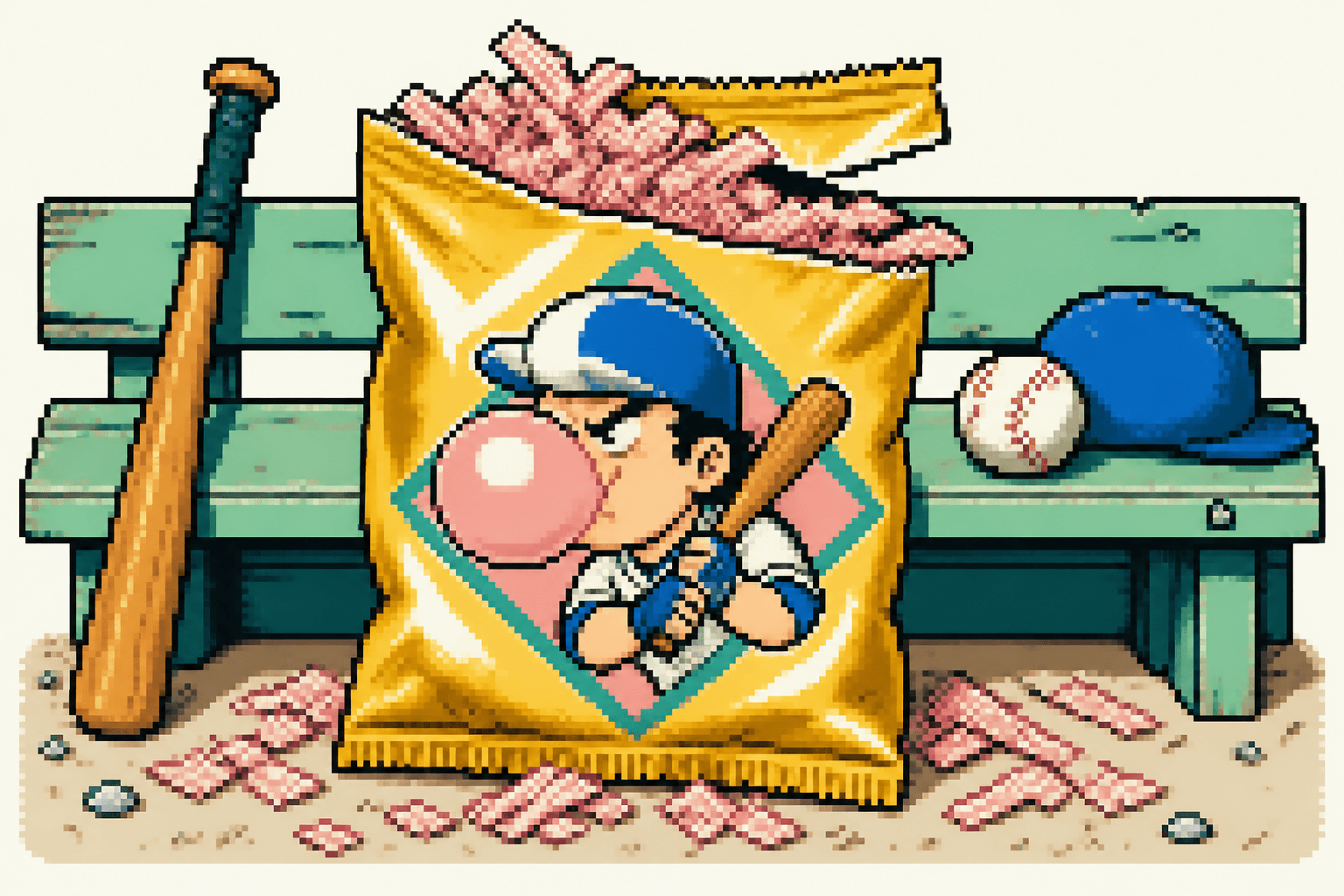
You bought it at the concession stand between innings. A dollar, maybe a dollar fifty by the end of the decade. The pouch was gold-foil and about the size of a wallet, and when you tore the top open with your teeth there was a smell that came out that I can only describe as strawberry and warehouse, and inside, piled like insulation, was a mass of pink shredded gum.
You stuck your hand in. You pulled out a pinch. You jammed it in the side of your mouth.
Your cheek bulged out like you'd been punched.
The Pouch
The pouch mattered. The pouch was the whole thing.
It was gold-foil with the words BIG LEAGUE CHEW on the front in a block font that was doing an impression of a baseball jersey. There was a cartoon player on it. He had a beard and a huge jaw and his cheek was blown out like a chipmunk's and he was happy about it. The pouch sealed with a resealable top strip that stopped sealing after the second day.
It was about four by five inches. You put it in the back pocket of your shorts. It stuck up out of the pocket a little. You could see the top of it. That was deliberate.
You weren't carrying candy. You were carrying something that looked like what adults carried.
What It Actually Was
Pink gum. Shredded. By weight, maybe two ounces. Flavor-wise, bubblegum - the generic kind, the pink kind, the kind that lives in a doctor's office floss. Other flavors appeared later: grape, blue raspberry, a sour one that was objectively better than the original and still is. In the beginning there was only the pink.
It was gum you would otherwise buy in a stick or a cube. The innovation was the format. You did not get a stick. You got a handful. The amount you took was up to you. The culture around how much to take at once was not up to you. The culture was take too much. If you took one shred, you were wrong. If you took enough to look like a baseball player with a chaw in his lip, you were right.
You were not supposed to put one shred in your mouth. You were supposed to put in a wad the size of a plum, pack it into your cheek with your tongue, and look like you'd been in the dugout since 1973.
The Thing We Weren't Supposed To Notice
Let me say the quiet part.
Big League Chew was shredded gum in a pouch. The pouch was gold-foil, lipped, resealable, sized to fit in a back pocket. The player on the front had a wad in his cheek. The whole package was shaped, visually and tactically, exactly like a pouch of chewing tobacco - the kind you'd pass around in a bullpen in 1978.
This was not an accident. The gum was invented in 1980 by a minor-league pitcher named Rob Nelson, who was looking for a substitute for the chewing tobacco that was wrecking the mouths of his teammates. The marketing committed to the bit. The product's whole personality was looks like dip, acts like gum.
As a kid, you did not notice this. You noticed that the pouch felt important. You noticed that you were allowed to buy and carry an adult-looking thing at the ballpark. You noticed that the batter on the pouch was you, if you were lucky, in about eight years.
The adults did notice. The adults did not stop you.
The Pinch
Take one. Take another one. The first pinch is not the point. The cheek is the point.
The Flavor Lasted Forty Seconds
The thing nobody told you about taking a huge wad of shredded bubblegum and jamming it into your face is that the flavor-to-mass ratio was bad. Four shreds would taste like gum. Forty shreds would taste like one gum. The sugar hit you in a wave and then left on the next wave, and you were left with a mouth full of rubbery pink mass that you could not swallow, could not spit out at the dugout because your coach was watching, and could not fit another thing into because your mouth was already full.
So you chewed. For twenty minutes. In silence. Breathing through your nose. One cheek permanently distended. You looked like a hamster that had committed to its life choices.
- 0:00 to 0:40 - flavor. honest, bright, pink.
- 0:40 to 3:00 - sweetness fading, texture still bouncy.
- 3:00 to 10:00 - gum. just gum. the jaw starts to hurt.
- 10:00 to 20:00 - you want to spit but a coach is looking.
- 20:00 onward - the wad is now rubber. you are chewing a rubber band. it is also stuck in your molars. your parents will find a pink wad on the car seat.
The Dugout Economy
Little league ran on a trading floor you could not see.
A full pouch, unopened, was a flex. An opened pouch was a resource. A near-empty pouch was a negotiation. If you had the pouch and the kid next to you did not, you were in the chair. He wanted a pinch. You decided how much of a pinch. You weighed, in the moment, how much he had traded you for last time, whether he was on your team today, and whether he had been a jerk about the bat bag last week.
If you were out of your own pouch, you were cold. You stood near the kid with the pouch. You did not ask. You hovered. You said man, that's a good flavor though. You stood there. Eventually either the pinch came or it didn't, and either outcome was information about where you stood in the dugout that week.
Nobody wrote this down either.
The Argument With Itself
I want to be fair about this.
The counter-argument is: it was gum. It was sugar. It was not nicotine, it did not stain your teeth, it was not making anyone sick, and most of the kids who chewed it never went anywhere near real tobacco. The pouch was marketing. The adults who worried about it were overthinking a product that gave kids something to do with their mouths between innings. If a boy wanted to look like Carlton Fisk in the on-deck circle, he could, and nothing bad happened to him. Lots of us turned out fine. Lots of us also still remember exactly how the pouch sat in the back pocket of our shorts. One does not disprove the other.
I agree with most of this. I would also note, out loud, that it is a little bit strange to sell children a product whose entire visual language is the thing you are not allowed to use yet, but will be soon. Not evil. Not predatory. Just a little bit strange, in the way that a lot of 90s marketing was a little bit strange, in the way that we got Joe Camel on billboards and SURGE in cans and Jolt Cola marketed on twice the caffeine, and nobody ever stopped to ask who was writing the plan.
The plan was: sell kids a thing that makes them feel like adults. The thing could be gum. The thing could be a leather jacket. The thing could be a pouch.
Nobody made you chew tobacco later. Nobody made you not. The pouch did not reach into your twenties. It just taught your hand what a pouch felt like.
The Lingering Wad
The pouch is still a product. You can still buy it. The flavors are better now, the pouch is maybe a little smaller or maybe I'm bigger, and the batter on the front is still a cartoon with a huge jaw and he is still happy about it.
I bought one, recently, in a drugstore where I did not need anything. I opened it in the parking lot. I took a pinch. The sensible amount. The amount an adult takes, which is pathetic, which is three shreds. I chewed. The flavor lasted forty seconds. I threw the rest in the glove box.
And I thought about how, if I'd been nine, I would have taken a wad the size of a plum, put it in the side of my mouth, let my cheek balloon out, and gone back out to the dugout to hover near somebody who still had theirs.
The pouch is just a pouch. It was always just a pouch. The gum, which was pink and sweet and ran out of flavor forty seconds in, was always just gum. And the kids, who are not kids now, still remember exactly how it felt in the back pocket of their shorts, sticking out just enough to be seen, and the way, when it was almost empty, you'd take your last pinch and press down on the foil to make sure the pouch kept its shape, so it would still look full, so nobody at the fence would ask.