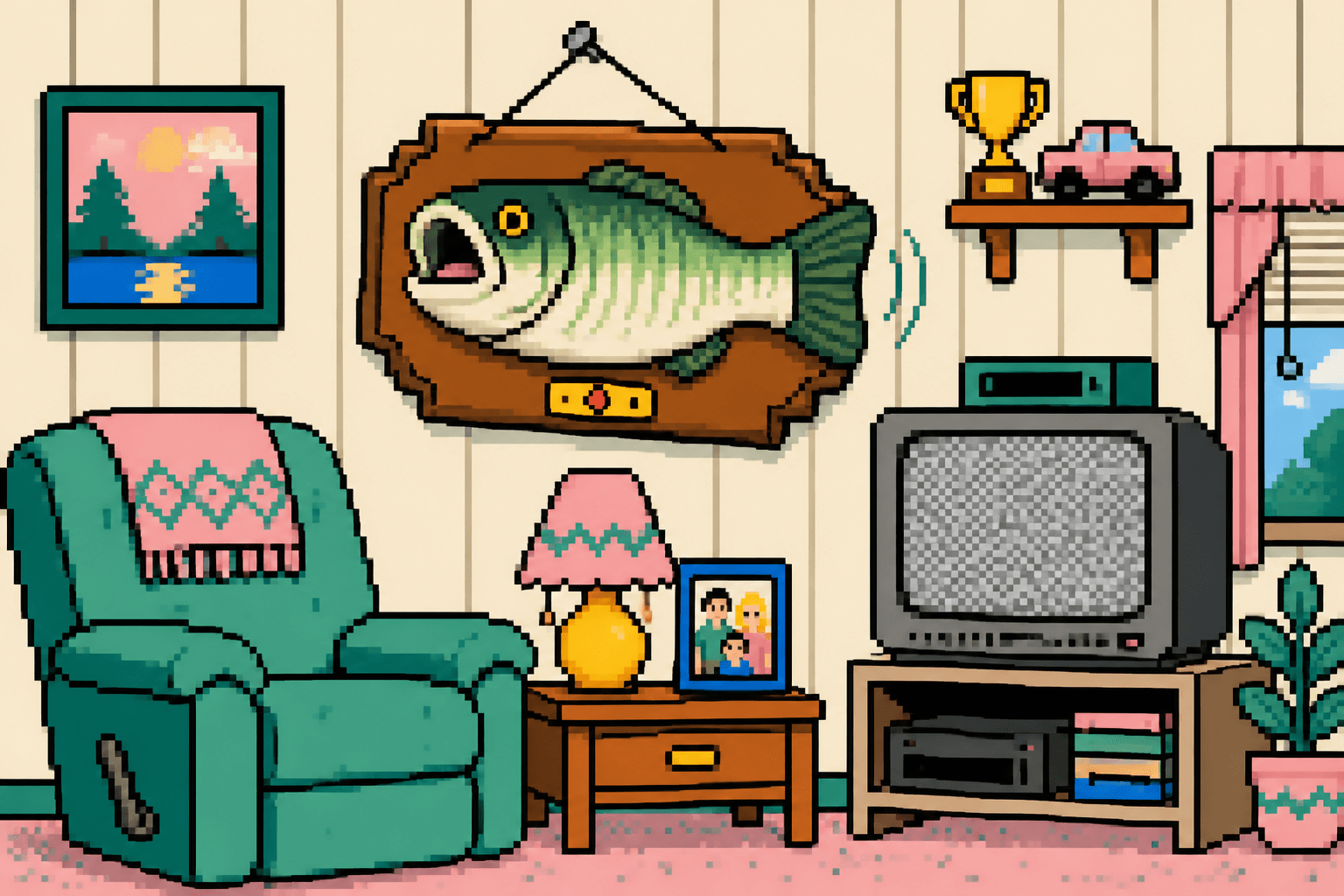
The fish was mounted to a piece of lacquered pine the size of a license plate. It was a largemouth bass, or a rubber impression of one, molded from a cast that had been molded from a photograph of a bass that had probably never existed. It was olive green on top and butter yellow on the belly. Its eye was glass or looked like glass. It was screwed to the wood at four points, and the wood was screwed to the wall at four points, and above the fish, burned into the pine with a woodworking iron, was the word BILLY.
You walked past it. You did not know it was there. It turned its head. It looked at you. Its mouth opened.
And then, from a speaker inside the fish, a 44-second loop of Al Green's Take Me to the River began to play, and Billy Bass, the fish on the plaque, lifted himself perpendicular to the wall, flapped his tail, opened and closed his rubber jaw roughly in time with the lyrics, and sang.
You screamed. Your dad howled. Your dad had been waiting six days for someone to walk past the motion sensor.
The Object Itself
Big Mouth Billy Bass was released in 1999 by a company called Gemmy Industries, which was based in Coppell, Texas, and which made almost nothing else of consequence but still, somehow, won.
The physical thing was heavier than it looked. The plaque was about fourteen inches wide, the fish was about twelve, and inside the fish were two small motors - one for the head, one for the tail - and a tiny circuit board and a tinny speaker about the size of a quarter. The motion sensor was a little black dome at the top of the plaque, slightly off-center, that any reasonable person would have mistaken for a knot in the pine. It could see you from about six feet. It could not tell the difference between you and the dog.
The fish ran on four C batteries, which were hidden behind a panel on the back of the plaque. The panel was held on with a single Phillips-head screw. You had to unscrew it to change the batteries, which happened about every three weeks, because everyone in the house was triggering the motion sensor several dozen times a day.
The motion sensor could see you from about six feet. It could not tell the difference between you and the dog. The dog triggered it eleven times a day and never once got used to it.
The Button Said Press Me
That is the Bass. Press the button, pick a song, and watch the fish look at you and sing. There is no audio. The audio is the memory you already have of exactly how it sounds, which, if you are between the ages of thirty and fifty, is stored somewhere near the memory of your uncle's laugh and cannot be deleted.
The Songs
There were, in the first production run, two songs.
One was Take Me to the River, by Al Green, 1974. The other was Don't Worry, Be Happy, by Bobby McFerrin, 1988. Neither of them was a 90s song. Neither of them had anything to do with a bass. Neither of them was performed by the actual artist on the actual fish - the recordings on Billy Bass were performed by session musicians who had been asked, presumably with a very specific brief, to sound approximately like Al Green through a quarter-sized speaker hidden inside a piece of rubber.
The songs did not play all the way through. They played a chorus, maybe a verse, and then they stopped, because a motor driven at 1.5 volts can only sustain mouth-flapping for so long before something inside the fish starts to smell warm. You got about forty-five seconds. You got the hook. You got the part your brain could sing.
- Take Me to the River - Al Green. The default. The one your dad wanted. The one that played when he opened the box on Christmas morning and laughed so hard his coffee came out of his nose.
- Don't Worry, Be Happy - Bobby McFerrin. The alternate. The one that played in the dentist's office waiting room, except now it was in your kitchen, and now the dentist was a fish.
- I Will Survive - Gloria Gaynor. Added in later production runs, after someone at Gemmy decided a bass should also be capable of empowerment.
- Fishin' Time - Original. The one song written for the fish, by someone, somewhere, for a licensing fee. Nobody remembers this one. Nobody ever heard it twice.
The Motor
The motor noise was a part of it.
Before the song started, there was a half-second of mechanical whirring - vvvzzt - and a click, and the fish's head would begin to lift away from the plaque. It took about a full second for the head to reach ninety degrees, which was the pose in which the fish could then face the viewer and sing. The head did not lift smoothly. It lifted in little jerks. If you listened closely you could hear the gears inside the plaque counting out their work, the same sound as a cheap toy car, the same sound as the kitchen timer my grandmother used to boil eggs.
Then the mouth would open. Then the song would start. Then, in the middle of the song, the fish would also flap its tail, because the second motor was now also engaged, and the fish was performing both of its moves at once, and the plaque would vibrate slightly against the wall, and a dust would come off the pine if you looked closely.
The whole thing cost twenty dollars at Walmart.
A bass, a plaque, a motion sensor, two motors, a quarter-sized speaker, four C batteries, and a looped recording of a session musician doing Al Green. Twenty dollars. The entire 1999 holiday season happened on top of this object.
Where It Was Mounted
Not in the living room. Never in the living room. Your mom would not allow it.
Billy Bass was a basement object, or a workshop object, or a man cave object, back when the term man cave was being used sincerely and not as a punchline. It was on the wall above the workbench, next to the pegboard of tools. It was on the wall of the garage, next to the calendar of a lineman from Snap-On. It was on the wall of the finished basement, next to the dartboard, under the Steelers banner. It was in the bathroom of the lake house. It was over the bar, if there was a bar.
It was, and this is important, your dad's thing. Billy Bass was almost entirely a dad object. The Venn diagram of people who owned Billy Bass and people who had a specific set of needle-nose pliers for which they knew the exact drawer was not a Venn diagram, it was one circle. Your mom tolerated it. Your mom thought it was fine. Your mom was not the one laughing at the fish every single time.
- Workshop wall, above the pegboard. 38% of all installs.
- Garage, next to the Snap-On calendar. 22%.
- Finished basement, by the dartboard. 14%.
- Bar area / bar cart / shelf over the kegerator. 11%.
- Guest bathroom, over the toilet. 8%.
- Office cubicle, briefly, until HR said something. 4%.
- Grandma's living room, over the couch. 1%, but it happened, and when it did, nobody questioned it, because grandma was in charge.
- The actual kitchen. 2%. Rare. Contested. Usually a divorce precursor.
The Freeze-Out
Here is the thing about a motion-activated novelty.
You cannot turn it off. You can take out the batteries, but then your dad will put them back in, because the fish is the fish. So you learn, over the course of about two weeks, how to walk past Billy Bass without triggering him. You learn the angle of approach. You learn the dead zone. You learn that if you come in from the left, hugging the wall, and you duck slightly at the Nebraska plaque, you can make it to the beer fridge without being sung at.
Everyone in the house learns this. Even the dog learns it, eventually, although the dog takes about four months longer than everyone else, because the dog is a dog.
And then one day the family comes home from a long weekend, and the batteries have died, and the fish is quiet, and you walk past it without even thinking about it, and when you look up you realize it has been three weeks since it last sang, and nobody has mentioned it, and nobody has replaced the batteries, and the pine plaque is the quietest it has ever been. And your dad, the dad who installed it, has also stopped noticing.
The fish just hangs there. It is still a fish. It is still screwed to a piece of pine. It is still, in some sense, Billy. But it does not sing anymore, and nobody is going to make it.
The Argument
I want to make the argument that this was a bad object.
It was a plastic rubber fish nailed to a piece of lumber that played the chorus of a song in a voice that was not Al Green's. It was not art. It was a prank machine, basically, a gag you installed in your own house so that you could prank your own family forever, and the prank was the same prank every single time, and the fish never got funnier.
It also cost twenty dollars, which in 1999 money was not nothing, and the dad who bought the Bass also bought, over the next five years, a Rocky Mountain Elk that sang Sweet Home Alabama and a lobster that sang Rock Lobster, and we should at some point have a serious conversation about why a generation of American dads spent the turn of the millennium buying animatronic woodland animals that performed classic rock in rubber. The Sears catalog in 2001 had an entire page for these. An entire page.
Between 1999 and 2004, American dads bought singing fish, singing deer, singing lobsters, singing moose, and a singing Christmas tree that performed Jingle Bell Rock in a baritone. We should, at some point, have a real conversation about this. We will not.
The Other Side
But here is the other side.
My dad kept his Billy Bass on the wall of his garage for twelve years. The batteries were dead for eleven of them. He never threw it away. Every time I came home from college, it was still there. The fish had faded from green to a kind of military grey. The pine had warped. The nameplate had tarnished. The thing had stopped being a prank years before, and had started being, I don't know, a fixture. A piece of the garage. Like the air compressor. Like the specific calendar.
My dad never said anything about it. Nobody in the family did. We walked past it a thousand times, and sometimes, if I was in the garage late at night looking for a flathead screwdriver, I would look at the fish, and the fish would look back at me, and nothing would happen, and that was correct. The fish had done its job. The fish had been uproarious for eighteen months in 1999 and 2000, and then it had become furniture, and that is what furniture is: a thing that was once an event, downgraded, over time, into a thing you walk past.
When my dad moved out of that house, in 2013, he took the fish down from the wall. He did not pack it carefully. He did not wrap it in anything. He just put it in a cardboard box with a power strip and an extension cord and a half-empty jar of three-in-one oil, and he put the box in the back of the truck, and he drove the fish to the new house, where he screwed it to the wall of the new garage, three inches below the existing pegboard, on a Tuesday afternoon, with four of the same screws it had in the last wall.
The batteries are still dead. The fish is still there. He is almost eighty. The fish does not sing. Neither one of them seems to need the other one to.
What Happened to Them
Big Mouth Billy Bass sold about half a million units in its first year. Gemmy Industries, the Coppell, Texas company that made it, is still in business and now makes most of the inflatable Halloween decorations on your neighbor's lawn. The company owns the Billy Bass patent. They re-release the fish occasionally, as a limited run around Christmas, and the new ones are Bluetooth-enabled - you can pair them to your phone and make them lip-sync to anything, which is both an upgrade and, in a way nobody wants to say out loud, a downgrade.
Al Green got royalties. Bobby McFerrin got royalties. The session musicians who did the vocals on the actual fish got, presumably, a flat fee, and a story to tell at parties for the rest of their lives, which is: I am the voice of Billy Bass.
The original fish, the 1999 one, the one your dad had, is on eBay for anywhere between eight and forty dollars, depending on whether the motors still work. They mostly do. The motors in these things were, bafflingly, built to last. The pine plaque will have warped. The batteries will have corroded in the housing and left a green crust. You will have to clean out the battery compartment with a Q-tip and some vinegar. And then, when you put four fresh C batteries in, and screw the panel back on, and lift the fish into position, and wave your hand in front of the motion sensor on the top -
the fish will turn. The fish will lift its head. The fish will open its mouth. And a session musician in Nashville, recorded through a four-dollar speaker in the back of a rubber bass in 1999, will begin, one more time, to sing about being taken to the river.
And your dad, wherever he is, will laugh.