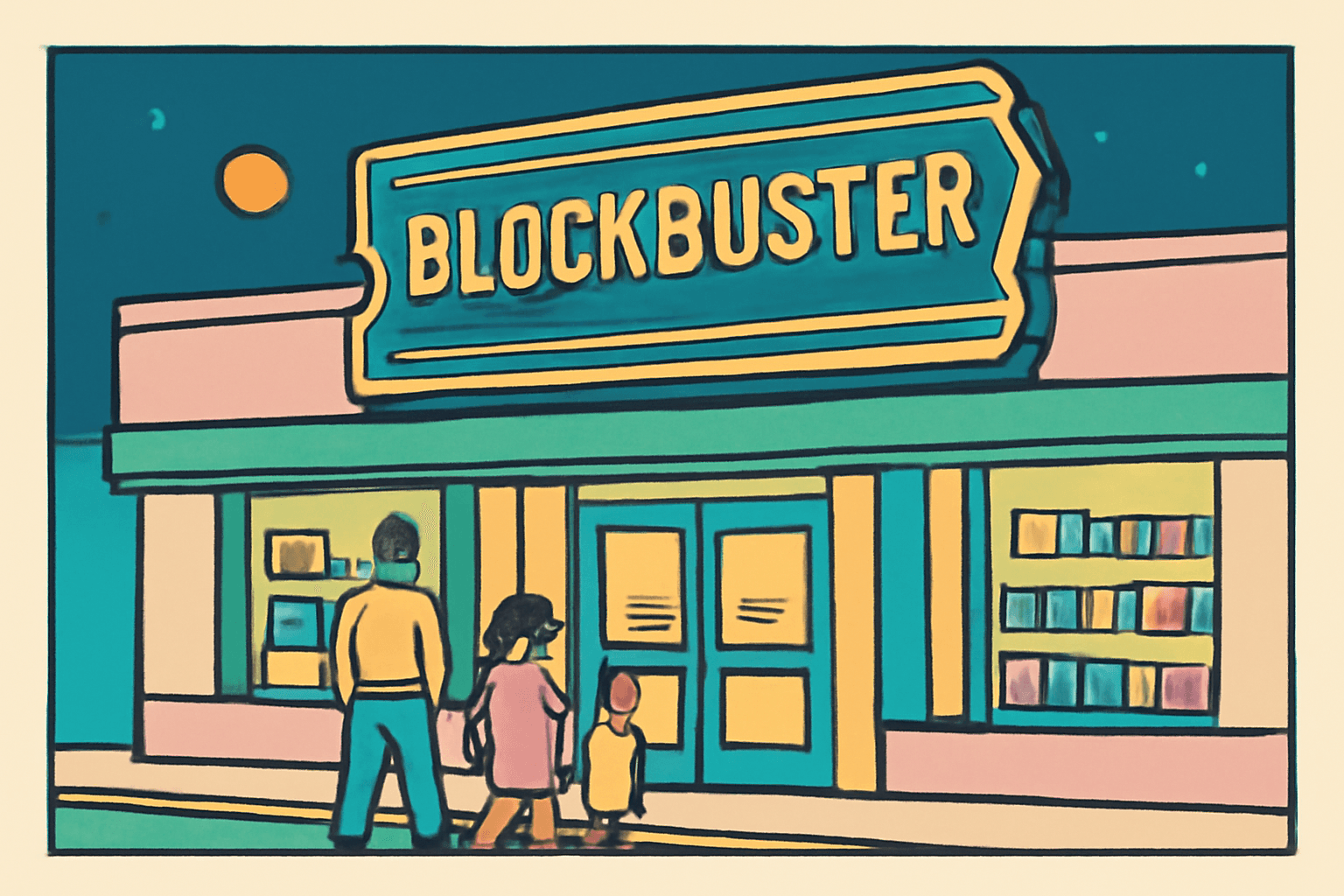
The smell hit you before the door even closed behind you. That specific Blockbuster smell - plastic clamshell cases, industrial carpet, and something faintly sweet that might have been the candy aisle or might have just been possibility. I've never encountered it anywhere else. I've never encountered anything close.
Friday at 6:30 PM. The week was over. My dad's car pulling into that strip mall parking lot, the blue and yellow awning glowing like a beacon. My sister and I already negotiating in the backseat. Already politicking.
Because here's the thing nobody tells you about Blockbuster Friday: it was a democracy, and democracy is exhausting.
The New Releases Wall
You always started at the new releases wall. Everyone did. It ran along the right side of the store, sometimes wrapping around the back, and it was organized face-out so you could see every cover. This was the prime real estate. This was where the action was.
And this was where your heart got broken on a weekly basis.
You'd walk in with a plan. You'd seen the commercial for that new movie all week. You'd been thinking about it since Tuesday. You'd get to the shelf and find the little placard with the title and the movie description and then - behind it - nothing. Empty slot after empty slot. All seventeen copies, rented. Gone.
"All copies are currently rented out" was the first real lesson in disappointment that wasn't anyone's fault.
There was a particular devastation to this. It wasn't like a toy being sold out at Christmas, where you could blame your parents for waiting too long. This was just math. Too many people, not enough copies. Sometimes the cashier would say "we might get some back tonight" and you'd briefly consider just waiting by the drop slot like a golden retriever, but no. You had to move on. You had to adapt.
The Negotiation
This is where it got political.
My dad wanted action. Schwarzenegger, Stallone, anything where something exploded before the twenty-minute mark. My mom wanted a comedy - not a crude one, a nice one, maybe something with Meg Ryan. My sister wanted whatever her friends at school had been talking about, which was usually a horror movie she was too young for and knew she wasn't going to get. And I wanted sci-fi, always sci-fi, specifically whatever had the coolest cover art.
Four people. One movie. Friday night hanging in the balance.
The unspoken rule was that whoever picked last week had the weakest claim this week. We never formally established this system. It just emerged, the way all family law does - through precedent and silent resentment.
So you'd wander. God, you'd wander. Up and down those aisles, pulling cases off the shelf, reading the backs, putting them back. The drama section. The comedy section. That weird little alcove with foreign films that nobody in my family ever once entered. The family section, where you'd end up if negotiations completely collapsed and everyone agreed on something safe, which meant something nobody actually wanted to watch.
My mom would hold up a movie and say "what about this?" and my dad would make a face. My dad would hold up a movie and my sister would say "Tyler said that one's boring." I'd hold up something with an alien on the cover and everyone would ignore me. This process took, conservatively, forty-five minutes. Sometimes longer. The Blockbuster employees must have watched families circle the store like slow, indecisive sharks every single Friday.
The Candy Aisle
But here's the secret. The candy aisle was the real reason we were all so patient with each other.
Because at some point during the wandering, mom would say the magic words: "You can each pick one thing." And suddenly the movie didn't matter as much. Suddenly you were standing in front of a wall of Sour Patch Kids and Milk Duds and those big boxes of Whoppers, doing a completely different kind of negotiation - this time with yourself.
The candy aisle was Blockbuster's pressure release valve. It kept families from imploding. I'm convinced of this.
The Membership Card
My dad kept the Blockbuster card in his wallet. Right behind his driver's license. It was blue and yellow, obviously, and it had a number on it that connected to our account, which connected to our rental history, which connected to our late fees.
Late fees. The great moral crisis of the American household.
Three dollars here. Four dollars there. It added up. My dad would get that look at the counter - that look of a man being told he owed $3.75 because someone in his family (it was always my sister) forgot to return Clueless on time. He'd pay it. He always paid it. But there would be a speech in the car.
"That's money we didn't need to spend," he'd say, like we'd set fire to a twenty.
And the rewinding. Be Kind, Rewind. It was printed on stickers, printed on the tapes themselves, practically tattooed on the national consciousness. If you returned a tape without rewinding it, there was a fee for that too, and the shame. You could buy a dedicated rewinder - a little device shaped like a race car or a sports car that did nothing except spin tape backward - and we did. We absolutely did. It sat next to the VCR like a loyal pet.
"Be Kind, Rewind" was less a suggestion and more a commandment. The eleventh one. Thou shalt not make the next person wait through two minutes of rewinding.
The Other Store
I should mention Hollywood Video.
Every town had one. Sometimes right across the street from Blockbuster, sometimes a few blocks away, always positioned as the alternative. Hollywood Video was where you went when Blockbuster didn't have what you wanted, or when your late fees had gotten so bad at Blockbuster that you needed to start fresh somewhere else. A clean slate. A new identity.
Hollywood Video was fine. It had movies. It had candy. It had that same general carpet-and-plastic smell. But it wasn't Blockbuster. It was like going to Pepsi when you're a Coke family. Technically acceptable. Spiritually wrong.
Some people were Hollywood Video people. We didn't understand them, but we respected their right to exist.
What We Were Really Doing
Here's what I didn't understand at ten years old: the movie barely mattered.
We'd get home, make popcorn - the Orville Redenbacher kind, the one with the foil pan that expanded into a lumpy silver dome - and pile onto the couch. Dad in his recliner. Mom under her blanket. My sister and I on the floor with pillows. The movie would start. Sometimes it was great. Sometimes it was terrible. Sometimes my mom fell asleep twenty minutes in and denied it afterward.
But we were all there. In the same room. Watching the same screen. For two hours on a Friday night, nobody was anywhere else.
The wandering the aisles, the bickering over what to rent, the candy negotiation, the late fee lecture, the rewinding - that was all part of it. The movie was just the excuse. The ritual was the point.
I drove past a building last year that used to be a Blockbuster. It's a urgent care clinic now. The awning is different but the shape is the same, and for a second - just a second - I caught something. Not the smell. Not really. More like the memory of the smell. Plastic and carpet and possibility.
My sister texted me last week asking if I'd seen some new movie on streaming. I told her yeah, I watched it Tuesday night. She watched it Thursday. We texted about it for maybe four minutes.
It's not the same thing. It was never going to be the same thing.