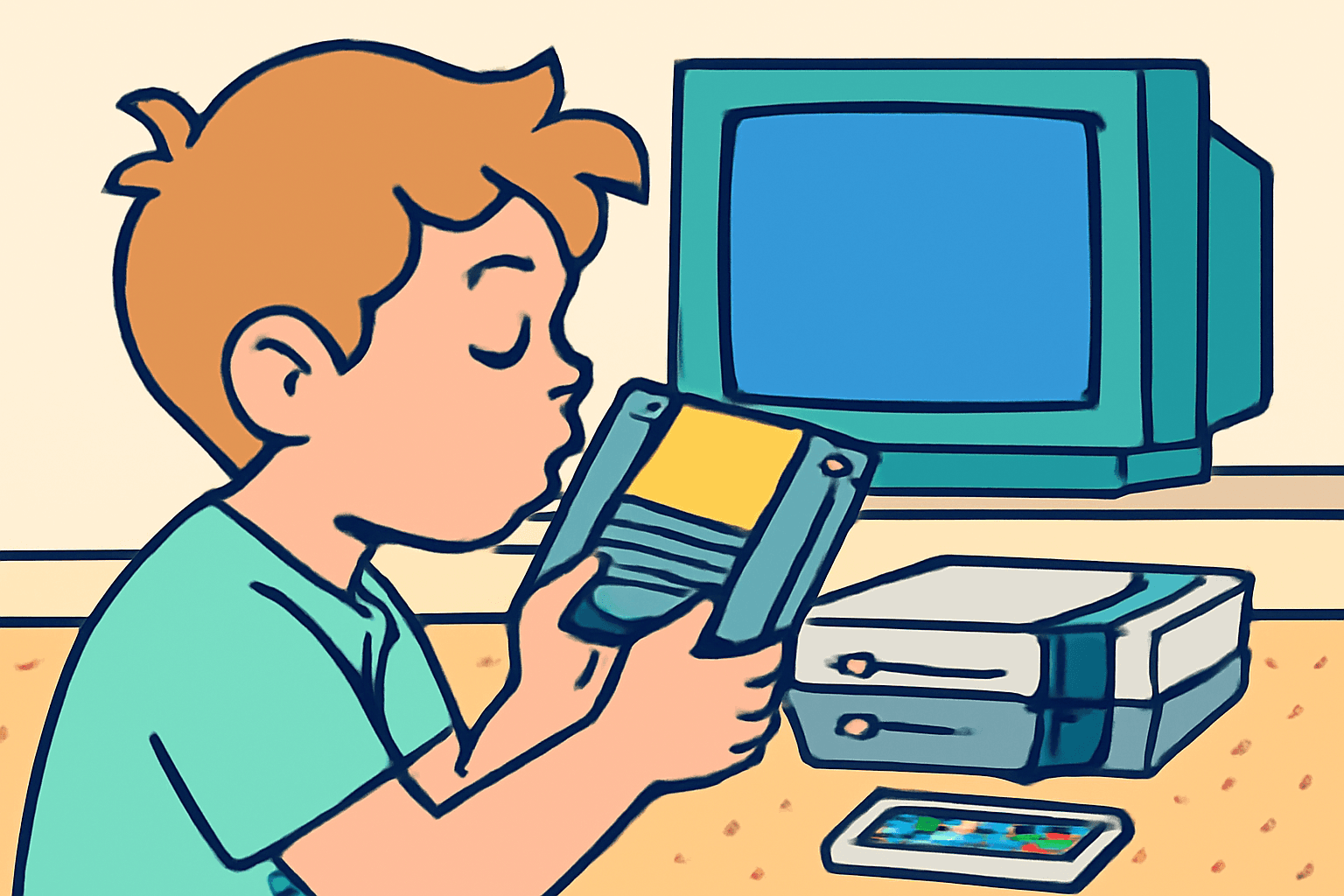
You'd be three worlds into Super Mario Bros. 3 - past the desert, past the ocean, deep into Giant Land where everything was enormous and terrifying - and the screen would glitch. A flash of color. A wall of gray. Then nothing. Just the blinking red light on the front of the NES, pulsing like a heartbeat that had given up.
You knew exactly what to do. Everyone did.
You pulled the cartridge out, held it up to your mouth, and blew into the bottom like you were performing CPR on a tiny plastic patient. A firm, steady breath. Maybe two. Then you slid it back in, pushed it down, and hit power. The screen flickered. The familiar ba-ding of the title screen. You were back.
It worked. It always worked. Except it didn't - not the way you thought it did.
The Ritual
Every kid in America between roughly 1986 and 2001 knew this move. It wasn't taught. Nobody's parents showed them. It wasn't in any manual. It spread the way all essential childhood knowledge spread - through whispered authority on the playground, through older cousins, through that one kid on your block who seemed to know everything about everything.
You blow in the cartridge. That's how you fix it.
It wasn't taught. Nobody's parents showed them. It spread the way all essential childhood knowledge spread - through whispered authority on the playground, through older cousins, through that one kid on your block.
The NES was the origin point, but it extended to every cartridge-based system that followed. SNES. Genesis. N64. Game Boy. Game Boy Color. Game Boy Advance. If it had a cartridge slot, someone was blowing into it. The technique was universal. The belief was absolute. And the science was completely wrong.
Why It Was Actually Bad
Here's what was really happening when you exhaled into that cartridge. Your breath contains moisture. Warm, humid air from your lungs landing directly on the metal contact pins that connect the game to the console. Over time, that moisture corrodes the contacts. It causes oxidation. It makes the connection worse, not better.
Nintendo knew this. They told people to stop. The official NES manual explicitly warned against blowing into cartridges. They even sold a cleaning kit - a little plastic tool with a pad on the end that you were supposed to use instead. Nobody bought it. Nobody used it. Blowing worked, so why would you buy a cleaning kit?
The NES Game Pak manual included the following instruction: "Do not blow into your Game Paks or systems." Nintendo also sold an official NES Cleaning Kit for $7.99. It included a cleaning solution and a tool that looked like a cartridge with a felt pad. Virtually no one remembers owning one.
The real fix was never the blowing. It was the reseating. When a game glitched out or refused to load, the problem was almost always a bad connection between the cartridge's pins and the console's connector. The act of pulling the cartridge out and pushing it back in - slightly differently, at a slightly different angle, with slightly different pressure - was what actually restored the connection. The blowing was a placebo. A superstition dressed up as troubleshooting.
But here's the thing about placebos. They work if you believe in them. And we all believed.
The Escalation Protocol
There was a hierarchy to the fix, and every kid followed roughly the same steps without anyone ever writing them down. It was an unspoken troubleshooting flowchart burned into our collective unconscious.
Step one: pull out the cartridge, blow into it gently, reinsert. This worked maybe 70% of the time.
Step two: pull it out, blow harder. Really get in there. Two or three sustained breaths. Reinsert with authority. Push it down slow.
Step three: pull out the cartridge, blow into it, then lean down and blow into the console itself. The console. You were now performing mouth-to-mouth on the entire system.
Step four: reinsert the cartridge but don't push it all the way down. Leave it slightly raised. Or push it down and then nudge it to the left. Or the right. Everyone had their own angle. Their own sweet spot. Some kids swore by a specific millimeter of tilt that they'd discovered through trial and error, the way a safecracker finds the right combination.
Step five: the jiggle. Cartridge in, power on, and while the screen is still scrambled, gently jiggle the cartridge until the image snaps into place. This was the most advanced technique. It felt like tuning a radio. You were finding the signal.
Everyone had their own angle. Their own sweet spot. Some kids swore by a specific millimeter of tilt, the way a safecracker finds the right combination.
Step six: give up, play a different game, come back to this one tomorrow.
There was no step seven. If it didn't work by step six, the cartridge was dead and you needed to borrow your friend's copy.
The Blinking Red Light
The NES had a particular cruelty built into it. When a game failed to load, the power light on the front of the console would blink. On, off. On, off. Steady and maddening. It was the console's way of telling you it was trying and failing, over and over, in a loop. A digital shrug.
That blinking light was the most stressful thing in your living room. More stressful than your parents' tax paperwork spread across the dining table. More stressful than the answering machine blinking with messages nobody wanted to check. The NES blink meant your afternoon was in jeopardy. It meant the thing you had been looking forward to since school let out might not happen.
The culprit, as it turned out, was the NES's front-loading design. The original American NES - the one with the gray rectangular body and the flip-up door - used a zero insertion force connector that pushed cartridges in horizontally rather than straight down. This design was chosen because Nintendo wanted the console to look like a VCR, not a toy. They were terrified of the American market after the video game crash of 1983. They figured if it looked like home electronics, retailers would stock it.
The Japanese Famicom used a top-loading cartridge slot. Push it straight down, done. But the American NES was redesigned with a front-loading mechanism to resemble a VCR. This "zero insertion force" connector bent the pins over time, leading to poor connections. Nintendo eventually released a top-loading NES redesign in 1993 that fixed the problem entirely - but by then, the blowing ritual was already gospel.
The trade-off was that the connector wore out. The pins bent. The connections got looser. And every kid in the country learned to blow.
Our First Superstition
I think about this sometimes - how blowing into the cartridge was the very first piece of tech folklore most of us ever learned. Before we knew what a driver was, before we knew what RAM did, before anyone said the words "have you tried turning it off and on again," we had this. A ritual. A breath and a prayer.
It was superstition, pure and simple. We performed an action. A result followed. We assumed causation. This is how every superstition in human history has worked, from rain dances to lucky socks. The only difference is that ours involved a copy of The Legend of Zelda and our hot breath.
And the beautiful part is that it was shared. You didn't have to explain it to anyone. If you handed a kid a cartridge that wouldn't load, they'd blow into it without being asked. It was instinct. It was culture. It was the one thing every American kid who owned a Nintendo agreed on, regardless of region, income, or which Mega Man was the best one.
We've gotten better at technology since then. We Google our problems. We watch YouTube tutorials. We submit support tickets and wait for someone in another time zone to walk us through a fix. It's all very rational, very efficient, very correct.
But none of it has the magic of holding a cartridge up to your face, breathing into it like you were whispering a secret, and watching the screen come back to life. You fixed it. With your breath. With nothing. With the warm air from your own lungs and a belief so total it didn't even occur to you to question it.
Sometimes I think we lost something when we stopped blowing into things.