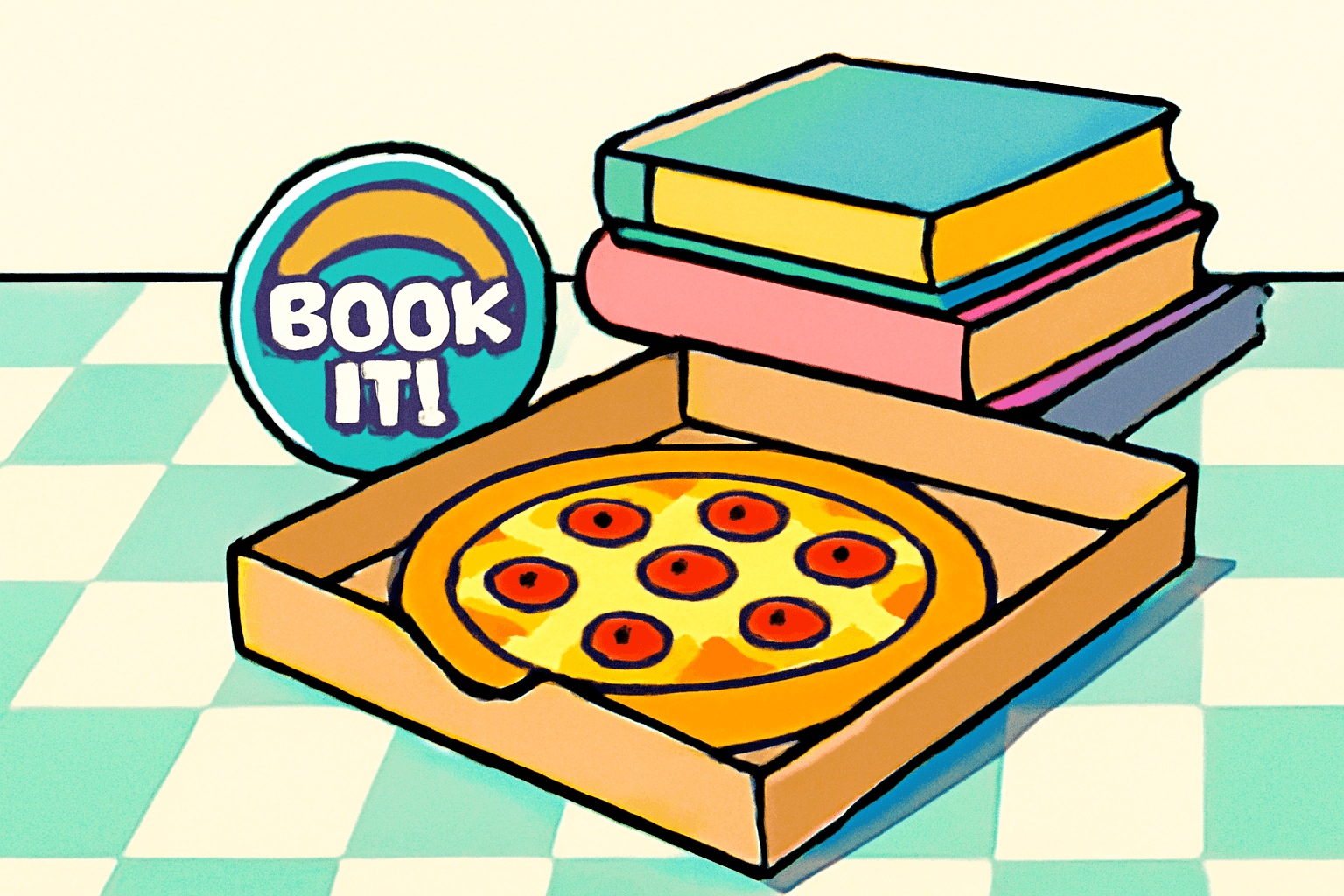
The pin was white and round, about the size of a silver dollar, and it had your name on it. Not printed. Written. In marker, by your teacher, in that careful teacher handwriting that somehow all of them shared. BOOK IT! in red and blue across the top, and underneath, five empty circles arranged in a row like a punch card for something important. Because it was important. Each circle was a month. Each month was a book. Each book was one step closer to the thing that actually mattered.
A personal pan pizza from Pizza Hut.
Free.
The Deal
The terms were simple, almost suspiciously so. You read a certain number of books each month - the exact number was set by your teacher, which meant some kids had it easy and some had it rough depending on whether Mrs. Patterson believed in achievable goals or character building. You got your parent to sign the reading log confirming you'd done it. You brought the log back to school. Your teacher placed a star sticker on your pin, filling in one of those five circles. And when the month was complete, you received a certificate.
The certificate was a small, flimsy piece of paper that entitled you to one free Personal Pan Pizza at any participating Pizza Hut location. It might as well have been a golden ticket. It was a golden ticket. Willy Wonka had nothing on this program.
The certificate was a small, flimsy piece of paper that entitled you to one free Personal Pan Pizza at any participating Pizza Hut location. It might as well have been a golden ticket.
Pizza Hut launched Book It! in 1984, and by the time I was in elementary school in the early '90s, it was as embedded in the public school experience as fire drills and square pizza on Fridays. Every kid in America between kindergarten and sixth grade knew the deal. The schools got kids reading. Pizza Hut got families through the door. And we got pizza. Everybody won, and nobody had to think too hard about whether bribing children with cheese and pepperoni was philosophically sound.
It wasn't. But it worked.
The Pin
You wore the pin on your shirt, or your backpack, or your jacket if you were the kind of kid who kept a jacket on indoors. It was a badge. Literally. And the stars on it told everyone exactly where you stood. Two stars by November meant you were on pace. Four stars by March meant you were a machine. An empty pin by February meant you either didn't like reading or you kept forgetting to bring your log back, which was a different kind of failure entirely.
Some kids had that pin gleaming with all five stars by April. They were done. They'd read their books, earned their pizzas, and now they were just coasting. The rest of us were doing the math in our heads, trying to figure out if we could squeeze in one more Goosebumps before the deadline.
- Goosebumps - Any of them. All of them. The backbone of the program.
- Animorphs - Longer, but you could knock one out in a weekend if you skipped the boring Tobias chapters.
- The Bailey School Kids - Vampires Don't Wear Polka Dots and its ninety-seven sequels.
- Wayside School - Short chapters. Strategic pick.
- Anything by Beverly Cleary - Ramona Quimby carried reading logs across this nation.
- Captain Underpants - Your teacher wasn't thrilled, but it counted.
The pin mattered more than it should have. There was no material difference between having it on your shirt and having it in your desk drawer. But wearing it felt like something. Like you were part of a club. Like you were the kind of person who read books, even if the only reason you read books was because a major pizza chain had entered into a strategic partnership with the American public school system to exploit your love of mozzarella.
The Log
Let's talk about the reading log. The reading log was the honor system in paper form, and the honor system is a beautiful thing that collapses immediately when pizza is on the line.
You were supposed to write down the title of each book, the author, and the number of pages. Then your parent was supposed to sign it, confirming that yes, their child had in fact read Matilda and not just watched the movie and filled in the blanks. The system relied on two layers of trust - that the kid was honest and that the parent was paying attention - and both layers were tissue-thin.
I'm not saying I fudged the reading log. I'm saying that the reading log was a document that existed in a world where children wanted pizza and verification was basically nonexistent. Draw your own conclusions.
The reading log was the honor system in paper form, and the honor system is a beautiful thing that collapses immediately when pizza is on the line.
The real move was picking short books. Not because you didn't like reading - maybe you did, maybe you didn't - but because the program rewarded volume, not difficulty. A kid who read five Magic Tree House books in a month got the same pizza as a kid who spent six weeks grinding through Island of the Blue Dolphins. The incentive structure was clear. Read fast. Read short. Get pizza.
This is probably not what the educators had in mind. But it was effective capitalism, which is arguably a more useful life lesson than whatever Island of the Blue Dolphins was trying to teach you about solitude.
The Restaurant
The trip to Pizza Hut was the real event. The reading was just the entrance fee.
You walked in with your certificate, and you were not a child being taken to dinner by your parents. You were a customer. You had earned this. The certificate was your currency, and you presented it to the server with the seriousness of someone handing over a boarding pass. This pizza was yours. You didn't have to share it. You didn't have to negotiate toppings with your brother. Personal pan meant personal. That word had never meant so much.
The pizza came in that little black pan, still bubbling, the cheese pulling away from the crust in that specific Pizza Hut way that no other pizza has ever replicated. It was small - laughably small, in retrospect, maybe six inches across - but it was yours. Your name might as well have been on it. You'd read four books for this. Or three books and one that you mostly read. The point is you'd done something and now there was pizza and the connection between those two facts was absolute and unbreakable.
The Conditioning
Here's the thing nobody warned us about. Book It! didn't just teach us to read. It taught us to associate reading with reward. Specifically, it taught us to associate reading with pizza. And that association, once formed in the brain of a seven-year-old, does not go away. It calcifies. It becomes permanent. It becomes personality.
I am in my thirties. I have a job and a mortgage and opinions about olive oil. And when I finish a good book, some small, lizard-brain part of me still thinks I deserve a pizza. Not in a conscious way. Not like I close the back cover and immediately open DoorDash. But there's a warmth there. A sense of completion that is suspiciously food-adjacent. A Pavlovian flicker that I trace directly back to a white pin with star stickers on it and a certificate I handed to a teenager in a red visor at the Pizza Hut on Route 9.
They did that to us. Pizza Hut and Mrs. Patterson and the entire American elementary school system conspired to wire our brains so that literacy and pepperoni would be linked forever. And I'm not mad about it. I'm not even a little mad. Because it worked. I read books. I still read books. And sometimes, when I finish one, I order a pizza, and I don't fully understand why it feels so right, but it does.
It really does.