My mom had this thing she'd say whenever I told her I was bored. She'd look at me over whatever she was doing - crossword puzzle, phone cord wrapped around her finger, something on the stove - and say, "Only boring people get bored."
I hated it. Every kid hated it. It was the verbal equivalent of a door closing in your face.
But she never offered a solution. That was the important part. She didn't hand me a device. She didn't pull up a schedule. She just left me there, standing in the kitchen doorway, with nothing but the hum of the refrigerator and an afternoon that stretched out like a desert.
And eventually, I'd wander off and do something.
The Shampoo Bottle Years
You know you were a 90s kid if you can still recite ingredients from the back of a Pert Plus bottle. Sodium laureth sulfate. I didn't know what it was. I still don't, really. But I read it so many times sitting on the toilet with nothing else to look at that it's permanently etched into whatever part of the brain stores useless information.
Boredom made you read anything. Cereal boxes. The World Book Encyclopedia - just whatever volume was closest. The TV Guide listings for channels you didn't even get. I once read the entire owner's manual for our 1994 Ford Taurus. Did you know the recommended tire pressure was 30 PSI? I did. I was nine.
This wasn't a failure of parenting. This was the ecosystem working exactly as designed. You had nothing to do, so your brain started foraging. It grabbed whatever was lying around and tried to make it interesting. And sometimes it actually worked.
The Creativity Engine
Here's what "I'm bored" actually produced in my neighborhood between 1993 and 1999:
A full-scale dirt bike track in the woods behind Tyler Mccaffrey's house. An ongoing comic book series about a superhero named Laser Dude that ran for forty-seven issues, all drawn on printer paper stolen from someone's dad's home office. A game called "Ditch" that was basically tag but with more hiding and a complex system of rules that shifted every time we played. A fort. Several forts, actually. An ill-advised attempt to dam up the creek. A working - and I use that word loosely - catapult.
None of this was scheduled. No adult supervised it. Nobody signed a permission slip or paid a registration fee. It all came from the same place: three or four kids standing around on a Saturday morning with absolutely nothing to do and nowhere to be until the streetlights came on.
"I'm bored" wasn't a complaint. It was an ignition sequence.
The boredom had to get bad enough first. That was the trick. You had to pass through the miserable part - the lying on the floor, the dramatic sighing, the flipping through all 60 channels twice and finding nothing - before you hit the other side. The side where your brain, desperate for stimulation, started making things up.
That's where the good stuff lived.
What the Scientists Say
Turns out my mom's indifference was backed by neuroscience. She just didn't know it yet.
Dr. Sandi Mann at the University of Central Lancashire has spent years studying boredom, and her research points to something that would've vindicated every parent who ever said "go find something to do." When we're bored, our brains enter what's called the default mode network - a state of mental wandering that's closely linked to creativity, problem-solving, and self-reflection. It's the brain's screensaver, and it turns out the screensaver is doing important work.
A 2014 study asked participants to do something boring - reading the phone book, copying numbers - before taking a creativity test. The bored group consistently outperformed the control group. Boredom didn't just not hurt creativity. It actively fueled it.
Other researchers have connected childhood boredom to the development of internal motivation - the ability to generate your own goals, entertain your own mind, figure out what you actually want to do rather than just consuming whatever's put in front of you. In developmental psychology, they call this "self-directed executive function." In 1995, we called it "going outside."
The American Academy of Pediatrics has started pushing back against over-scheduled childhoods, recommending unstructured free time as essential for healthy development. But they're fighting an uphill battle against an entire economy built on making sure no one is ever bored for more than eleven seconds.
The Extinction of Nothing
Try to be bored now. Seriously, try it.
You can't. Or you can, but it takes effort, which kind of defeats the purpose. Every moment of potential boredom - waiting in line, sitting in a waiting room, lying in bed before sleep - has been colonized by a screen. The phone is always there. The infinite scroll is always ready. There is always, always, always something to consume.
I'm not saying this to be some old man yelling at the cloud. I do it too. I catch myself reaching for my phone during a commercial break that's already an interruption from a show I'm only half watching. I can't sit in a parking lot for two minutes without checking something. The muscle memory of boredom avoidance is that deep.
But here's what I notice: I don't make things up anymore. I don't stare at the ceiling and let my mind wander to strange places. I don't have those weird, unbidden thoughts that used to arrive like weather - sudden and from nowhere and sometimes worth following.
The pipeline has been reversed. Instead of boredom pushing creativity out, content is being pushed in. And it feels fine. It feels totally fine. That's the scary part.
Summer, 1996
The most bored I ever was - truly, transcendently bored - was the summer between fifth and sixth grade. My best friend was at his grandma's in Michigan for three weeks. It was too hot to be outside past noon. I'd already read every book I owned at least twice.
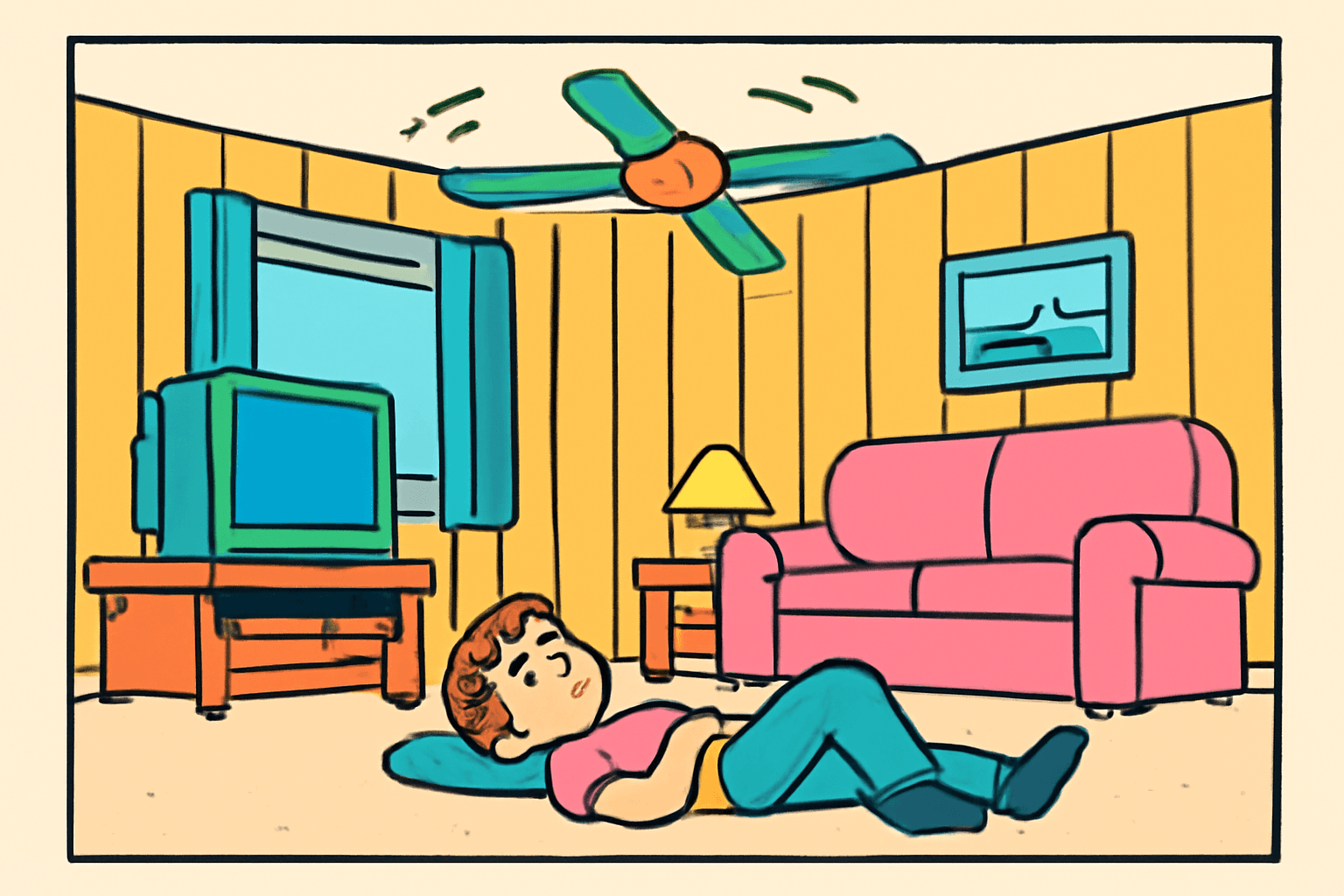
I spent entire days lying on the living room carpet with the ceiling fan going, doing nothing. Literally nothing. Just existing and thinking and being uncomfortable with the bigness of an unscheduled day.
And somewhere in the second week of that, I started writing a story. It was terrible. It was about a kid who finds a portal in his closet. Narnia stuff, basically, but worse. I wrote it in a spiral notebook in pencil, and I wrote for hours every day for the rest of that summer.
I didn't become a novelist because of it. That's not the point. The point is that something in me had to get quiet enough and empty enough for that impulse to surface. If I'd had a smartphone, I would've watched YouTube videos instead. And that would've been fine. It would've been fine.
But it wouldn't have been the same.
Boredom was never the absence of something. It was the presence of possibility - you just had to sit in the discomfort long enough to find it.
The Starting Line
Every adventure I remember from childhood started with "I'm bored." Every single one. The bike rides to nowhere. The time we walked the train tracks all the way to the next town. The afternoon we spent trying to teach my dog to skateboard. The hours in the garage with a tape recorder making fake radio shows.
None of it was important. All of it mattered.
I don't know how to give that back to kids who've never had it. I'm not sure I know how to give it back to myself. But I know that when my mom left me standing in that kitchen doorway with no solution and no entertainment and nothing but my own restless mind, she was giving me something.
She was giving me the space to figure out who I was when nobody was telling me what to watch.