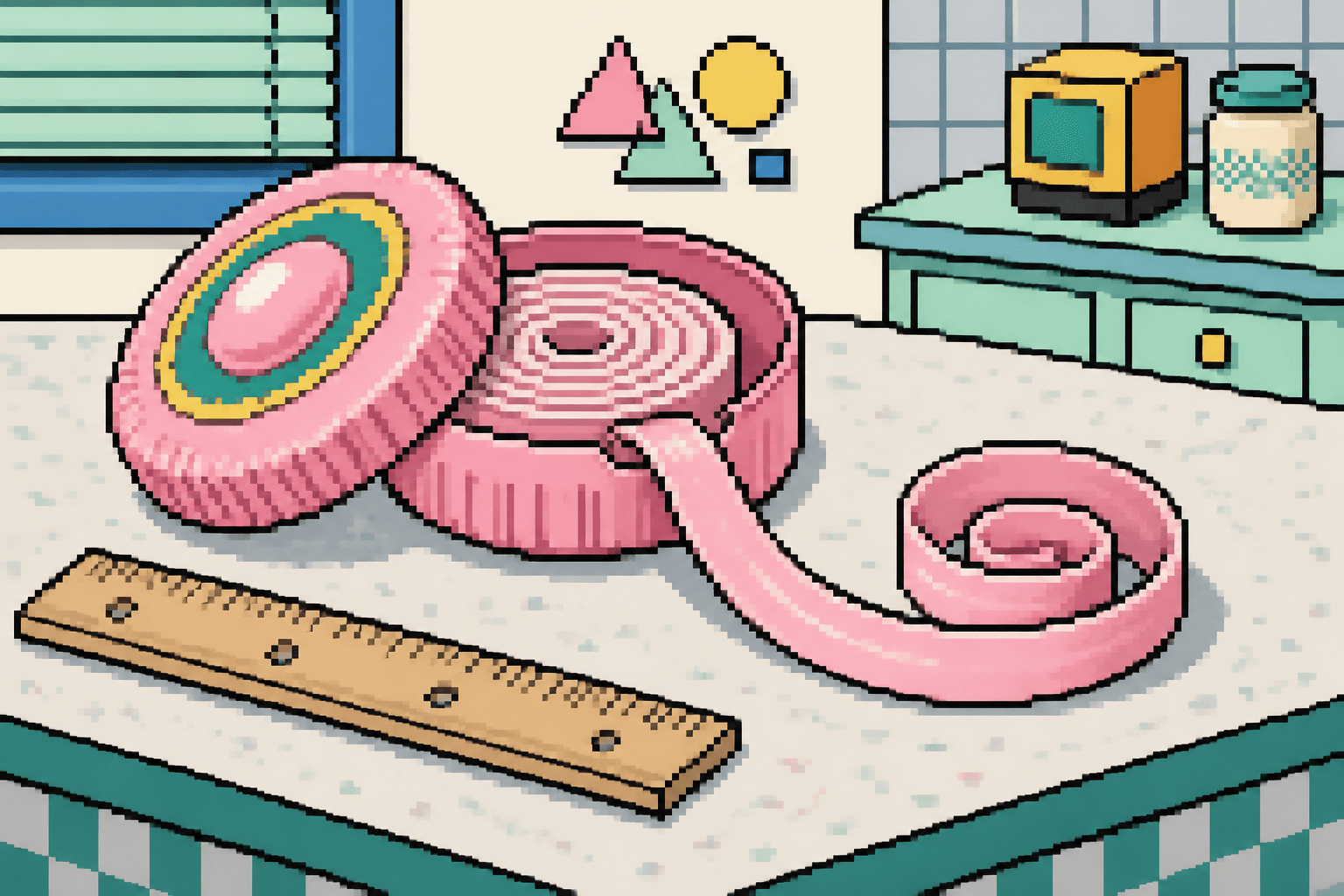
You paid a dollar for a pink plastic hockey puck at the front counter of the 7-Eleven, and you walked out of the store already prying the lid off with your thumb, and the lid was already slightly loose because the lid was always slightly loose, and inside was a coiled ribbon of pale pink gum wound around a plastic spool, and printed on the outside of the can, in a font that was doing its absolute best to sound like a threat, was the number 6 FT.
Six feet. Of gum. For you.
You did not question this. You were nine.
The Pitch
Bubble Tape was launched by Amurol Confections in 1988, which is a company owned by Wrigley that made all the weirder gums - the ones the main Wrigley brand did not want on the same shelf as Doublemint. Bubble Tape was the flagship, and its whole gimmick was that it was long. Not that it tasted good. Not that it lasted. Long. Six feet long. Coiled inside a plastic disc the size of a hockey puck, dispensed through a slit in the side, like an industrial dressing station for a wound that was going to be gum-shaped.
The marketing was aimed at exactly one person: a nine-year-old who did not have adult supervision at the checkout counter. The tagline, in one form or another, was always some variation of for you, not them. This was the entire point. The dispenser looked like a supply. The tape came out in inches. You could dispense it in front of a friend and pretend to be a candy pharmacist doling out prescriptions. The physical format was the whole product.
The tape came out in inches. You could dispense it in front of a friend and pretend to be a candy pharmacist doling out prescriptions. The physical format was the whole product.
Amurol had figured out, before most of the rest of American snack food, that a nine-year-old buying candy is not buying candy. They are buying a bit. They are buying something to do with their hands at the picnic table behind the school where the older kids sit. They are buying a slightly-illegal-looking dispenser that pretends to be an adult tool. The gum itself was just what the dispenser was full of, the way a nail gun is full of nails. Nobody complains that the nails are not delicious.
The Can
The can was, structurally, a cheap piece of injection-molded plastic that was rigid enough to survive a lunchbox and thin enough that if you dropped it on the driveway, one of the seams would crack. The lid snapped on and off with a small satisfying click, but only for about the first three uses. After that the lid would sort of loosely rest on top, and the tape inside would begin to dry out where the wrapper had opened up around it, and pieces of pocket lint - blue jean lint, specifically - would find their way inside and become, functionally, part of the gum.
You would take a piece of tape out and it would have a small blue fuzz on one edge. You would pretend you had not seen it. You would eat it.
The whole design of the can was optimized for the moment of purchase. Bright pink, a wordmark that vibrated slightly in your peripheral vision, a lid that made a satisfying noise. It was less optimized for anything after that. The interior spool, which was supposed to keep the tape neatly coiled, would slip its track around day two and thereafter the tape came out in a tangled snarl, sticking to itself, sticking to the walls of the can, sticking to your fingers when you tried to fish out the end. What emerged, after enough time, was less a ribbon than a knot.
You would tear off a piece with your teeth. You would try to smooth it out. The knot would grow.
The Chew
Here is what nobody in Amurol's marketing department wanted you to think about too hard: gum flavor is not additive.
You can chew one inch of Bubble Tape or eighteen inches of Bubble Tape, and the flavor lasts the same amount of time, which was, generously, thirty seconds. The gum was engineered on the exact same flavor curve as any other Amurol product - a burst of pink, undifferentiated, followed by an implication of sweet, followed by a long steady decline into rubber. The extra length did not extend the experience. The extra length was so you could produce, on demand, a whole ball of gum the size of your fist and shove it in your mouth in a single act of public defiance.
- Original (1988). Pink. Sweet. Vaguely strawberry. The one on the shelf.
- Sour Apple (1990s). Neon green. Numbed your tongue for a minute.
- Watermelon (1990s). Actual color of a watermelon Jolly Rancher.
- Cotton Candy (later 90s). Blue-pink. Marketed as rare.
- Snow-Cone / Snozberry / Awesome Original and roughly forty other one-off flavors that appeared for four months at a Kroger in Ohio and were never restocked anywhere ever again.
This was, in fact, the correct use of Bubble Tape. Nobody was buying it to chew it. They were buying it to deploy it. You unspooled a fist-sized wad, forced it into your mouth, and produced, roughly ninety seconds later, a single pink bubble the size of your own face, which then popped and adhered permanently to your eyelashes. That was the arc. That was the show.
Nobody was buying it to chew it. They were buying it to deploy it.
The rest of the tape, most of it, was structurally unchewable. Nobody in the entire recorded history of Amurol Confections had chewed one entire Bubble Tape roll in a single sitting. Nobody. The jaw could not do it. The masseter would give out at inch twenty-two. The tape would win.
The Argument
I want to say something in defense of Bubble Tape as a piece of design, because I have been circling it for six paragraphs now and I am starting to think I am being unfair.
The thing about Bubble Tape - and this is true of a lot of 90s candy, and I am not going to be able to prove it, so you will have to take my word for it - is that it understood the customer. It understood that a nine-year-old at the 7-Eleven with a wrinkled dollar is not making an economic decision about how much gum per unit price. They are making a social decision about what will I have to show for this at recess tomorrow. The answer, if you spent your dollar on Big Red, was: nothing. The answer, if you spent your dollar on Bubble Tape, was: a six-foot ribbon of pink gum, in a can I can dispense from in front of the whole third grade.
That is not a bad piece of product design. That is a piece of product design that has correctly identified what nine-year-olds are actually purchasing when they buy candy, which is performance-grade candy. Candy that does a bit. Candy that produces a show. Candy that puts the nine-year-old on stage and gives them a prop. The gum itself is the setup. The dispenser is the punchline. The six feet is the applause.
I did not know any of this at nine. I only knew that I wanted the can. And that when I brought it to the sleepover I was going to unroll the whole thing across the coffee table for the applause, and then somebody's mom was going to make me throw it away, and my dollar was gone, and none of us would ever eat one inch of it.
But we would remember it. We are, in fact, still talking about it. That is what my dollar bought.
The Death of the Can
The Bubble Tape can died, most often, in the crack between the couch cushions.
Not with a bang. Not with the last inch of tape triumphantly consumed. Nobody ever finished a Bubble Tape can. It died in a slow, quiet way, where the lid came off and got lost, and the tape dried out to a slightly stiffer version of itself, and the whole thing rolled under the passenger seat of the family Toyota Camry, where it stayed for eleven months, and where, over the course of those eleven months, the remaining tape absorbed the ambient odor of the car - which was: fast food bag, plus air conditioner mildew, plus the parking lot at the community pool. One day your mom would clean out the car and hold up the disc and say is this yours and you would look at the tape inside, now hard and slightly grey, and you would say no, and she would throw it away.
You did not defend it. You had, honestly, forgotten. You had spent your dollar. You had done your bit. The tape had done what it needed to do, which was be visible on the coffee table for one Saturday night in the fall of 1996. Its work was done. It had never needed to be eaten. That was not the deal.
I bought one last year.
They still make it. It is still six feet. It is still pink. The can is a little sleeker now, the pink is a little more corporate, the wordmark has been re-drawn about four times since 1988 and now looks like the logo of a startup that sells software to dentists. But it is unmistakably Bubble Tape. I brought it home and I put it on the counter and I stood there for a full minute looking at it.
I opened it. I unspooled about an inch. I chewed it. It tasted exactly the way I remembered it tasting, which is to say: like pink. The flavor lasted, generously, thirty seconds. The remaining five feet, eleven inches of the tape stayed in the can, coiled around its little plastic spool.
I put the lid back on. The lid did not quite catch. I put it in the cabinet.
It has been in the cabinet for a year. I am not going to eat the rest of it. Nobody is. The tape will slowly dry, and the lid will slowly loosen, and one day I will find it while I am looking for something else, and I will throw it away, and I will not feel bad about it, because the point of a Bubble Tape was never to eat the whole roll.
The point was that I had, once, for one dollar, held a whole six feet.