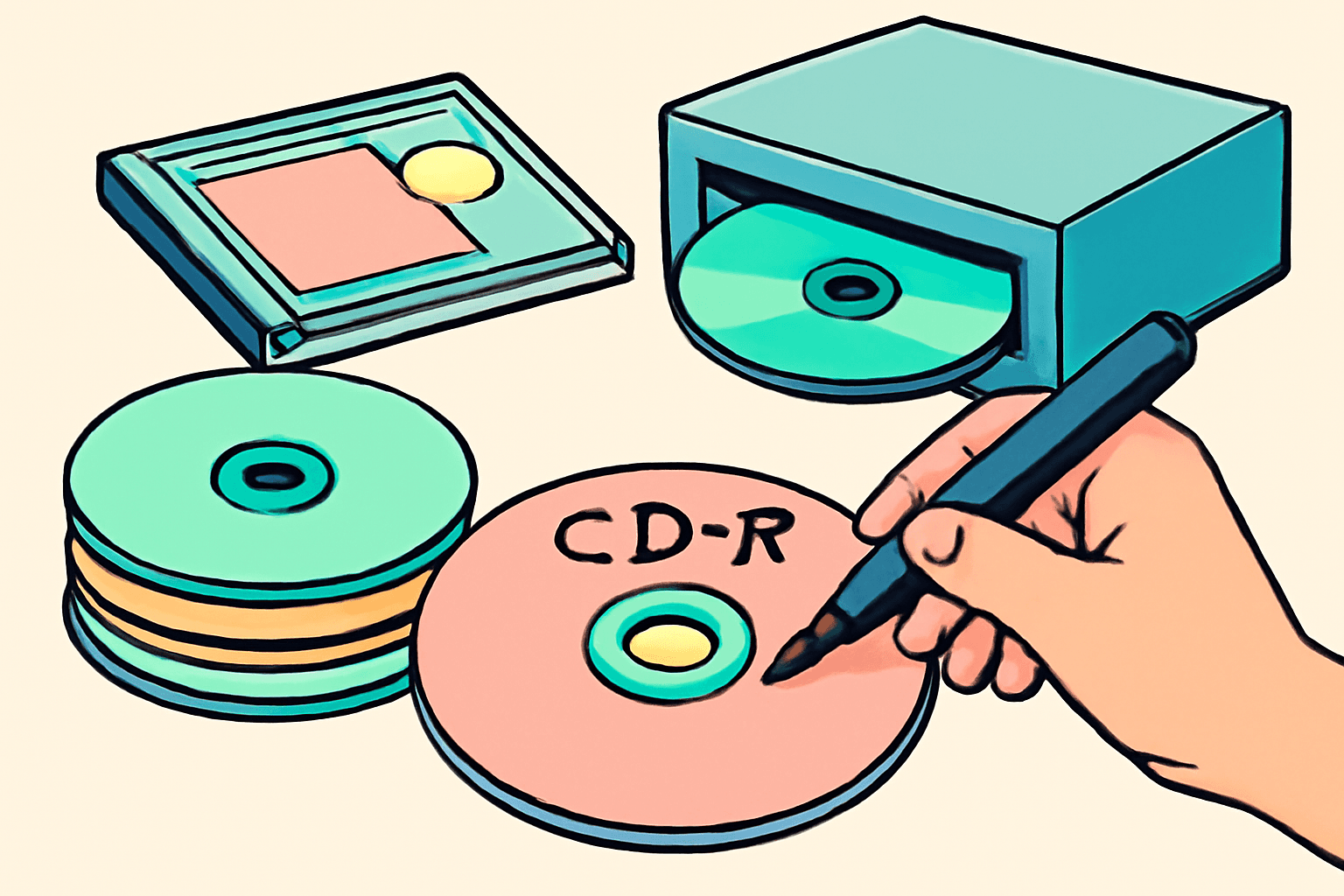
The Sharpie was purple. This mattered.
It mattered because you were writing the tracklist on a Memorex CD-R in your bedroom on a Saturday afternoon, and the disc was for a girl named Sarah who sat behind you in American History, and you needed her to understand - through your handwriting, through your song choices, through the color of the marker - that you were a person of depth and taste. That you got it. Whatever "it" was. You were fifteen. You didn't get anything. But you had a CD burner and a dream.
You wrote the songs in your neatest print. Tiny letters curving around the inner ring of the disc. Third Eye Blind. Blink-182. One Smashing Pumpkins deep cut to show range. You misspelled "Disarm" and had to start over on a fresh disc, which cost you roughly sixty cents from the fifty-pack spindle your dad bought at Best Buy, and the ruined disc went into the trash with a little crack of heartbreak.
The Ritual
Burning a CD was not a casual act. It was a ceremony. A commitment. You did not simply drag files into a window and press go. I mean, technically that was what you did, but spiritually? Spiritually it was so much more.
First, you had to choose your software. And this was a real choice with real consequences.
- Nero Burning ROM - The serious option. Dark interface. Vaguely Roman theme for reasons nobody understood. Your friend's older brother swore by it.
- Roxio Easy CD Creator - Came bundled with the drive. Perfectly fine. Nobody bragged about using it.
- Windows Media Player - For people who didn't know better. God help them.
- Winamp with a burning plugin - For people who wanted to feel like hackers.
Then you had to decide on speed. And this is where it got philosophical.
You could burn at 1x speed. This took about seventy minutes for a full disc. It was the safe choice. The wise choice. Your uncle who "worked in IT" told you that burning at 1x produced fewer errors, and you believed him with the same conviction that medieval peasants believed their local priest. Was it true? Maybe. Probably not. Didn't matter. You burned at 1x and you waited over an hour and you felt responsible about it.
Or you could burn at 4x. Sixteen minutes. Reckless. Thrilling. Living on the edge. The disc might work perfectly. It also might skip on track seven every single time, and you wouldn't know until you tested it in your Discman, and by then you'd already written the tracklist in Sharpie.
Buffer underrun. Two words that could ruin your entire afternoon.
The buffer underrun was the great enemy. Somewhere in the middle of the burn, your computer would decide to do something else - check for updates, run a screensaver, just generally lose focus like a golden retriever hearing a doorbell - and the stream of data going to the CD burner would hiccup. The burn would fail. The disc was now a coaster. A tiny, reflective coaster that could hold exactly zero beverages and represented twenty minutes of your life you'd never get back.
You learned. You closed every program. You turned off the screensaver. You didn't touch the mouse. You barely breathed. Burning a CD required the same stillness and focus as defusing a bomb, except the stakes were somehow higher because this one was for Sarah.
CD-R vs. CD-RW: A Theological Divide
CD-Rs were permanent. You burned them once and that was it. Whatever you put on there was on there forever, which gave every burned disc a kind of weight. A finality. You had to be sure about your track order. You had to mean it.
CD-RWs were rewritable. You could erase them and start over. They cost more - like two or three bucks each compared to fifty cents for a CD-R. And there was something about them that felt less committed. Less romantic. Giving someone a CD-RW was like giving them a love letter written in pencil. Technically fine. Emotionally suspect.
The CD-R was the move. Everyone knew it. You burned it, it was done, it existed in the world as a fixed object. Like a letter you'd already mailed. No take-backs.
The Sharpie Kids vs. The Label Kids
There were two kinds of people in the early 2000s, and the divide was absolute.
The Sharpie kids wrote the tracklist directly on the disc. Quick. Honest. A little messy. Your handwriting was part of the gift. The disc looked like something a human being made, because a human being made it, in their bedroom, probably while listening to the same songs they were burning.
And then there were the label kids.
The label kids had printers. They had ambitions.
The label kids opened Microsoft Word. They inserted clip art. They found a picture of a sunset, or a guitar, or one of those tribal designs that were on everything in 2002. They typed the tracklist in size 10 Papyrus - always Papyrus or Comic Sans, there was no third option - and they printed it out on special CD label paper from Staples and carefully applied it to the disc using a little plastic alignment tool that came in the label kit.
Some of them made jewel case inserts. Front cover. Back cover with the tracklist. Spine with a title. The whole production. These people grew up to be project managers.
The label looked professional. Clean. Intentional. It also had about a 30% chance of peeling up on one edge after a week and getting stuck in your CD player, so there was a real element of danger involved. The Sharpie, for all its crudeness, never betrayed you like that.
The Gift Economy
Here is what Spotify will never understand: a burned CD was a gift. Not content. Not a playlist. A physical object that someone made for you, by hand, on purpose.
Making a mix CD for someone meant sitting at your computer for hours. Choosing songs. Agonizing over the order. Does "Everlong" go before or after "The Freshmen"? Do you open with something upbeat and let it get emotional, or do you hit them in the feelings right away? These were decisions that mattered. These were decisions you could not undo because you were using a CD-R like a person with convictions.
Making one for your crush was an act of bravery that kids today will never have to attempt. You were handing someone a physical object that contained, in order, the exact sequence of emotions you wanted them to feel. It was basically a love letter disguised as a playlist. And everyone knew it. If someone gave you a burned CD with Boyz II Men's "I'll Make Love to You" on it, the message was not subtle. Even if it was tucked between two Weezer songs for plausible deniability.
You'd hand it over in the hallway between classes. "Hey, I made you this. It's just, like, some songs I thought you'd like." Casual. So casual. You'd been working on it for three days. You'd burned four copies because the first three had the songs in the wrong order and you noticed, even though nobody else would have noticed, and you noticed because it mattered.
Sometimes they'd say thanks and you'd never hear about it again and you'd spend the next two weeks wondering if they'd even listened to it.
Sometimes they'd say "track five is really good" and you'd float through the rest of the day like a person who'd just been told the meaning of life.
The Transition
Mix tapes came first, obviously. They were the original format for "I have feelings and I'm going to make them your problem." But tapes were imprecise. You had to record in real time. You had to press play and record simultaneously and hope you hit it at the right moment. There were gaps. There was hiss. The audio quality was, to be charitable, warm. To be honest, muddy.
The mix CD was the mix tape with a promotion. Crystal clear audio. No hiss. Exact track breaks. You could fit 74 minutes - or 80, on the good discs - and every song started exactly when it was supposed to start. It felt like the future.
And for about five years, it was.
Then the iPod showed up. Then iTunes playlists. Then Spotify. The burned CD became obsolete almost overnight, like so many beautiful, clumsy things. Nobody burns CDs anymore. Nobody writes tracklists in purple Sharpie on a disc that costs fifty cents and holds seventy minutes and means everything.
A burned CD was a letter. A playlist is a text message.
I still have some. Somewhere in a box in my parents' garage, there's a sleeve of burned CDs with faded Sharpie writing on them. Songs I loved when I was fifteen. Songs I chose for someone specific. The discs probably don't even work anymore - CD-Rs degrade over time, the dye layer breaks down, the data rots. Which feels about right. You can't keep those moments. You can only remember that you burned them at 1x speed, with every other program closed, holding your breath the whole time.
Sarah never said anything about the CD, by the way.
But track five was really good.