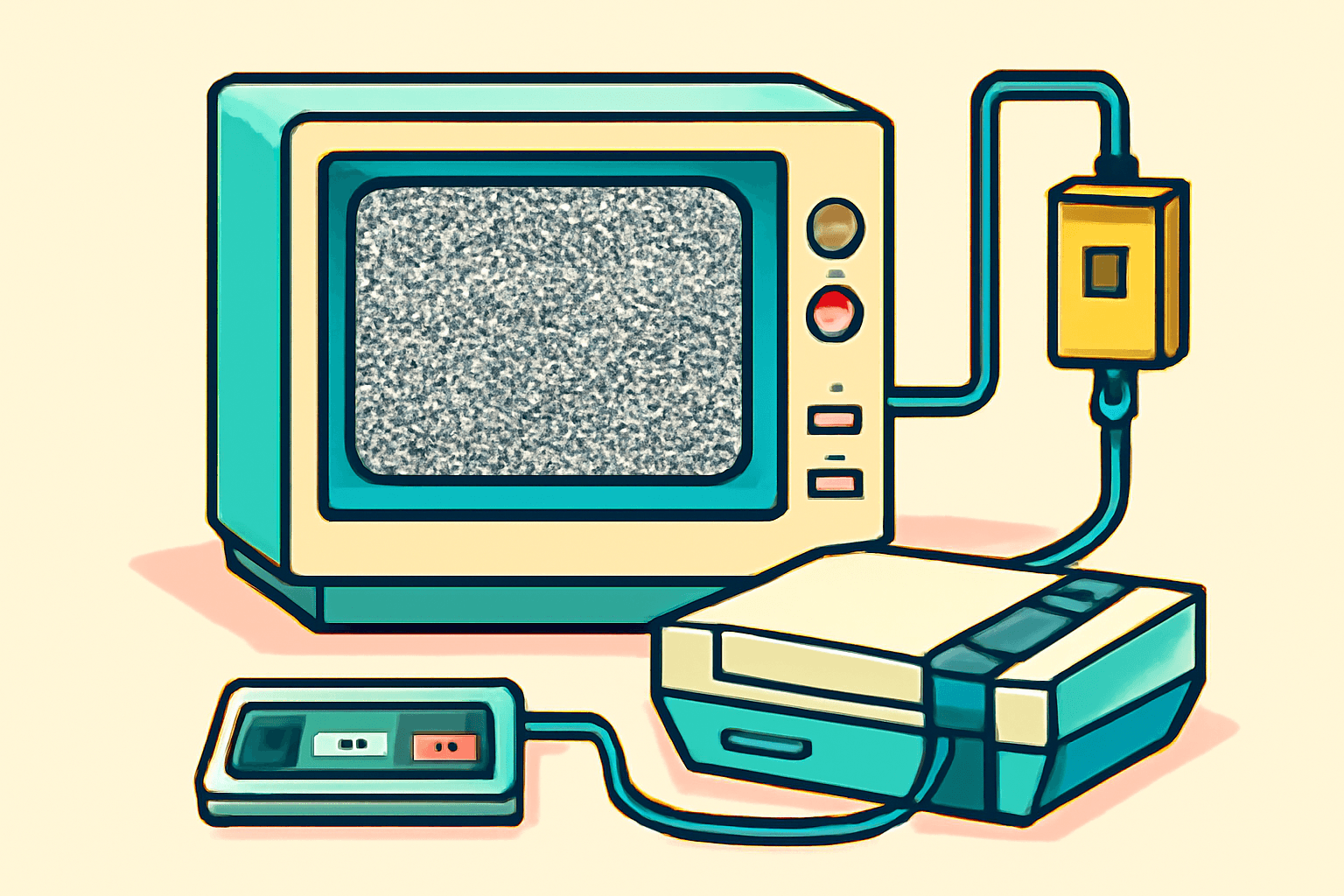
The Nintendo wasn't working. I was standing in front of the TV, cartridge in the slot, power light glowing red, and nothing on the screen but static. That angry, buzzing, gray-and-white static that meant something was wrong between the console and the television set. My dad walked by and said, without looking, "Are you on channel 3?"
I was not on channel 3.
I hit the channel down button twice and there it was - the Super Mario Bros. title screen, bright and perfect, like it had been waiting for me the whole time. It had been. I just wasn't tuned to the right frequency. In the 90s, that sentence applied to almost everything you wanted to do with a television.
The RF Adapter Was the Real Console
Every gaming console, every VCR, every cable box - they all came with the same thing in the box. A small, usually beige or gray RF adapter with a coaxial output on one end and some kind of proprietary connector on the other. This was the bridge. The translator. The little device that took whatever signal your console was producing and converted it into something your TV could understand, which was a fake television channel. Channel 3. Or, if channel 3 was already being used by an actual broadcast station in your area, channel 4.
Every single device in your entertainment center funneled through the same coaxial cable, the same RF switch, the same two-inch toggle on the back of a plastic box.
The coaxial cable itself was a whole experience. That screw-on connector with the tiny copper wire sticking out of the center that you had to thread onto the back of the TV just right. Too loose and you'd get static. Too tight and - well, you couldn't really get it too tight, but you'd try, cranking it with your fingers until the metal bit into your skin. Some families had the push-on kind, which was easier but less secure, and the cable would fall off the back of the TV if someone walked too heavily across the room.
And on the back of the RF adapter - that little sliding switch. CH 3 / CH 4. Two options. That was your entire input selection system. Two channels. You picked one when you set it up and you never touched it again, unless you moved to a different city and suddenly channel 3 was CBS and you had to switch to 4.
The Chain of Devices
Here's where it got complicated. You didn't just have one thing hooked up to channel 3. You had everything hooked up to channel 3. The VCR was the hub. The coaxial cable from the wall went into the back of the VCR, then another coaxial cable went from the VCR's output to the TV. The Nintendo's RF adapter connected to the same VCR input, or to one of those cheap RF switches - the little silver box with a toggle that said TV/GAME.
So the signal chain went: wall to VCR to RF switch to TV. And if you wanted to play Nintendo, you had to make sure the TV was on channel 3, the VCR was off (or set to the right input), and the RF switch was flipped to GAME. If any one of those things was wrong, you got static. Or you got whatever was on channel 3 for real. Or you got the blue screen of the VCR's tuner.
- NES (1985) - RF adapter included, no other option
- Sega Genesis (1989) - RF adapter included, AV cables optional
- Super Nintendo (1991) - RF adapter included, AV cables optional
- The family VCR - always connected, always on channel 3
- The cable box, if you had one
- Atari 2600 for the kids who still had one in the closet
- N64 (1996) - RF adapter included, AV cables optional
- PlayStation (1995) - AV cables included, RF adapter sold separately
- Sega Saturn (1995) - same deal
Troubleshooting was an art form. "Are you on channel 3?" was always the first question, the universal diagnostic. It was the "did you try turning it off and on again" of the analog era. And nine times out of ten, that was actually the problem. Somebody had been watching TV, changed the channel, and left it on channel 47. Now you're standing there pressing the power button on the Nintendo over and over, thinking the console is broken, when really you just need to be on 3.
The Static Between Worlds
There was a specific quality to the static on channel 3 when something was almost connected. Not the clean, dense static of an empty channel. A flickering, unstable version with ghostly hints of color bleeding through. You could almost see the game. Almost. Like it was behind a waterfall of noise. You'd jiggle the RF adapter, push the coaxial connector a little tighter, and suddenly the picture would snap into focus. Then you'd let go and it would dissolve again.
My friend Kevin's house was worse. He had the NES, the VCR, and a Sega Genesis all fighting for channel 3. There was a rat's nest of coaxial cables behind his TV that looked like it could pick up signals from space. His dad had rigged up some kind of splitter situation with electrical tape involved. Every time you wanted to switch from the Nintendo to the Genesis, you had to physically get behind the television, unscrew one cable, screw on another, and hope you didn't knock the whole setup loose. It was a ten-minute process to change gaming platforms. Nobody complained. That was just how it worked.
The Yellow Cable Revolution
And then, at some point in the mid-90s, everything changed. Not all at once. Gradually. The back of the TV started having these new ports - three round holes in a row, color-coded. Yellow for video. White for left audio. Red for right audio. Composite cables. RCA jacks. Whatever you wanted to call them.
The PlayStation came with composite cables in the box. Not an RF adapter. Composite cables. This was a statement. Sony was saying: we're not going through channel 3 anymore. We're going direct. And suddenly the picture was sharper, the colors were cleaner, and you didn't have to be on any channel at all. You pressed the Input button on the TV remote - a button that had existed the whole time, apparently, doing nothing, waiting for this moment - and you were on AUX or VIDEO 1 or whatever your TV called it.
The Input button had existed on the remote the whole time, apparently doing nothing, waiting for this exact moment in history.
The first time I saw a PlayStation running through composite cables on a friend's TV, I thought something was wrong. The image was too clean. Too sharp. I was used to the slightly soft, slightly fuzzy look of RF. It was like taking off glasses you didn't know you were wearing. I went home and looked at my Super Nintendo through the RF adapter and it looked like someone had smeared Vaseline on the screen. It had always looked like that. I just didn't know until I'd seen the alternative.
The Input Button Changed Everything
Once you had composite cables and the Input button, the whole channel 3 infrastructure became obsolete overnight. No more RF switches. No more screw-on connectors. No more sliding toggle between CH 3 and CH 4. You just plugged in three color-coded cables - even a kid could do it, match yellow to yellow, white to white, red to red - and pressed Input until you found the right one.
And TVs started getting multiple inputs. VIDEO 1, VIDEO 2, VIDEO 3. Suddenly you could have the VCR on one input, the PlayStation on another, and the N64 on a third. No more cable swapping. No more getting behind the TV. You just sat on the couch and pressed a button.
It was a revolution that nobody talks about because it was boring. It was infrastructure. Nobody writes songs about infrastructure. But the jump from RF to composite was the moment that the television stopped being a television and started being a monitor - a screen that could display whatever you plugged into it, without pretending to be a broadcast channel.
I still think about channel 3 sometimes. Not in a nostalgic, wish-we-could-go-back way. More in a that was weird, right? way. The fact that every single gaming experience of my childhood was filtered through a fake TV channel. That the Super Nintendo and the evening news came through the same coaxial cable, separated only by a frequency. That the answer to almost every technical problem was just "change the channel."
My kids will never know what it means to be on the wrong channel. Their TV doesn't even have channels, really. It has apps. It has inputs labeled HDMI 1 through 4. It has a home screen. But it doesn't have that moment - that specific, weirdly satisfying moment - of punching in 03 on the remote and watching static dissolve into a world.
Channel 3 wasn't a channel. It was a door. And for a while there, everything worth doing was on the other side of it.