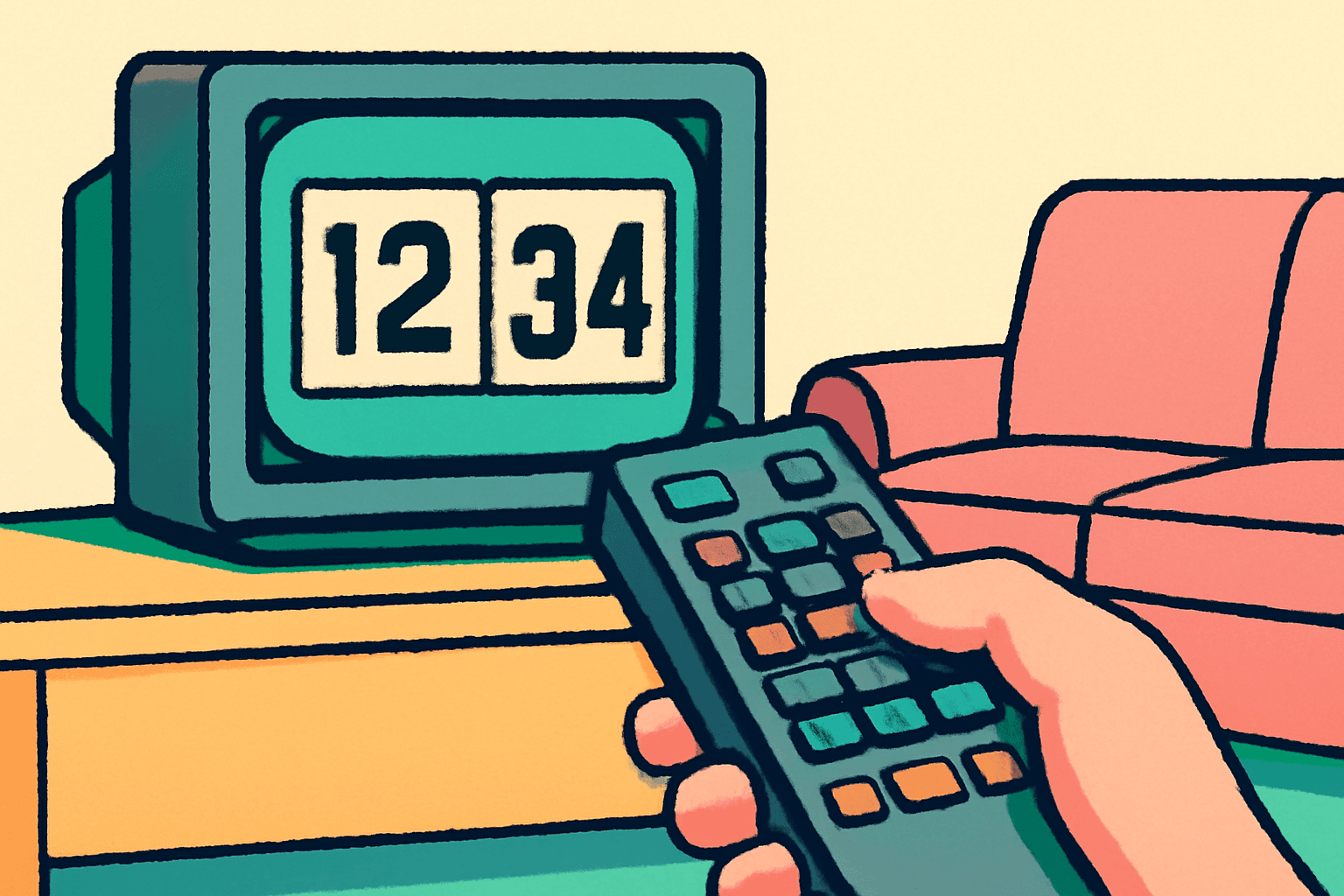
The TV Guide Channel scrolled at the speed of continental drift. You know this. You lived this. You'd flip to channel 22 or whatever it was in your market and there it was - a yellow grid crawling upward, one row at a time, while the bottom half of the screen showed some interview with a soap opera actress you didn't care about. You needed to know what was on channel 58. You were currently looking at channel 31. So you waited. And waited. You'd watch the channels tick by - 34, 35, 36 - and then your brother would say something and you'd look away for three seconds and when you looked back it was on channel 61.
You missed it.
Start over.
This happened every single time. The TV Guide Channel was a test of patience that nobody ever passed. It was designed by someone who understood suffering on a molecular level. And yet you went back to it, night after night, because the alternative was finding the actual paper TV Guide, which your dad had already taken apart and lost half the pages of.
The Remote Was a Weapon
Every household had a remote control hierarchy and it was non-negotiable. Dad was at the top. This was understood the way gravity was understood. When dad sat in his recliner and picked up the remote, programming negotiations were over. You were watching whatever he was watching. Usually this meant the History Channel, which in the 90s was roughly 90% World War II documentaries. Sometimes it meant golf. You'd sit there watching golf with your father, neither of you speaking, and somehow that was fine.
The real wars happened between siblings. My sister wanted MTV. I wanted Cartoon Network. My brother wanted ESPN. Nobody ever compromised willingly. The remote would get hidden under couch cushions, smuggled into bedrooms, held hostage. "Mom, he won't give me the remote" was said in American households approximately four billion times between 1993 and 1999. Mom's ruling was always the same: "Just find something you can all agree on." This was impossible. We'd end up watching America's Funniest Home Videos because it was the only demilitarized zone in the entire channel lineup.
The Art of Stumbling In
Here's the thing about channel surfing that I genuinely miss. You'd land on a movie that was already forty minutes in and you had no idea what it was, who anyone was, or what was happening, and you'd just watch it anyway.
No Googling. No pulling up the synopsis on your phone. You'd catch Harrison Ford running through some building and think, okay, I'm in, and you'd piece together the plot from context clues like a detective working a cold case. Sometimes you'd watch an entire hour of a movie and never learn the title. It just lived in your memory as "that one movie where the guy did the thing and then the helicopter exploded."
You didn't choose what to watch. You discovered it. There's a difference, and it matters more than you'd think.
TBS was the king of this. TBS played the same fifteen movies on a loop - The Shawshank Redemption, Overboard, some Burt Reynolds thing, Twins with Schwarzenegger and Danny DeVito - and you could tune in at literally any point and just settle in. USA Network had the same energy. You'd find a Steven Seagal movie at the halfway mark on a Saturday afternoon and think, this is unwatchable, and then two hours later you'd watched the whole thing. Twice, if they ran it back-to-back, which they often did.
The Channels Had Personalities
Nickelodeon after school was sacred ground. You'd get home, throw your backpack somewhere your mom would yell at you about later, and flip to Nick. Doug. Rugrats. Hey Arnold. Rocko's Modern Life if you were lucky with the timing. Nickelodeon understood something fundamental about being a kid in America - you needed a soft landing after six hours of long division and dodgeball politics, and they provided one.
Cartoon Network was the wilder option. Dexter's Laboratory. Johnny Bravo. Cow and Chicken, which was genuinely unhinged in retrospect. Late at night, Cartoon Network became Space Ghost Coast to Coast, and if you were awake for that, you were either a teenager or an insomniac or both.
And MTV. This is hard to explain to anyone under thirty, but MTV used to play music videos. That's it. That was the channel. You'd turn it on and there would be a music video playing, and then another one after that, and then another one. TRL with Carson Daly was an event. You'd watch the countdown and have opinions about whether the Backstreet Boys deserved the number one spot over Limp Bizkit, and those opinions felt important. They were not important. But they were yours.
Nothing's On
"There's nothing on."
This was the official motto of the American living room. You'd cycle through 200 channels - which felt like an almost obscene abundance, because your parents remembered having five - and declare that there was nothing to watch. This was objectively false. There were hundreds of things to watch. What you meant was that nothing matched the exact specific thing you wanted at that exact specific moment, and since you couldn't just summon it on demand, you were stuck.
So you'd keep going. Up through the channels, past the home shopping networks, past C-SPAN where some guy was talking to an empty room, past the channel that was just a radar map of local weather on a loop, past three different ESPNs, past whatever was happening on Lifetime, and eventually you'd end up somewhere unexpected. A nature documentary about octopuses. An old episode of Quantum Leap. Some Australian rules football on one of the sports channels. And you'd stop. Not because you chose it. Because you got tired of looking.
The 2 AM Layer
If you were up late enough - sleepover late, summer vacation late, couldn't-sleep-on-a-school-night late - you hit a different layer of television entirely. The infomercials. Ron Popeil selling the Showtime Rotisserie with the intensity of a man who believed chicken was going to save the world. "Set it and forget it!" The AbRoller. The Magic Bullet blender. Proactiv with Jessica Simpson looking concerned about pores.
- The Ronco Showtime Rotisserie ("Set it and forget it!")
- Oxy Clean with Billy Mays (RIP)
- The George Foreman Grill
- Girls Gone Wild ads that you scrambled to mute
- That knife set where they cut through a shoe and then a tomato
- Miss Cleo ("Call me now!")
There was something hypnotic about infomercials at 2 AM. The production values were terrible. The acting was worse. But you'd sit there watching a woman pretend to struggle with a regular mop for nine minutes and think, yeah, she does seem like she needs that Swiffer. The infomercial economy ran entirely on the vulnerability of people who were awake when they shouldn't have been. It was predatory and fascinating and you could not look away.
What It Taught You
I don't want to oversell this. Channel surfing wasn't some profound spiritual practice. It was mostly just boredom with a remote control. But there was something in it that I think we actually lost.
You had to be open. You couldn't curate your experience down to exactly what you wanted, so you had to meet the world halfway. You had to sit with things that weren't your first choice. You had to give that random movie ten minutes before you decided. You had to tolerate the possibility that the best thing on TV tonight might be a show you'd never heard of on a channel you never watched.
That's not nothing.
Now everything is on demand. Every show, every movie, every clip, served up by an algorithm that already knows what you like. And somehow - with all of it available, all the time, instantly - I hear people say the same thing we said in 1996, sitting on the carpet with a remote that had buttons worn smooth from use.
There's nothing on.