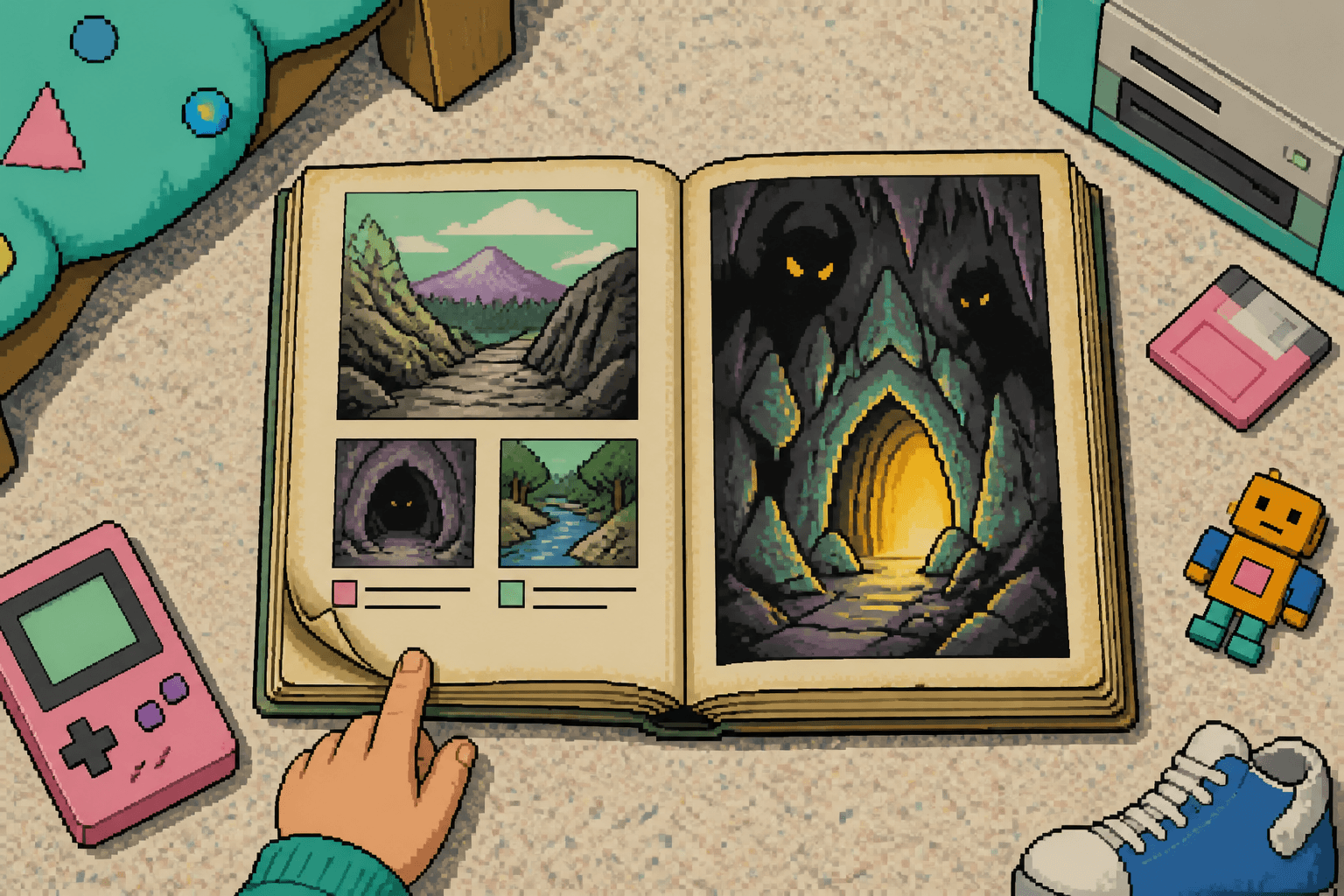
The book was thin. Not in pages - in spine. About a quarter of an inch of cheap newsprint paperback, the cover painted by someone who was very excited about caves or spaceships or the inside of a haunted house. There was a number on the spine. #43. That mattered. Numbered books always matter to children. It implied there were forty-two before this one, all of which you also needed.
You bought it at the Scholastic book fair for $2.50, or you got it at the dentist's office because your mom told the receptionist you were a reader, or you found it in your cousin's old room with the cover ripped halfway off and a thumbprint in jelly on page 91. It did not matter where you got it. You opened it the same way.
YOU are the main character of this book. YOU decide what happens. YOU must use your wits to survive...
You used your wits and you died on page 47.
The Architecture
Here is what a Choose Your Own Adventure book actually was, mechanically.
It had a one-paragraph setup that did a remarkable amount of work. You were an oceanographer, suddenly. You were a spy. You were a kid your own age who had inexplicably been entrusted with a passport, a backpack, and a working knowledge of a dialect spoken only in one valley in the Himalayas. Whatever you were, you had been dropped, fully formed, into the middle of a situation that required decisions.
The decisions came in pairs. Almost always two. Sometimes three, if the book was feeling ambitious. They lived at the bottom of the page in italics, separated from the narrative by a thin line, like a fence between the part where you were told what was happening and the part where you were blamed for it.
The choices lived at the bottom of the page in italics, separated by a thin line, like a fence between what was happening to you and what you were about to be blamed for.
If you climb down into the chasm, turn to page 62.
If you head back to the village, turn to page 84.
You climbed down. Page 62 said you fell. The end. You backed up. You went to page 84 instead. The village was on fire. The end. You backed up further. You tried not picking up the cursed coin from page 12. The book did not let you not pick up the cursed coin. The book needed you to pick up the cursed coin. Every other path eventually looped back to the chasm or the village, and you died in both, every time, no matter what.
The Endings
There were, on average, somewhere between fifteen and forty endings per book. Of those, exactly two were good.
The rest were death.
Death by lava. Death by drowning. Death by some kind of mole creature whose existence had not been telegraphed in any way before you turned the page and found that the mole creatures had got you. Death by aging, which was a specific Choose Your Own Adventure obsession - you would find a watch or a mirror or a small stone idol, and the book would inform you, with no apparent regret, that you had aged seventy years in a single paragraph and were now a skeleton on the floor of a temple. The End.
The endings were almost always one or two paragraphs long. The death endings had a particular tone. They were not dramatic. They were not sad. They were brisk. The author was clearly done with you and ready to move on. You step off the edge of the cliff. You did not look first. THE END. No funeral. No moral. The book just ended your specific life and waited for you to flip back.
- Spatial: You walked into the wrong room. Often a basement.
- Temporal: You aged seventy years. Sometimes in three seconds.
- Trust-based: You believed the stranger. The stranger was, regrettably, the villain.
- Curiosity: You touched the glowing thing. It would not stop glowing.
- Loyalty: You went back for your friend. Your friend was now a wolf.
- Inaction: You did nothing. The cave did the rest.
The good endings - and again, there were maybe two per book - were a strange experience. You'd read the words YOU HAVE COMPLETED YOUR MISSION and feel, instead of triumph, a vague suspicion. You'd flip backward, retracing your steps. You'd want proof. You'd want to know which decisions, exactly, had earned you a non-death.
It was almost always one weird decision early on. You'd chosen, on page 4, to put the strange green pebble in your pocket instead of leaving it on the dock. Nobody would have done that. The book was just waiting to see if you would.
The Fingers
Here is what you actually did.
You held the book open with your left hand. You used your right thumb to keep a bookmark on the page you'd just left. You used your right index finger to hold the page before that. If the book got really hairy - if you were three or four pages deep into something that smelled like it was going to kill you - you'd shove your pinky into another page, the one with the last real choice, the one where you could still believe in yourself.
By the time you got to a death ending, your right hand looked like a pianist's seizure. Four fingers, four pages, all kept open by force, while your eyes did the actual reading and your brain did the actual lying to yourself about whether this counted as playing fair.
You held three fingers in the book. Four, if it was getting bad. The book pretended you were playing fair. You pretended you were playing fair. Nobody was playing fair.
It did not count. We all knew it did not count. The whole point of the genre - if you took the genre seriously, which we did not, because we were nine - was that you committed to a choice and lived with it. The book even said so, somewhere on page one, in the same disclaimer that told you YOU are the main character. You were supposed to play it like the Choose Your Own Adventure was telling you something true about the kind of person you were.
We did not play it like that. We played it like a maze. We worked backward from the good endings - which we had located by flipping to random pages and skimming for the word MISSION - and reverse-engineered the route. We treated the book like a poorly designed video game with no save points. We were not reading. We were solving.
The Argument
And here's where I want to argue with myself for a second.
There's a version of this essay where I tell you the Choose Your Own Adventure book was the first interactive narrative most of us encountered, and that it taught us something about agency, about how every choice forecloses other choices, about how literature is a system of branching counterfactuals. There are scholars who have written this essay. They have made good points. I don't want to disagree with them, exactly.
But I also need to say: nobody finished those books.
Nobody finished them. You did not read every ending. You did not respect the architecture. You skipped to the back of the book and read all the endings out of order. You read the title of one ending - THE WIZARDS THANK YOU FOR YOUR SACRIFICE - and decided that was the ending you wanted, and then you flipped backward through the page numbers looking for a chain of decisions that might land you on that page. The book was supposed to be a story. We turned it into a flowchart.
And then we put it back on the shelf and grabbed Goosebumps instead, which only had one ending, but at least respected our time.
The Genre
Choose Your Own Adventure was a brand - capital-C, capital-Y, capital-O, capital-A, owned by a company called Bantam, with a logo on the spine that looked like a maze. But the genre was bigger than the brand. There were knockoffs. There were imitators. Time Machine. Endless Quest. Fighting Fantasy, if you were a particular kind of kid who wanted dice involved. The Goosebumps series briefly had its own branching line called Give Yourself Goosebumps, which leaned hard into death and also into werewolves.
The shelves at the library had a whole section. It was always in disarray. The book numbers never lined up because nobody who borrowed #27 Inside UFO 54-40 returned it next to #26 or #28. The librarian had given up. The cards in the back pocket - and yes, in the early 90s, they were still cards in the back pocket - had the same six names on them, every time. There was a small community of kids who were working their way through the entire series, and you knew their names by their handwriting.
You traded them at school. You'd lend out #3 By Balloon to the Sahara and get back #11 Mystery of the Maya and a half-eaten Slim Jim. The books smelled like other people's basements. The covers were always a little soft at the corners. The page where you died most often was a little softer than the rest of the page.
The Toy
Anyway. Here. I made one.
It is shorter than a real one. It has fewer endings. Most of them kill you, because I was raised on the originals and I respect the form. Try to find them all. Use the bookmark to cheat. We all did.
You and Marcus snuck out of cabin 7 at 11:43 PM. The cave is right where the older kids said it would be. Marcus shines his flashlight in. Something moves.
I want to point out that the act of "using your finger to flip back" is now a button, which is exactly the wrong thing to do to a Choose Your Own Adventure book. The whole texture of the genre - the specific pinch of pages between your fingers, the small dishonesty of going back, the physical evidence of how badly you were doing - is gone the moment you can just click FLIP BACK (CHEAT) and not feel anything.
It still works. You'll still die in it. But you will not have to lie to yourself.
The Last Page
I went to a used bookstore last fall. There was a wire rack near the children's section labeled CYOA - $1 EACH in marker on an index card. I dug through it. The numbers were not in order. #43 was there - The Mystery of the Maya, I think, or maybe Inside UFO 54-40, I can never keep them straight. The cover was creased. The corner of page 47 was folded down. Somebody had died there once. Maybe a lot.
I bought it. I took it home. I sat on the couch and read it from start to finish, every page in order, ignoring the choices completely. It was incoherent. The protagonist - me, technically - made decisions that contradicted the previous page. The plot looped. I died on page 47. I kept reading. I died on page 62. I kept reading. By page 90 I had been killed in seven different rooms by seven different creatures, and at no point had the book noticed.
I closed it. I put it on the shelf next to the regular books, where it does not belong, because Choose Your Own Adventure books are not regular books. They are a specific argument about what reading is for. They argue that the story is yours and the choices are yours and the death, when it comes, is also yours, and that the whole thing is a moral exercise dressed up as a vacation.
I think they were wrong. I think they were also right. I think there is a version of me, still, somewhere in the middle of page 47, with a finger jammed in page 42, deciding whether to be honest about this. I do not know what that version chooses. I never finished the book.