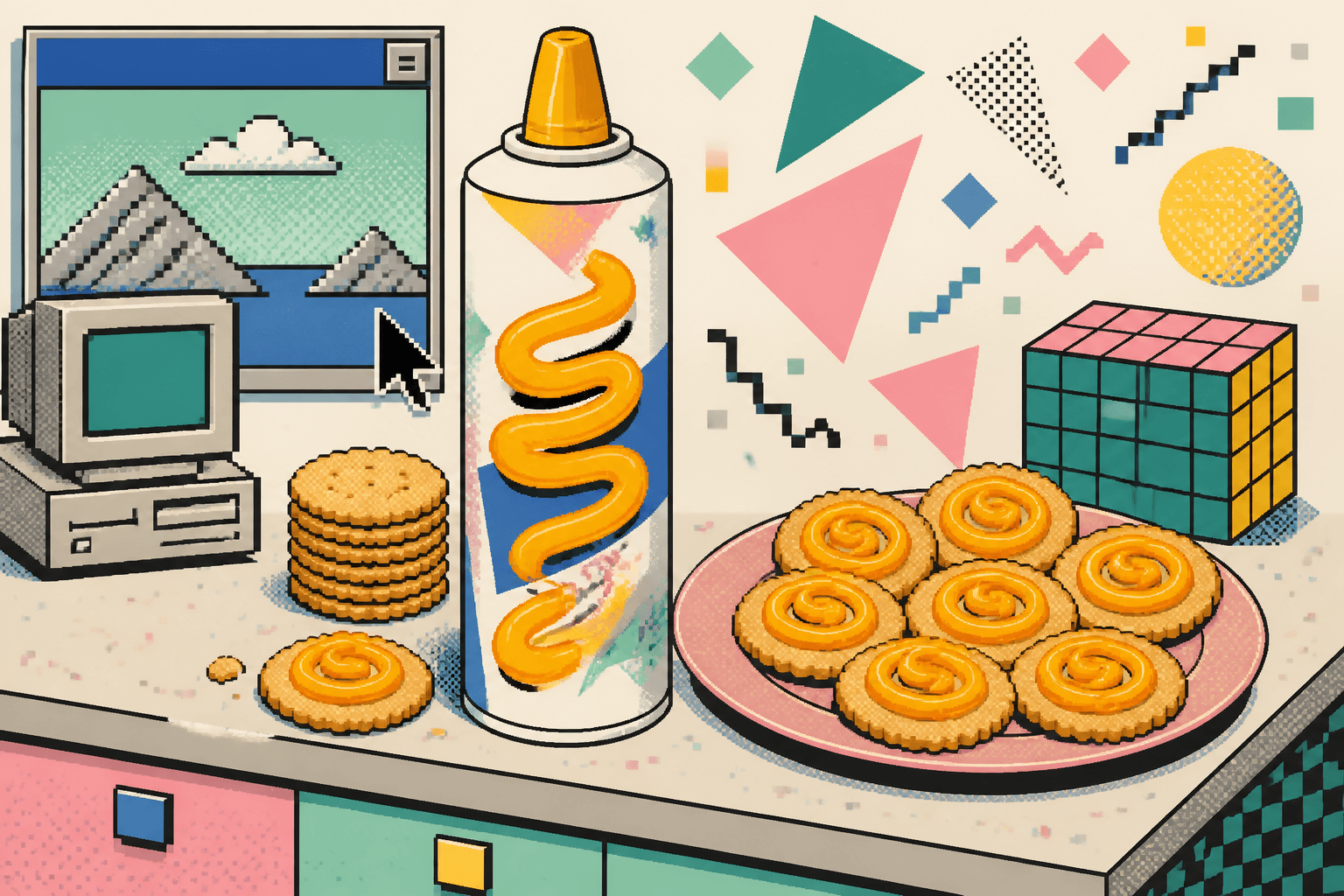
The can was the wrong shape for cheese.
It was a can. A real can, the kind a can of WD-40 came in, with a metal body and a plastic cap and a nozzle on top that you turned to aim. It sat on the shelf at eye level between the squeeze bottles of mustard and the boxes of Cheez-Its, and it was, somehow, cheese. The label said so. Easy Cheese, in a font that suggested neither easy nor cheese, with a little cartoon swoosh and the brand mark Kraft had used since approximately 1953. You picked it up. It was heavier than you expected. You shook it. It sloshed.
You put it in the cart. Your mom said fine, but you have to eat the crackers with it, which you would not, because the crackers were a delivery system for the cheese, and the cheese was a delivery system for operating an aerosol can in a kitchen at age nine.
The Pull Of The Cap
The cap came off with a satisfying click. Underneath was the nozzle - an off-white plastic stem that pointed straight up, a small slit cut across the top of it. You were supposed to turn it sideways to aim. You did. You always aimed at your own hand first, for some reason, the way you'd test a hose for pressure. You'd lift the can, point the nozzle at your palm, and press.
Nothing happened.
You had to press harder. The nozzle had a stiff little resistance to it, and there was a moment of is this thing broken before the can went hisssssssss and a thick yellow-orange worm of cheese product emerged onto your palm at a velocity that was both too fast and too slow at the same time.
It was warm.
That was the part nobody mentioned. The cheese came out warm. It had been sitting on a shelf, then in your kitchen pantry, at room temperature, possibly for years, and when it came out of the can it was the temperature of your room, which is not what cheese should be, but you didn't think about that. You looked at the worm of cheese on your palm. You ate it.
The can was the wrong shape for cheese. The cheese was the wrong temperature for cheese. The texture was wrong. The color was wrong. You ate it anyway.
The Color
Let's talk about the color.
The cheese was orange. Not cheddar orange. Not real-cheese orange. Construction-cone orange. Caution-sign orange. It came out of the can looking like something a child had drawn with a marker and labeled CHEESE. The first time you saw it as an adult, after twenty years away, you'd be honestly a little startled. That, you'd think, is not the color of food.
But that was the trick. The color told you it was processed. The color was a promise. The color said I have been engineered specifically so that nine-year-olds will recognize me as snack-shaped from across a room. And you did. You always did. You could spot the can from three aisles away.
There was a sharp cheddar variant. There was a bacon variant, briefly. There was an American variant, which was the same color as the cheddar but with less flavor, somehow, like they had dialed down a knob you couldn't see. There was no version that was actually the color of cheese. The closest was the white version, which was the color of no cheese, and which nobody bought, because if cheese is not orange, what is the point.
The Mechanism
I want to give credit where credit is due, because the mechanism was kind of beautiful.
A can of Easy Cheese was a pressurized vessel. Inside the metal can was a flexible bag full of cheese product, and around the bag was a gas, and when you pressed the nozzle, the gas pushed the bag, and the bag squeezed the cheese, and the cheese came out the slit. The gas never touched the cheese. The cheese never touched the gas. They were separated by the bag, and the whole system worked through displacement, the way a tube of toothpaste works if you could fill the cap of the toothpaste with carbon dioxide and let it do the squeezing for you.
This is, on paper, a clever piece of engineering. It is also, on paper, a piece of engineering that has no business being applied to dairy. The reason aerosol cheese exists is not that anyone said I wish I could spray cheese onto a cracker without lifting a knife. The reason is that someone at Nabisco, in 1966, had a pressurization patent and a surplus of process cheese, and the two things met at a meeting, and somebody said yes.
Nobody at that meeting said but should we, though. The 90s benefited from this, and nobody asked.
The Patterns
You did not eat Easy Cheese the same way twice.
The first cracker got a line. A straight bead of cheese product, drawn from one edge of the Ritz to the other, with the can held steady and the nozzle pulled smoothly across, like icing a tiny cake. This was the professional dose. The way the can said to do it. There was a photo on the side of the can showing exactly this, a Ritz with one neat line of cheese on it, and you tried to replicate that line every time, and you never quite did.
The second cracker got a spiral. You started in the center, you held the can still, you let the cheese coil out on top of itself in a little Dairy Queen swirl, and you finished with a flourish at the top, the way the Dairy Queen man finished a cone. This was the show-off cracker. You'd show it to your sister. Your sister was unimpressed.
The third cracker got a smiley face. Two eyes, a curving smile, a small dot on the forehead for some reason. This was for younger cousins. This was advanced cheese craft. By the time you finished arranging a smiley you'd used a quarter of the can on one cracker, and you'd eat it in one bite anyway, and the smile was gone.
By the fourth cracker, you weren't using the cracker anymore.
The Honest Confession
You ate it straight from the can.
I know. You don't want to admit it. Neither do I. But you did. Everyone did. You'd point the nozzle at your open mouth, you'd press, you'd take in a hot loop of cheese product directly. The cracker was a formality. The cracker was your mom's idea. The cracker had crumbs and the cheese was right there in a can and the can already had a nozzle on it engineered specifically for dispensing into a small opening, and your mouth was a small opening, and you were nine, and the math was obvious.
- The Ritz (proper, sanctioned, photographed on the can)
- The saltine (acceptable, dryer cracker for more cheese ratio)
- The Triscuit (adventurous, possibly correct)
- The pretzel rod (advanced, technically a tool)
- The celery stalk (you saw this on a cooking show once and tried it twice)
- Directly into mouth (the kid in you knows this is what you actually did)
- On a spoon, alone at the counter (this is between you and god)
The can had an unintentional convenience: the nozzle was the same diameter as the back of your throat. The engineers at Kraft did not design it this way on purpose. But they did not design it against it, either. They knew. They had to have known.
The Ingredients List
The ingredients list was a small horror.
In the order Kraft was legally required to print them, the can said: whey, water, milkfat, milk protein concentrate, canola oil, sodium phosphate, whey protein concentrate, salt, lactic acid, sodium alginate, apo-carotenal (color), enzymes, cheese culture, annatto (color).
There is cheese in there. Sort of. Buried in the back of the list, after the phosphate and the carotenal, there is a line that says cheese culture, which is the bacterial part of cheese, which technically means the can contains microorganisms that would make cheese, given milk and time and a wheel. The can did not contain those things. The can contained a suggestion of cheese, held in suspension by alginate and phosphate, colored to look like a Crayola, and pushed out through a slit by compressed nitrogen.
You did not read the back of the can. You were nine. You read the front. The front said Cheddar Cheese Snack in cheerful yellow letters, and that was a complete sentence, and that was all you needed.
The Argument
Here is where I am supposed to argue that Easy Cheese is bad, actually, and we should not have eaten it. I am not going to do that. Easy Cheese was bad. I knew it was bad. My mom knew it was bad. The kid down the street whose family didn't have it in the house knew it was bad. We all knew. That was not the argument.
The argument was that Easy Cheese was fun. It came out of an aerosol can. It made a hiss. It let you draw with food. It let a nine-year-old hold a metal pressure vessel and operate it with adult competence in a kitchen, producing edible output, on demand, in any pattern. There was no other food product in the 90s grocery store that gave a kid that much agency. The closest was the can of whipped cream, and the can of whipped cream had restrictions. Don't spray the whipped cream into your mouth. Easy Cheese had no such restrictions. Easy Cheese was, by design, for spraying into a mouth or near a mouth or at a small cracker that was almost a mouth.
There was no other food product in the 90s grocery store that gave a nine-year-old that much agency. The whipped cream had restrictions. Easy Cheese was the libertarian aisle.
The point was the can. The point was always the can. The cheese was an excuse to let you operate the can.
The Persistence
Easy Cheese is still on the shelves.
You can buy it. Today. At the same grocery store. In the same aisle, between the squeeze cheese and the wax-wrapped Babybels, in the same yellow can with the same orange swoosh and the same Kraft logo, and it costs about five dollars, which feels like a lot for what it is until you remember that what it is is a small can of pressurized snack-engineering and a delivery system disguised as a cheese product. It has not been improved. It has not been reformulated. It has not been artisanal-ized. It is the same goop in the same can, and you can hiss it onto a Ritz tonight if you want to, and the cheese will be the same construction-cone orange it was in 1994.
I bought one last fall. I am forty-something. I stood at the counter in my own kitchen, I pulled the cap, I turned the nozzle, and I pressed. The hiss was instant. The smell hit me three seconds later and it was exactly the smell. That specific phosphate-and-canola-oil smell, the smell of the inside of a can of process cheese, the smell that does not exist in any other product in any other aisle. I had not smelled it in twenty-five years and I recognized it immediately.
I sprayed it on a Ritz. I made a line. The line was professional. The line was the line on the can. I ate the cracker. The cheese was warm. It tasted like exactly what it had always tasted like, which is to say, like a chemical impression of cheese delivered at body temperature in a thick paste form, and it was - and I want to be honest about this - kind of good. In the way an old song is kind of good when you haven't heard it since you were a child.
I ate three crackers. I sprayed the fourth one directly into my mouth. I am forty-something. I would do it again tomorrow.
The Quiet Engineering
I keep coming back to the engineering.
Somewhere, in a Kraft facility in 2026, there is still a production line filling small flexible bags with process cheese and sealing them inside aluminum cans and pressurizing them with food-grade nitrogen and shipping them by the pallet to grocery stores across the country. There are workers whose job is to monitor the cheese-pressure ratio. There are quality-control inspectors whose job is to confirm that the nozzle slit is exactly the right width. There are food chemists whose job is to ensure the alginate-to-phosphate ratio holds the cheese matrix together for the eighteen-month shelf life.
This is happening, right now, somewhere. Has been happening, every day, since before you were born. The fact that I find this both ridiculous and beautiful is, I think, the entire point of the product.
The can sat on the counter for three days afterward. I kept walking past it. I'd think I should put that away, and I wouldn't, because there was nowhere to put it. The fridge was wrong - the can was room temperature cheese, that was the whole identity. The pantry was wrong - it felt like an active object, something that should be reached for, not stored. The countertop was right. The countertop was where the can went. The countertop was where the can had always gone, in some other kitchen, twenty-five years ago, where my mother had given up trying to convince me that this was not a real food and had decided to let me figure it out myself.
I put the cap back on. I left it on the counter. I checked the shelf life on the bottom of the can. The can said good until 2028. The can had outlived its first owner's interest in the can and was prepared to wait, patiently, on my counter, for the next time I felt nine.
I felt nine the next day. I made another line.
The hiss was the same. The line was the same. The cheese was, somehow, still warm.