The encyclopedia salesman came to our door on a Tuesday evening in 1993. I remember this because my dad had just sat down to watch Seinfeld and was not happy about getting up. The guy was wearing a short-sleeve dress shirt and carrying a briefcase that looked like it weighed forty pounds, and he wanted to talk to my parents about World Book Encyclopedia. Twenty-two volumes. Annual yearbook supplement. A bookshelf included, if you ordered tonight.
My mom let him in because that's what people did in 1993. Strangers came to your door and you let them sit on your couch and pitch you things. The guy opened his briefcase and pulled out a sample volume - the "S" volume, always the "S" volume, because it had Space and Sharks and the Solar System, which were the heavy hitters when you were trying to impress a nine-year-old standing in the hallway pretending not to listen.
My parents didn't buy it. We already had a set of Funk & Wagnalls from the grocery store, purchased one volume per week over the course of an entire year. The spines didn't quite match because they'd changed the design halfway through. We were missing volume 14. Nobody talked about it.
The Card Catalogue Was a Filing Cabinet You Could Get Lost In
Before any of this, there was the library. And before the library was useful, you had to learn the card catalogue, which was basically a wooden dresser full of index cards that told you where books were hiding. The Dewey Decimal System. Just the name alone sounded like something invented to make children feel small.
Research meant going somewhere. It meant getting in the car. It meant your mom dropping you off at the public library on a Saturday afternoon and saying she'd be back in an hour, which meant you had sixty minutes to find everything you needed for your report on the Louisiana Purchase. The clock was ticking the moment she pulled away from the curb.
And if the books didn't have what you needed, there was microfiche. Microfiche. The word itself sounded like a disease. You'd sit at this machine that looked like it was designed by NASA's least creative engineer and scroll through tiny photographs of old newspaper pages, squinting at text that was slightly too blurry to read comfortably. The machine hummed and got warm. The whole experience felt like being punished for wanting to know things.
Then Encarta Showed Up
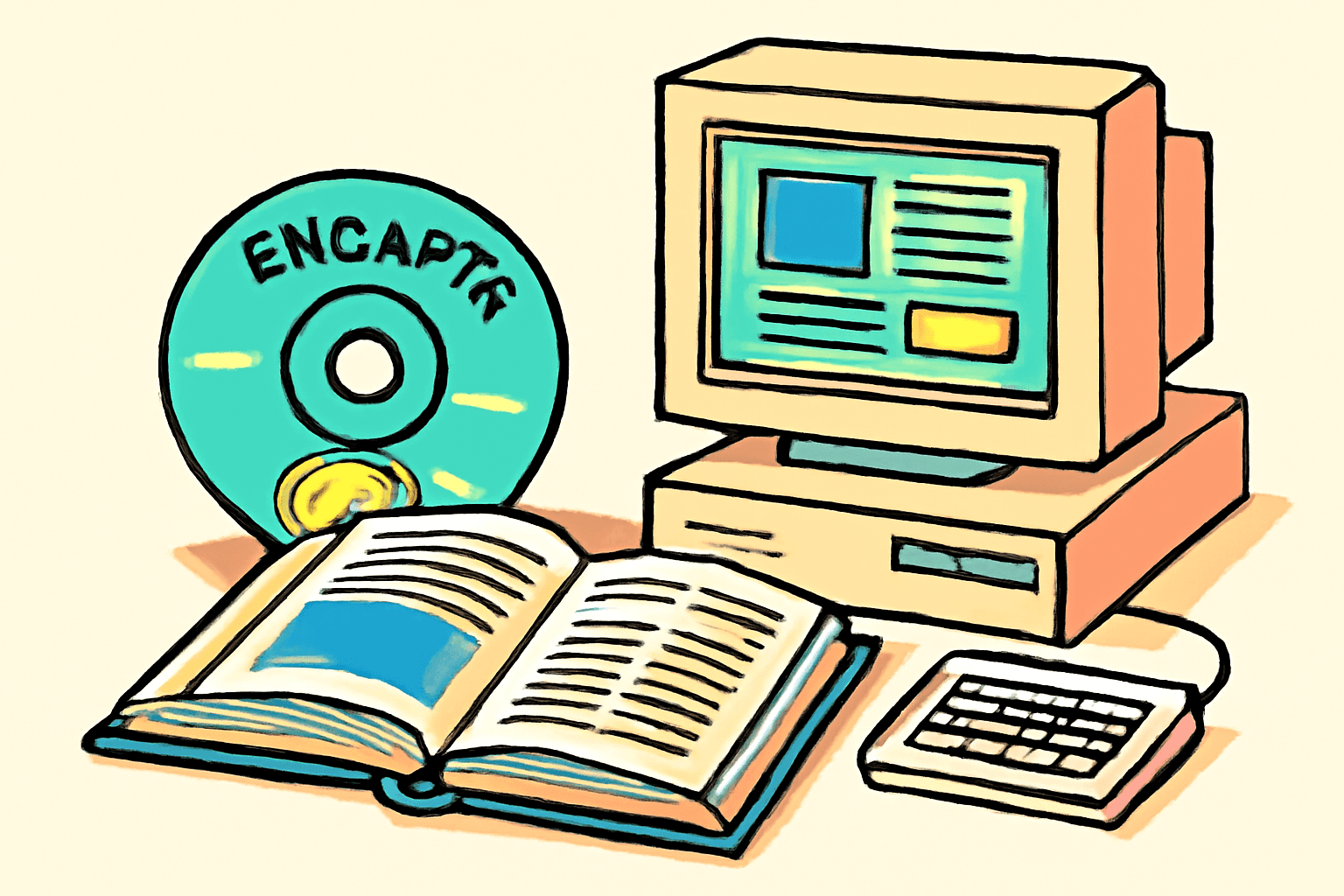
Microsoft Encarta came into our house in 1994, bundled with our Packard Bell computer. It was a single CD-ROM in a jewel case, and it contained - according to the box - over 26,000 articles, 8 hours of sound, 7,000 photographs, and 100 animations and video clips. All on one disc. The same size as an Ace of Base album.
I don't think I can explain to anyone who didn't live through it how impossible that felt. You put this disc in your computer and suddenly you had an encyclopedia that could talk to you. You clicked on "Beethoven" and it played you Beethoven. You clicked on "Martin Luther King Jr." and you heard the actual "I Have a Dream" speech. You clicked on the moon landing and there was video. Grainy, tiny, compressed-to-death video in a window the size of a postage stamp, but video. On your computer. In your house.
You put a single disc in your computer and suddenly the whole world was in there. It wasn't the internet. It was better than the internet, because it actually worked.
For a lot of us, Encarta was the internet before the internet. This was 1994, 1995. Most families didn't have AOL yet. The web was a rumor. But Encarta was right there, already installed, already miraculous. You could look up anything. You could jump from article to article using hyperlinks, which was a concept that felt genuinely revolutionary - you're reading about Egypt and there's a blue underlined word that says "pharaoh" and you click it and now you're reading about pharaohs. The future had arrived and it was running on Windows 3.1.
MindMaze
We need to talk about MindMaze. If you know, you know. If you don't, I'm sorry for what you missed.
MindMaze was a game hidden inside Encarta. A game. Inside an encyclopedia. You navigated through a medieval castle, room by room, answering trivia questions to unlock doors. The graphics were early-90s spooky - stone walls, torches, suits of armor. There was a narrator with a vaguely British accent who said ominous things. The whole vibe was somewhere between educational software and a haunted house.
- The castle had multiple floors
- Wrong answers sent you back a room
- There was a hall of fame for high scores
- The questions pulled from actual Encarta articles
- You could play it for hours and technically call it "studying"
Here's the thing about MindMaze: it gave you a reason to open Encarta even when you didn't have homework. You'd fire it up on a Saturday just to play, and then you'd get a question wrong about the Crimean War and think, huh, I should look that up. And then you'd spend twenty minutes reading about the Crimean War. Microsoft accidentally invented the most effective educational tool of the decade by hiding a dungeon crawler inside a reference disc.
Every kid I knew who had Encarta played MindMaze. Every single one. We'd compare how far we'd gotten. It was a shared experience in the way that only a handful of things were in the 90s - before everything fragmented, before everyone was watching different stuff on different screens. You had MindMaze or you didn't, and if you did, you understood.
The Multimedia Clips That Changed Everything
Go back to those video clips for a second. Today you can watch a 4K drone flyover of the Pyramids of Giza on your phone while you're in line at Starbucks. In 1995, you could watch a twelve-second video of the Pyramids in a window roughly the size of a Wheat Thin, and it was the most amazing thing you'd ever seen on a screen that wasn't a television.
The audio clips were almost better. Encarta had recordings of animal sounds. Click on "wolf" and you could hear a wolf howl. Click on "humpback whale" and your computer's tinny speakers would produce this eerie, warbling song from the deep ocean. In your bedroom. In suburban Ohio. The whale didn't care that you were ten and had never seen the ocean. It sang for you anyway.
There were pronunciation guides for foreign words. Little audio tours of famous places. A clip of JFK saying "Ich bin ein Berliner." Musical instruments you could listen to one by one - the oboe, the bassoon, the sitar. Each one a tiny window into a world you hadn't known existed, delivered through a two-inch desktop speaker that also made the Windows startup sound.
The In-Between
What gets me now is how brief the window was. Encarta came out in 1993. By 1998, 1999, most families had some kind of internet access, and Encarta started to feel quaint. By 2001, Wikipedia existed. By 2009, Microsoft killed Encarta entirely. Sixteen years, start to finish, and the golden era was maybe four or five of those.
But in that window - 1993 to 1997, let's say - something genuinely magical happened. Knowledge stopped being a place you went and became a thing you had. The library was twenty minutes away. The card catalogue was confusing. Microfiche was a nightmare. The encyclopedia set on the shelf was expensive and out of date before the ink dried. And then suddenly, for the cost of a CD-ROM that came free with your computer, you had everything. Or close enough to everything that it didn't matter.
Knowledge stopped being a place you went and became a thing you had. The whole shift happened in about four years, and most of us were too young to realize what we were watching.
The encyclopedia salesman stopped coming to the door. I don't know exactly when. One year they were there and then they just weren't, like a species that went quietly extinct while nobody was paying attention. World Book is still around, technically, but nobody's hauling a forty-pound briefcase to your porch anymore. That job disappeared the same way the card catalogue disappeared, the same way microfiche disappeared - not with a bang, but with a click. A single click on a blue underlined word that took you somewhere new.
The Packard Bell is long gone. The CD-ROM is in a landfill somewhere, probably. But I can still hear that wolf howl if I close my eyes. Tinny and small and coming from a two-inch speaker on a desk in a room where the future was just beginning to boot up.