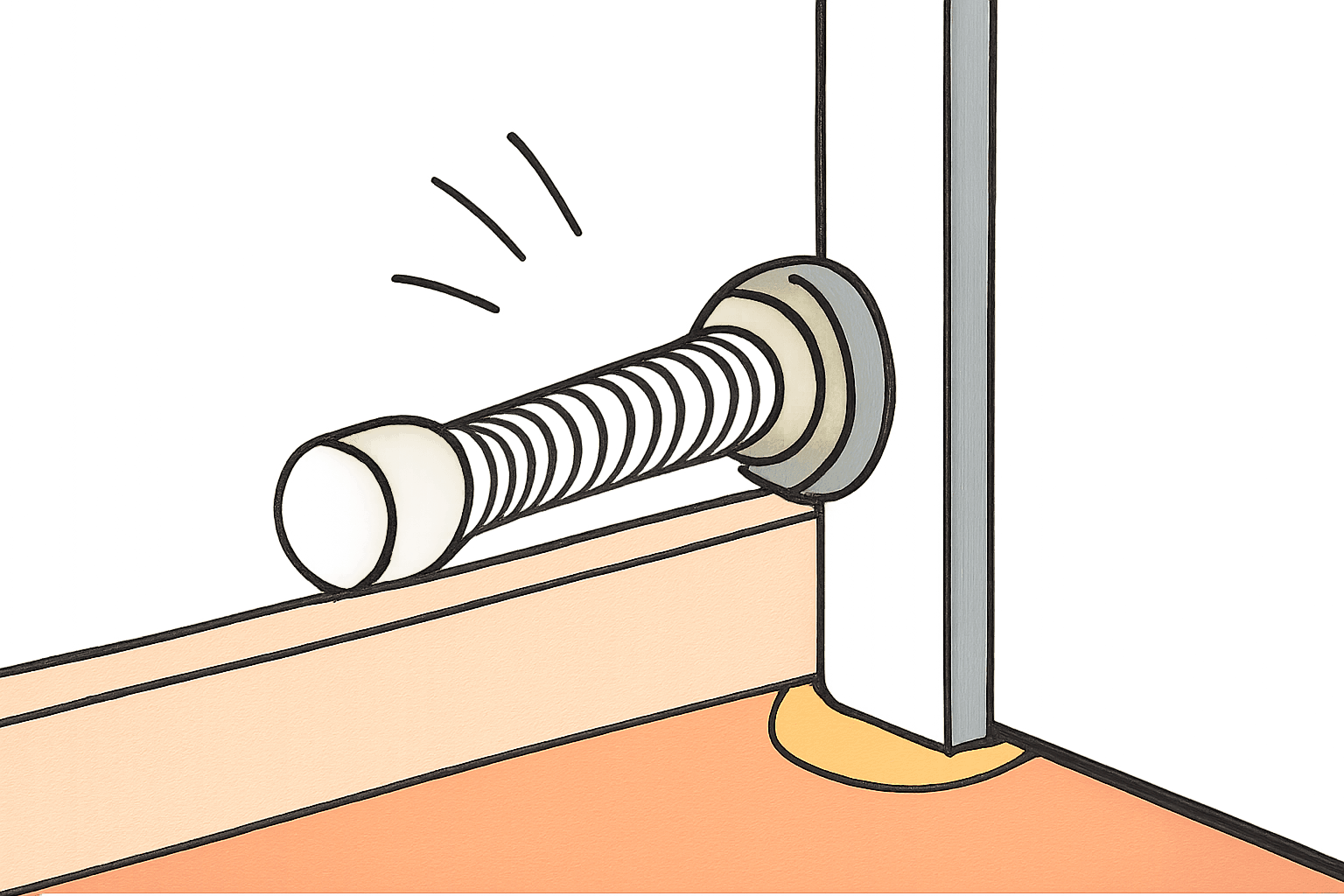
You weren't looking for it the first time. You were sitting on the floor - maybe playing with Legos, maybe just existing at carpet level the way kids do - and your foot or your hand or your elbow brushed against something small and metal sticking out of the baseboard behind the door. A little spring with a rubber tip. You didn't know what it was for. You didn't care what it was for. You touched it, and it went bwoingggg, and your entire life changed.
Not really. But also kind of really.
Because once you discovered the springy door stopper, you could not leave it alone. Nobody could. It was physically impossible. It sat there, three inches off the floor, a coiled steel spring with a white rubber cap, mounted to the baseboard with a single screw, and it called to you. Every time you walked past it. Every time you were bored. Every time you were in a room and had a hand that wasn't doing anything. You'd reach down and flick it, and it would go bwoingggg, and for a second, everything was fine.
The Sound
Let's talk about the sound, because the sound was the point.
It wasn't a ding or a ring or a buzz. It was a bwoingggg. A vibrating, oscillating, metallic wobble that started loud and then decayed into a high-pitched hum that seemed to last longer than physics should allow. It was the sound of a cartoon spring translated into real life. It was the most satisfying noise in the house, and the house contained a TV, a phone, and a microwave that beeped.
The bwoingggg was proof that the universe contained small, free, perfect things. You didn't have to buy it. You didn't have to earn it. You just had to flick it.
And the variations. Oh, the variations. A light flick gave you a delicate, almost musical hum. A hard flick - the kind where you pulled it back and let it snap - gave you the full concert. The violent, room-filling BWOINGGGG that made the dog look up and your dad yell from the other room. There was a middle ground too, a medium flick that produced the platonic ideal of door stopper sound, the one that lives in your memory, the one you're hearing right now as you read this.
You could also hold the tip and let it go. Different sound. Brighter, sharper, less wobble. Or you could flick it rapidly, back and forth, creating a machine gun of tiny bwoings that sounded like a broken telephone. Or you could press it against the baseboard to muffle it and create a dull, buzzy vibration that you could feel in the wall. You were a percussionist. The door stopper was your instrument. The hallway was Carnegie Hall.
Every Room Had One
The beautiful thing about the springy door stopper was its ubiquity. They weren't in one room. They were in every room. Behind every door in the house, there was a spring-loaded cylinder of joy mounted to the baseboard or the wall, positioned exactly where the door handle would hit if you swung the door open too hard. That was its job - to prevent the doorknob from punching a hole in the drywall. A humble, utilitarian purpose. A purpose it fulfilled admirably while also being the most entertaining three inches of hardware in the American home.
- Bathroom: 1 (the most private bwoingggg)
- Kitchen: 1 (the one your mom told you to stop touching)
- Master bedroom: 1 (forbidden fruit)
- Your bedroom: 1 (the personal bwoingggg, played before bed)
- Hallway closet: 1 (the forgotten one, discovered during hide and seek)
- Front door: sometimes a different kind entirely (the wedge type, useless)
- Total springs available for flicking: 4-6 per household
The bathroom one was special. Because you were alone in there, and the acoustics were different - tile and porcelain made the bwoingggg echo slightly - and you had time. You were in there anyway. What else were you going to do? Read the back of the shampoo bottle? Yes, also that. But between the ingredient list on the Suave and the ingredient list on the conditioner, you'd reach down and give the door stopper a flick, and it would sing to you in that small tiled room, and it was a private concert that nobody needed to know about.
The Escalation
Here's what always happened. You'd flick it once. Gently. The satisfying bwoingggg. Good. Fine. Enough.
Except it was never enough.
You'd flick it again. Harder. Louder bwoingggg. Better. Then again. You'd pull it back farther, bend the spring nearly to the wall, and release. Now you were getting the full frequency range, the deep wobble at the base note and the high whine at the top, and it was so good that you had to do it again, and now you were just sitting on the floor flicking a door stopper repeatedly like some kind of percussive gremlin, and the sound was filling the hallway, bwoingggg bwoingggg bwoingggg, and then -
"STOP PLAYING WITH THE DOOR STOPPER."
Every parent in America yelled this sentence at least once a week between 1993 and 2001. It was as universal as "close the door, you're letting the cold air out."
The parental intervention. It always came. Not after the first flick, and not after the second, but somewhere around the sixth or seventh, when the bwoingggg had crossed the threshold from "background noise" to "are you kidding me." Your parent could be three rooms away, watching the news at a volume that should have drowned out everything, and they would still hear it. The bwoingggg penetrated walls. It carried through ductwork. It was a frequency specifically calibrated to reach the auditory cortex of any adult within a forty-foot radius and trigger an involuntary irritation response.
You'd stop. For a while. Maybe five minutes. Maybe ten. But the spring was right there, and your hand was right there, and eventually - quietly, carefully, with the delicacy of a safecracker - you'd reach down and give it the gentlest possible flick. A whisper bwoingggg. A bwoingggg so soft that only you could hear it. A secret between you and the spring.
The Rubber Tip
Eventually, the rubber tip came off. This was inevitable. It was held on by friction and optimism, and after enough flicking - and especially after the thing where you twisted it while pulling, which everyone did - the little white rubber cap would pop off and disappear under the dresser or into the heating vent, never to be seen again.
And now you had a naked spring. A bare metal coil with a sharp end where the rubber used to be.
- The sound changed (sharper, more metallic, arguably better)
- It could now scratch the wall (your mom noticed within 24 hours)
- It could now scratch you (a risk you accepted)
- Flicking it became slightly dangerous and therefore more appealing
- Your dad said he'd "fix it" and then didn't for six months
- It became a tiny weapon in sibling disputes
The sound did change. Without the rubber dampening the tip, the spring rang out with a cleaner, more metallic tone. Purists preferred it. It was the door stopper unplugged, the acoustic version, raw and unfiltered. But it also meant the spring would scratch a little arc into the baseboard paint every time it wobbled, and that was evidence, and evidence meant consequences.
Some parents replaced the rubber tip. Hardware store, probably Ace, probably in a little plastic bag with four tips that cost eighty-nine cents and sat in the junk drawer for three years before anyone remembered what they were for. Some parents replaced the entire door stopper, which felt like an overreaction. Some parents did nothing, because the list of things that needed fixing in a house in 1997 was long and the door stopper was not at the top.
The Other Kind
We should acknowledge that not all door stoppers were created equal. There was another kind - the solid, wedge-shaped kind that sat on the floor. A triangle of rubber or wood that you kicked under the door to hold it open. Functional. Practical. Completely devoid of joy.
There was also the rigid kind - a solid metal bar that stuck out of the baseboard at an angle, tipped with rubber, no spring at all. This was the door stopper equivalent of decaf coffee. It did the job but it offered nothing extra. No sound. No wobble. No reason to touch it. If your house had these instead of the springy ones, you have my sympathy. You grew up in a home without music.
The springy door stopper was the only one that mattered. The spring-loaded, baseboard-mounted, rubber-tipped coil that existed to protect drywall and accidentally became the most reliable source of idle entertainment in the American home. It cost about a dollar. It lasted years. It required no batteries, no WiFi, no subscription, no updates. It just sat there, behind the door, waiting for a foot or a finger or a bored kid with nothing better to do.
Why You Remember It
You remember it because it was always there. In the background, at floor level, in every house you ever visited. Your house. Your friend's house. Your grandparents' house. The church bathroom. The doctor's office. You'd walk in, see the spring behind the door, and feel a pull - not of nostalgia, not yet, just the simple, Pavlovian urge to reach down and make it go.
Nobody ever taught you to flick the door stopper. It was instinct. Pre-verbal, pre-rational, baked into the human operating system. See spring. Flick spring. Hear bwoingggg. Feel good.
It wasn't a toy. It wasn't designed for you. It was a piece of hardware doing a boring job, and you turned it into an instrument, a weapon, a fidget spinner twenty years before fidget spinners existed. It was the original stimming device for an entire generation of kids who didn't have phones in their pockets and had to find entertainment in the architecture.
They're still there, you know. In your house, probably. Behind the bathroom door or the bedroom door, three inches off the floor, coiled steel with a rubber tip that may or may not still be attached. You could walk over there right now. You could reach down. You could give it one good flick and hear that sound again - that exact sound, unchanged, the same bwoingggg from 1996 and 2003 and last Tuesday, the same frequency, the same slow decay into silence. Go ahead. Nobody's watching. And if someone yells at you to stop, well. That's part of it too.