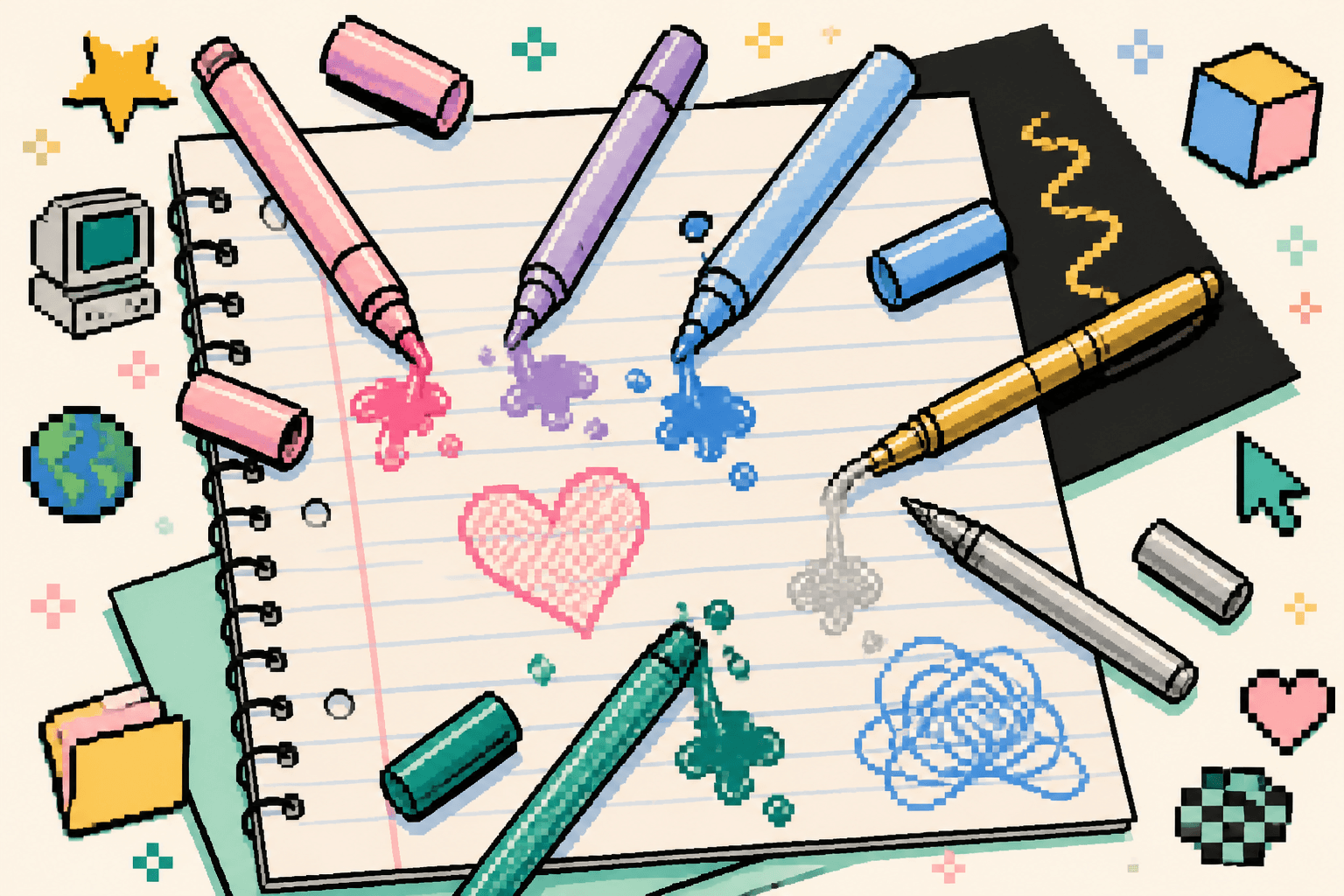
Halfway through the n in your last name, it started to skip.
You knew what it was. You'd known for two words. The line had been getting thinner - a full opaque pink, then a lighter pink, then a sort of pink suggestion, and now you were pressing hard enough to leave a groove and the paper was giving you back a dashed line that couldn't decide if it wanted to be there. You scribbled in the corner. Nothing. You held the pen tip-down and thumped it against the desk. Nothing. You did the shake. The one you'd seen your friend do. Cap-on, wrist-flick, three sharp times, like a thermometer. Nothing.
That Milky Pen had cost you two dollars and lasted about a page and a half.
The Ink
Regular pen ink was a liquid. Gel pen ink was a substance. It came out of the tip a little slower, a little thicker, and it sat on top of the paper for a second before it committed. You could feel it under your fingertip if you touched the line while it was still wet. It smudged. It smudged forever. It smudged three days later if the sun came through the window in a way it hadn't before.
A Bic Round Stic scratched. A Papermate flowed but flowed thin, like watered soup. A gel pen deposited. It laid down a raised bead of color that shone under the fluorescent lights of the science classroom in a way that made the word "pancreas" look, briefly, like a compliment.
You didn't write with a gel pen. You iced with a gel pen.
You didn't write with a gel pen. You iced with a gel pen. A regular blue Bic was a Toyota. A gel pen was a birthday cake.
The Milky Pen
The Milky Pen was a Pentel product and it was, functionally, an accident. The ink was pastel - pink, lavender, mint, sky blue, buttercream yellow - which meant that on regular notebook paper, which was white or off-white or cream, the ink was almost the same color as the paper. You could see it. You couldn't quite read it. You wrote a note to your friend in Milky Pen pink on a piece of ruled paper and your friend held it under the desk lamp and squinted and said, "What?" and you said, "It says Kyle likes you," and she said, "I can't tell," and you were both, immediately, safer than you would have been in blue Bic.
That was the whole product. Deniability by opacity.
The Milky Pen was designed to be read on black paper, or on a dark folder, or on the back of a school photo. Nobody used it on those things, because nobody carried black paper around, so we used it on regular paper and squinted and complained and bought more of them.
The Gelly Roll Gold
The Sakura Gelly Roll gold pen was a separate category of object.
Gold ink is not a thing that occurs naturally in the pen aisle. Gold ink implies wedding invitations. Gold ink implies a fountain pen and a specific kind of thick cream paper and a person who owns cufflinks. Gold ink, in the plastic body of a $2.29 gel pen next to the Bic Round Stics at Meijer, made no sense whatsoever, and every kid who saw one bought one immediately.
It was a lie in every sense that mattered. On regular paper, the gold went down as a sort of dim khaki, half-visible, like somebody had spilled decaf tea on your notebook. On black construction paper, however - which you now had a reason to steal from the art room - the gold went down like actual gold. Metallic. Warm. Sitting on top of the black like a stroke of frosting on chocolate cake. You could write your name on a piece of black construction paper in Gelly Roll gold, and it looked like the name of a person who had already won.
You did this once. Once was enough. You then kept the pen for approximately eleven months and used it about six times, because the ritual of getting out the black paper was, itself, a lot to organize, and it turned out that most of your writing needs were homework, and homework did not require a gold pen. You had a $2.29 luxury item for making your signature look, on a specific surface, like the sponsorship logo on a race car.
You loved it anyway.
- Milky Pink. The default. Every girl in your class had one. Every note passed under a desk in 1998 was written in this ink.
- Milky Blue. Fine. A backup Milky Pen. Slightly harder to read, which was the point.
- Milky Lavender. Slightly more sophisticated. Owned by the girl who also had a butterfly clip in every color.
- Gelly Roll Gold. The trophy. Used almost never. Owned proudly.
- Gelly Roll Silver. Gold's less-glamorous sibling. Somehow always dried out first.
- Glitter Green. The chaos option. Contained visible glitter chunks. Wrote fine and looked amazing. Ran out in a week.
- Any color labeled "neon." Assertive. Difficult to read. The Milky Pen for kids who wanted to be seen.
Try one
Pick the gold pen. Draw on the notebook page. Marvel at how it doesn't work. Hit BLACK PAPER and draw the same line. The pens all have a little ink meter. Watch it drain. Give it about thirty seconds and you'll be doing the shake.
The Ritual
There was a ritual, at the beginning of every gel pen's life, that everyone independently invented.
You uncapped the new pen. You held it above the corner of a piece of paper. You brought the tip down. You scribbled - a tight little zigzag, three seconds' worth, until the ink flowed evenly and the line was solid and consistent. Only then did you use it for whatever you were going to use it for. This was the priming scribble, and every notebook in every backpack in America in 1998 had a dozen of them in the corners of the pages, in every color of gel pen, like a swatch card kept by a private detective.
The priming scribble had no name and nobody taught it to you. You just did it. You saw somebody do it once and you knew it was correct.
There was also a death ritual, which was less consistent. You'd feel the pen start to skip. You'd scribble. You'd get half a line. You'd rotate the pen ninety degrees, thinking maybe the ink had settled on one side. Sometimes this worked. Usually this did not work. You would tap the pen against your palm, hard. You would breathe on the tip. You would, when you thought no one was looking, put the pen tip in your mouth like a thermometer and hold it there. Nobody knew what any of these were supposed to do. Everyone did them.
Every notebook in every backpack in America in 1998 had a dozen priming scribbles in the corners, in every color of gel pen, like a swatch card kept by a private detective.
The Smudge
You learned very quickly, because your palm told you, that a gel pen took a long time to dry.
If you were left-handed, this ruined your life. If you were right-handed, it still ruined about three lines a page, because you'd write a word, cross a t, dot an i, move on to the next word, and drag the heel of your hand back across the wet ink of the word you'd just written. Now the word was smeared. Now your hand was pink. Now the paper had a pink shadow where the word used to be, and the actual word was legible only if you held the paper at a specific angle.
You developed strategies. You wrote a word, waited a beat, wrote the next word. You held your hand above the paper like you were playing a piano too hard. You put a folded piece of scrap paper under your palm as a barrier. Nothing really worked. You accepted, over time, that a gel pen page was going to look a little smeared, and that this was, on some level, the price. A ballpoint page looked neat. A gel pen page looked lived on.
Also: the ink didn't wash off your hand right away. If you did a whole afternoon of gel-pen homework, you had, for the rest of the day, a pale pink tattoo on the outside of your left pinky, in the shape of the last three lines you'd written. Your mom would see it at dinner and say what happened to your hand and you'd look at it and say I don't know because the honest answer was I chose this.
The Economics
Gel pens cost about two dollars each and lasted about ten pages.
We knew this. We didn't care. We would trade one at recess for one of a different color and consider it a fair swap, even though what we had actually done was trade a half-empty pink for a half-empty blue and now we each had two dying pens instead of one. We bought them in ten-packs and eight-packs and thirty-packs from the Scholastic book order, and the pack of thirty always contained twenty-eight colors we didn't want and two we did, which we used up in a week. We hoarded the ones that still worked. We labeled them with masking tape to keep them from getting lost. We stored them, capped, in a specific compartment of our Trapper Keeper, so we would know they were ours if anyone borrowed one.
Nobody ever gave a gel pen back. That was one of the physical laws.
You would lend somebody your Milky Pink. She would use it for a note. She would cap it. She would put it on her own desk, unconsciously, because gel pens had a magnetism that made them feel like they belonged to whoever was currently touching them, and you would forget you had loaned it, and she would forget she had borrowed it, and it would end up in her pencil case, and you would notice, three weeks later, that you didn't have your Milky Pink anymore, and you'd say I think I lent it to Rachel, and Rachel would say no you didn't, and Rachel would have been telling the truth as she understood it. The pen was, at that point, part of Rachel's ecosystem. The pen belonged to Rachel now. This was a kind of theft that nobody committed on purpose and nobody had any recourse against.
The Argument
Every essay about a specific object from childhood, eventually, wants to turn the object into a lesson. About patience, or attention, or the way constraints breed creativity, or the way we used to make things instead of consuming them.
I don't have that lesson for gel pens.
We spent two dollars for a pen that ran out in a week. We used it to write notes that were, functionally, illegible. We stained our hands. We lost the good ones. We bought the same thirty-color pack five times because the two colors we liked kept dying. If a marketing executive proposed this product to a boardroom in 2026 they would be laughed out of the building, and rightly, because gel pens were a bad product. They were bad by any metric a normal person would apply to a pen.
But nobody was applying normal metrics to a pen.
We were, for about four years, in a specific period of our lives when the look of a written word was the same thing as the word. When your name in Gelly Roll gold on a piece of black construction paper was a different name than your name in blue Bic on a piece of notebook paper. When decorating the cover of your binder in six colors of Milky Pen script was not decoration, it was declaration. When you dotted your i with a heart, or a star, or a little smiley face with a curl on top, and you did it in the specific color of gel pen that felt like you that day, and you did it slowly, because the ink was slow, and you couldn't rush it without smudging, and the slowness was, itself, a form of taking-yourself-seriously that a Bic did not permit.
I bought a pack of gel pens last year. I don't remember why. Some listicle probably told me they were back. I opened it in my kitchen and I did the priming scribble in the corner of a Post-it, without thinking, the way you find yourself dialing a childhood phone number you did not know you remembered.
I wrote my daughter's name on a piece of black paper in the gold pen. I showed it to her. She said cool and went back to her iPad and I stood there in the kitchen holding a piece of black paper with her name written on it in gold, and I felt, for a second, extremely stupid, and then I felt, for a longer second, exactly the way I felt at eleven, when I did the same thing for the first time, and it worked, and I stared at it, and I thought I made that.
The pen ran out three days later. I did the shake. Nothing.
I bought another pack.