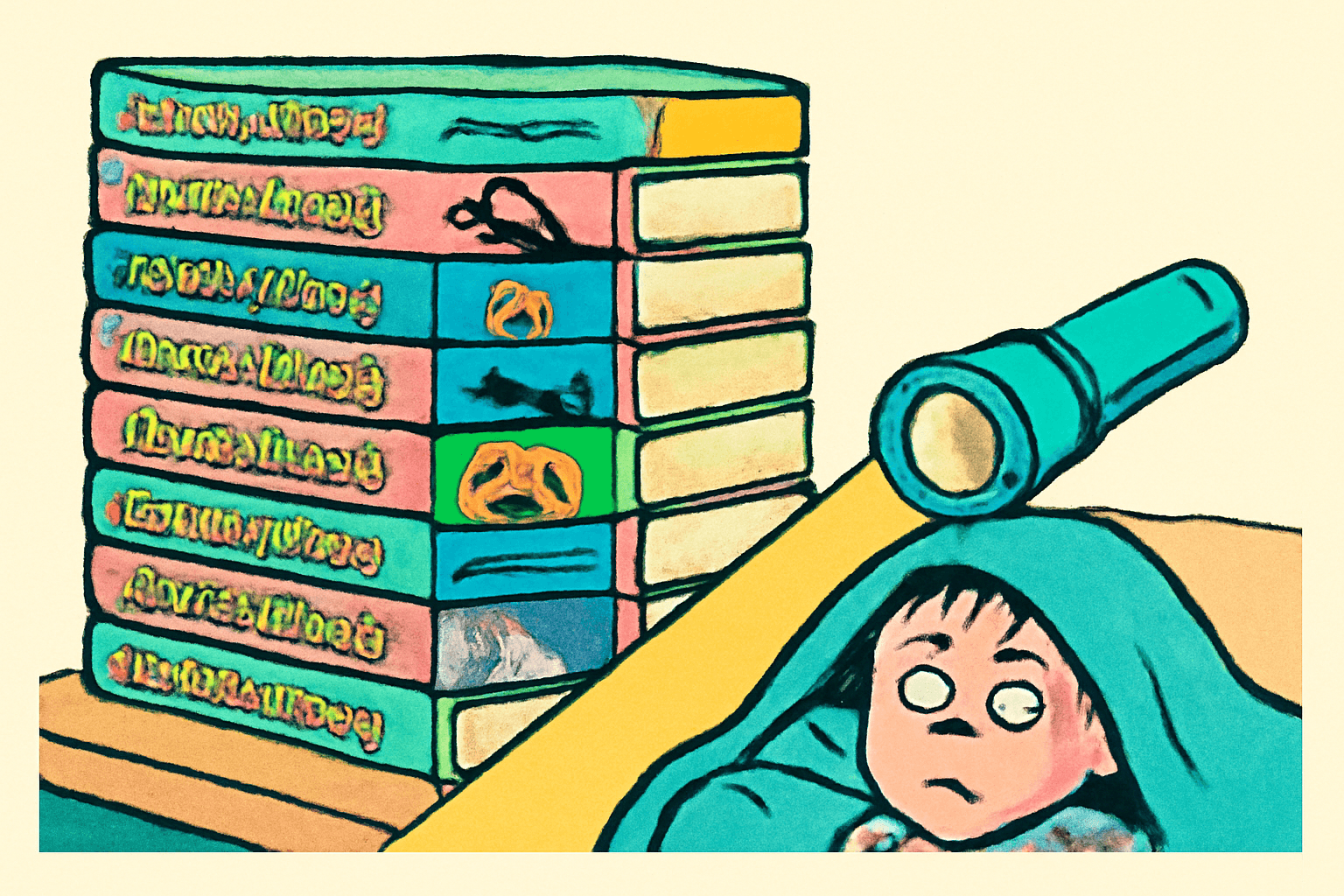
The lettering was raised. You could feel it. You'd run your thumb across the bumpy green letters that spelled GOOSEBUMPS before you even opened the cover, and something about that texture told your brain this is a real thing you are holding, and it might be dangerous. It wasn't dangerous. You were nine. You were in a school library. But the raised lettering didn't care about context. It meant business.
The covers did most of the heavy lifting. That curling, drippy font. The artwork that was always slightly too vivid - not cartoonish enough to dismiss, not realistic enough to be truly upsetting. A ventriloquist dummy with eyes that followed you. A camera leaking green slime. A dog turning inside out. Tim Jacobus painted every one of those covers, and he understood something critical: the image had to make a kid pick up the book, not put it down. It had to be scary the way a roller coaster is scary. You wanted to look.
I always looked.
The Scholastic Pipeline
The Scholastic Book Fair was the primary distribution system for Goosebumps and everyone involved knew it. R.L. Stine was putting out a new one practically every month, and Scholastic had them stacked on those folding tables like ammunition. You'd walk into the library - transformed for three glorious days into something between a bookstore and a carnival - and there they were. A whole row. Spines out, covers facing you, each one a tiny dare.
- Say Cheese and Die! - The evil camera. You took a picture and something terrible happened in it. Simple, devastating concept.
- Night of the Living Dummy - Slappy. The ventriloquist dummy who was alive. Spawned approximately nine sequels. Nobody asked for nine sequels. Slappy didn't care.
- Monster Blood - Green slime that wouldn't stop growing. That's it. That's the whole book. It was enough.
- Welcome to Dead House - The first one. The one that started everything.
- The Haunted Mask - Girl puts on a Halloween mask. Mask won't come off. Mask becomes her face. I thought about this every October for years.
The order form was almost worse. You'd get it weeks before the fair, and there they were in the little thumbnail images, three or four new titles you hadn't read. You'd circle them and hand the form to your parents with the casual energy of someone requesting a glass of water, as if you weren't asking them to fund a terror habit.
My mom never questioned the Goosebumps purchases. Not once. I think she was just glad I was reading. If she'd actually opened one and read the chapter where the kid gets locked in a coffin or the family dog gets replaced by a shapeshifter, she might have had follow-up questions. But the covers looked like Halloween decorations, not trauma, and the Scholastic logo was right there on the spine. Scholastic was safe. Scholastic sold erasers shaped like zoo animals. How bad could it be?
The Formula
Pretty bad, actually. In the best way.
R.L. Stine had a formula and it worked every single time. Kid moves to a new town, or goes to camp, or visits a relative's weird house. Something is off. The adults don't believe them. The friend might be part of the problem. Things escalate. Things get genuinely creepy. And then - the twist.
The twist ending was the whole point. You didn't read Goosebumps for the prose. You read it for that last page, that final paragraph where everything you thought you understood flipped upside down.
The kid defeats the monster, escapes the haunted whatever, gets home safe. You exhale. And then the last two sentences reveal that the neighbor's dog has glowing eyes, or the new kid at school is smiling wrong, or the thing in the basement isn't actually gone. The end.
It was a contract. Stine would scare you, then he'd let you go, then he'd yank you back for one final jolt. You knew it was coming every time, and it worked every time. That's craft. I don't care what anyone says. That man understood story structure better than half the writers on the bestseller list.
Reader Beware
The Give Yourself Goosebumps books were a different animal entirely. "Reader Beware - You Choose the Scare!" It was Choose Your Own Adventure with a horror skin and it was magnificent.
You'd get to the bottom of a page. "If you open the door, turn to page 73. If you run, turn to page 112." And you'd sit there, genuinely weighing the options, as if your decision mattered, as if the fictional child in the fictional haunted carnival would live or die based on whether you turned left or right. You kept a finger jammed in the page you came from, of course. Everyone did. That was the emergency exit. If you chose wrong and ended up dissolved in a vat of acid or trapped in a mirror dimension, you just flipped back and chose the other thing.
It was cheating. It was universal. Nobody played those books honestly. The whole point was the illusion of risk without actual consequence, which - now that I think about it - is basically the thesis statement of the entire Goosebumps empire.
The TV Show
Then the show happened. Fox Kids, 1995. That theme song with the dog barking and the door creaking. The opening credits with the "G" floating toward you. It ran for four seasons and it was, objectively, not very good. The child actors were doing their best. The special effects were doing less than their best. The monsters looked like what you'd get if a Spirit Halloween store had a film budget.
But it didn't matter. The show worked because the stories worked. The Haunted Mask was a two-parter that legitimately upset me. Night of the Living Dummy gave Slappy a voice and a laugh and I did not want either of those things. Say Cheese and Die had Ryan Gosling in it, which nobody knew at the time and everybody brings up now.
The TV show was appointment television in a way that's hard to explain to anyone who grew up with streaming. You watched it when it aired or you didn't watch it. If you missed it, you waited for the rerun. If you didn't catch the rerun, you just carried that gap in your Goosebumps knowledge forever.
The Gateway
Here's what nobody talks about enough. Goosebumps was a gateway drug and Stine was the dealer and he was operating in plain sight.
You'd start with Goosebumps in third or fourth grade. The scares were manageable. The twists were fun. You felt brave. And then one day you'd be at the book fair or in the library and you'd see the other shelf. The one with the slightly more grown-up covers. The one that said FEAR STREET.
Fear Street was R.L. Stine's line for older kids, and "older" meant twelve, which meant you were ready. Fear Street had teenagers. Fear Street had actual death - not just "the monster got you" death but stabbing, poisoning, people-actually-die death. Fear Street had dating and jealousy and parties where bad things happened. It was the next rung on the ladder, and Stine had built the ladder himself.
I picked up my first Fear Street in sixth grade because I recognized the author's name and because the cover had a cheerleader screaming, which seemed like a reasonable thing to investigate. It was called The New Girl and it was about a boy obsessed with a girl who might not exist. I finished it in one night. I was in.
Goosebumps taught you that scary things could be fun. Fear Street taught you that scary things could be real. And then you were ready for Stephen King, whether your parents liked it or not.
The Acceptable Level
That's what Stine figured out. The acceptable level of childhood terror. Not so much that a kid had nightmares - though some kids had nightmares, and those kids' parents wrote letters, and those letters were hilarious. Not so little that the books felt safe. Right there in the sweet spot where your heart beats a little faster and you keep reading past your bedtime and you check under the bed just once before you turn off the light. Not because you believe there's something there. But because R.L. Stine made you consider the possibility, and considering the possibility was the whole thrill.
Sixty-two original books. Dozens of spin-offs. A TV show. Movies, eventually, decades later. The man sold four hundred million copies. But I don't think about the numbers. I think about the raised lettering under my thumb. I think about sitting cross-legged on the carpet at the Scholastic Book Fair, reading the first chapter of Welcome to Camp Nightmare because my mom said I could only pick two and I was trying to decide.
I think about the formula. The kid, the monster, the twist. The permission to be scared and the promise that the fear had edges. That it started on page one and ended on page 120 and when you closed the book, the scariest thing in your room was the dark, same as always.
That was the deal. Stine kept his end of it. Every single time.
Somewhere in a box in a closet, there are thirty-odd paperbacks with cracked spines and yellowed pages and raised green letters you can still feel if you close your eyes. You'll never read them again. But you'll never get rid of them, either. Some doors, once opened, stay open. Turn to page 1 if you understand.