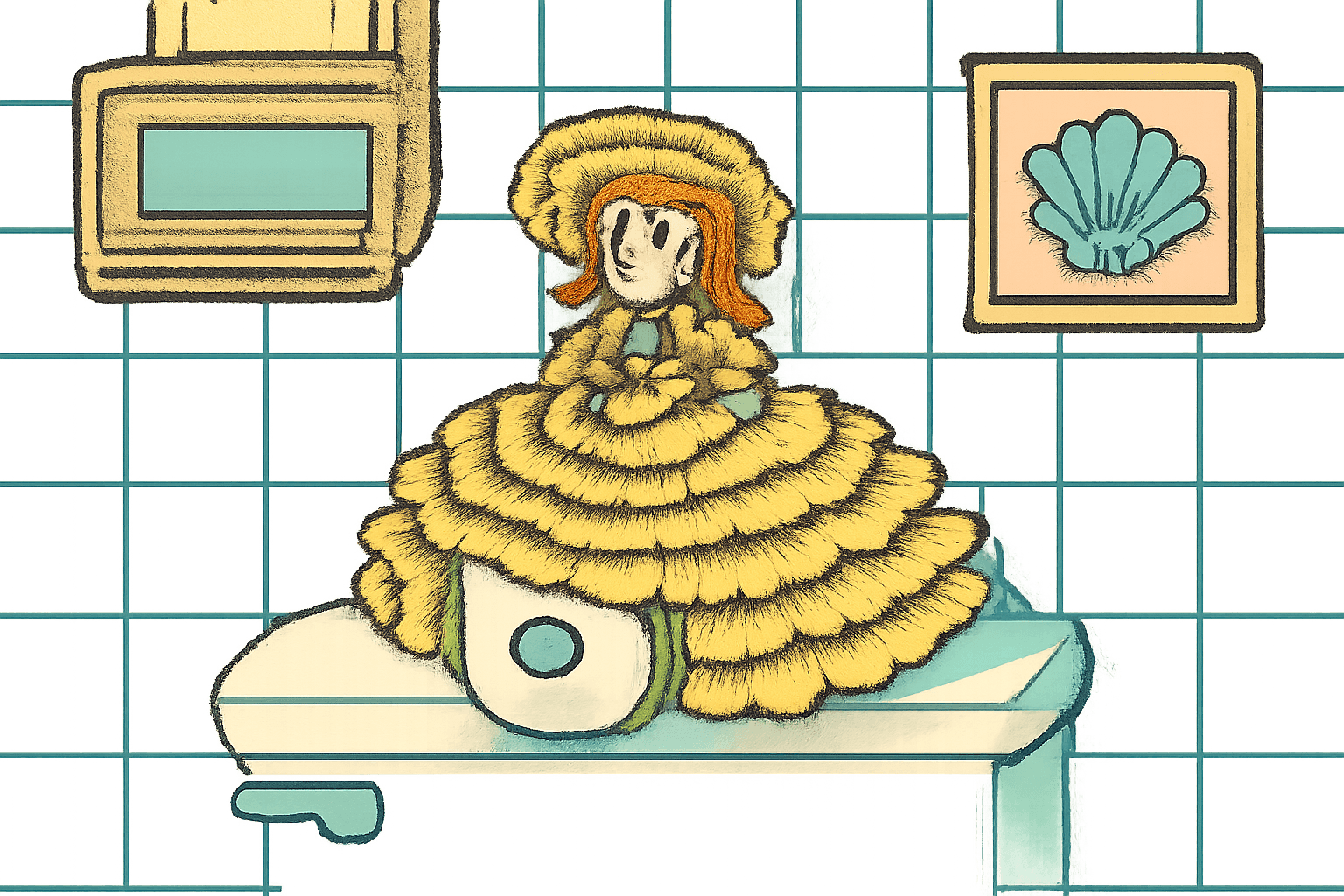
You were six years old, at your grandma's house, and you went to use the bathroom. Everything in that bathroom was pink. Pink tile. Pink rug. Pink soap shaped like a seashell that you were not allowed to touch. And on the back of the toilet tank, sitting there like she lived there, like she had always lived there, was a doll.
She was wearing a ball gown. An enormous one. The skirt flared out into a perfect dome that took up the entire back of the toilet, and the skirt was crocheted, and the top of the skirt was a plastic Barbie torso in a little crocheted bodice with tiny pearl buttons, and she had a tiny crocheted hat, and her hair was yarn, and you thought: why is there a doll on the toilet.
And then you picked her up.
Under the skirt was a roll of toilet paper. Just sitting there. The doll had been a lid this entire time. The doll was a hat for toilet paper. The doll's whole job was to cover the toilet paper so nobody would have to look at it, as if toilet paper were a problem that decor could solve.
The Southern Belle Industrial Complex
There was no name for these things. Or if there was a name, nobody used it. You never heard an adult say "where's the crocheted toilet paper cozy in the shape of a Southern Belle." They just existed, in every grandma's bathroom, in roughly the same three color schemes - pink and white, peach and cream, or for the rebels, powder blue and lavender.
They were handmade. Always. Not handmade in the cottagecore Etsy sense. Handmade in the your grandma's friend Pat made forty of them over one winter sense. Pat made them. Doris made them. Your own grandma made them if she was in a certain phase. They showed up at craft fairs in church basements, arrayed on a folding table next to the potholders and the Christmas ornaments made out of clothespins, and they cost somewhere between four and seven dollars, and Pat would not take a check but she would take a five and tell you to keep the change.
The doll on top was not a real Barbie. It was a Barbie-shaped object. A three-dollar knockoff from the craft store with slightly wrong proportions and a face that looked like Barbie if you were describing her to a sketch artist. The head was a little too big. The eyes pointed in slightly different directions. But the skirt was magnificent, and the skirt was the whole point, and nobody was looking at her face anyway.
The Three Layers
Let's be clear about the engineering. This was a three-layer device.
Layer one: The doll torso. Plastic, rigid, with articulating arms that you were absolutely not supposed to move but that you definitely moved the first time you picked her up, and then you couldn't get them back into their original pose and you panicked.
Layer two: The skirt. A crocheted dome, usually worked in the round with some kind of ruffle pattern that created tiers - three tiers, four tiers, occasionally a truly ambitious five-tier number that indicated Pat was going through something. The skirt was stiff. It had been treated with sugar water or starch or some grandma-pharmacopeia mixture that made it hold its shape for decades. You could tap it with your fingernail and it made a sound.
Layer three: The secret. A single roll of toilet paper, nestled inside the skirt like a surprise at the center of a piñata. Virgin white. Untouched. A backup. A just-in-case. A roll of toilet paper that would never be used, because the real roll was on the holder next to the toilet, and by the time you needed the backup your grandma would have already noticed and gotten up and walked to the linen closet, because she was that kind of grandma.
- The tissue box (crocheted cube)
- The KitchenAid mixer (crocheted tarp)
- The toaster (crocheted tarp with a little handle)
- The cold cream jar on the vanity (tiny crocheted beret)
- The spare roll of paper towels in the kitchen (a crocheted rooster)
- The landline phone on the hallway table (crocheted cozy shaped like a cat)
- Literally anything your grandma could reach
Why
I have thought about this a lot, and I think the answer is not "to hide the toilet paper." The answer is that grandma did not believe any object should exist uncovered. Grandma had opinions about nakedness as a general principle, and those opinions extended to furniture, kitchen appliances, and paper goods. A bare roll of toilet paper was a roll of toilet paper that had not yet been dressed. And grandma had crocheted her entire life specifically so that nothing in her house would ever have to be naked again.
This is not a joke. Her couch had covers on the cushions, and her cushions had doilies on the armrests, and her doilies had little glass cups on them, and the glass cups had coasters under them even though the cups were the coasters, and the coasters were probably crocheted too. Grandma lived inside a nested system of textile protection, a russian doll of fabric and yarn, and the toilet paper doll was just one small node in that system. It was not strange. It was consistent. It was the most consistent thing in the house.
The doll was not trying to disguise the toilet paper. The doll was trying to dignify the toilet paper. There is a difference, and your grandma understood it.
The First Discovery
I want to talk about the moment you realized what she was.
You were little. You had been staring at the doll for a while, maybe trying to figure out why she had a skirt so big it seemed architectural, and you decided - with the full confidence of a six-year-old who has never been told no in a convincing enough way - that you were going to investigate.
You picked her up by the torso. The skirt came with her. You expected the skirt to be attached to something, to be a decoration on a little stand. Instead, the skirt lifted cleanly off the toilet tank, and underneath it, there was a roll of toilet paper, white and round and obvious, looking back at you like it had been caught.
Your brain did a small acrobatic thing. The doll is a hat, it said. For the toilet paper. And then, a second later: This is something adults decided to make on purpose. And then, a third second later: I am going to put this back exactly the way I found it and we are never going to discuss this.
You lowered the doll back down. You adjusted her skirt until it looked right. You washed your hands with the seashell soap that you were not allowed to touch, because the seashell soap was part of the same system, and you understood now that you were living inside a museum of small rules and quiet rituals, and you were going to respect them even if you did not understand them.
The Craft Fair of It All
It's worth saying: an entire economy ran on these things in the late eighties and through the nineties. Church craft fairs. School holiday bazaars. The folding tables at flea markets. The back room of the fabric store where the ladies gathered on Tuesday mornings and drank coffee out of mugs with their grandchildren's names on them and crocheted toilet paper dolls for twelve dollars a pop while talking about someone named Barbara who had done something unforgivable at the parish council meeting.
The patterns were handed down. Literally handed down, on mimeographed sheets stuck in a three-ring binder. Southern Belle Toilet Tissue Cover. Ruffled Princess Commode Companion. Victorian Lady Bathroom Accent. They had names. Someone had written these patterns. Someone had sat down with a pencil and a pad and a ball of yarn and reverse-engineered the exact stitch count needed to cover a standard American roll of toilet paper, and then she had shared that pattern with her friends, and her friends had shared it with their friends, and that was how culture worked before the internet, which is to say: slowly, locally, and with great attention to toilets.
The Decline
Nobody makes these anymore. I mean, somebody does - there is an Etsy listing somewhere, there always is - but the mass production is gone. The craft fair circuit has thinned out. The ladies who made them have moved on to other things or to other places, and the dolls that survive are the ones that were made in 1992 and are still sitting on the same toilet tanks they were placed on thirty years ago, in houses that are now owned by the grandchildren of the women who made them.
I know one person who still has one. It's in her guest bathroom. She didn't buy it. Her grandmother made it, and when her grandmother's house was being cleaned out, the doll came home with her, and she put it on the back of the toilet because that is where the doll lives. She doesn't think about it. She does not curate it. It just sits there, in a bathroom in a city hundreds of miles from the church basement where it was born, covering a roll of toilet paper that has been the same roll of toilet paper for six years because nobody has ever needed to use the backup.
The Thing About the Doll
I think about her sometimes. Not the specific one at my grandma's, because that one is gone, along with the house and the pink tile and the seashell soap and the grandma herself. I think about the idea of her. The commitment it took to decide that the problem with a roll of toilet paper was not that it was uncomfortable or expensive or hard to reach, but that it was ugly. And that the solution was a doll.
It's so absurd. And so sincere. And so specifically the product of a moment - a generation of women who had time and yarn and church friends and a deep, unshakable belief that a home should be dressed. Not decorated, exactly. Dressed. Like a person.
My grandma didn't have a design philosophy. She had a doll on the back of the toilet and a doily under the telephone and a plastic runner on the carpet, and together those things were a philosophy, even if nobody ever said it out loud.
The other day I was at a friend's house and I noticed there was nothing on the back of her toilet. Just porcelain. A clean, modern surface. Very tasteful. Very intentional. And I stood there for a second and I thought about the doll, and about Pat, and about my grandma's friend Doris who made the blue one with the lavender ruffle, and I thought: we lost something when we decided that the back of the toilet should be empty. I don't know what, exactly. Maybe just the idea that somewhere in the world there was a woman who thought a toilet should have a doll on it, and who made one, and who gave it to my grandma, and who expected my grandma to keep it forever. And who was right.