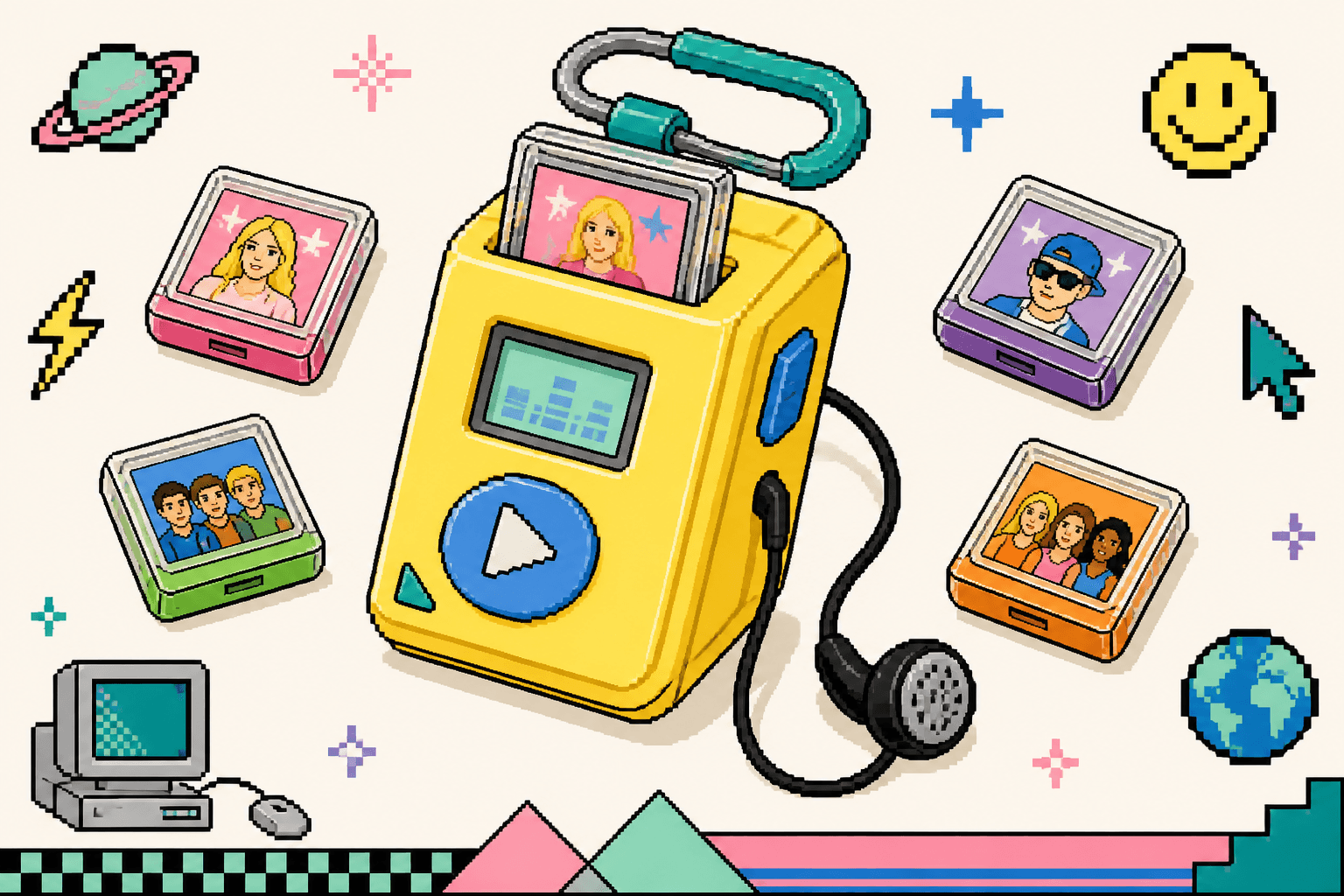
The Hit Clip player was a piece of yellow plastic the size of a pack of gum. There was a slot in the top of it, the size and shape of a Chiclet. You slid in a separate piece of plastic, also the size of a Chiclet, with a sticker on it that said BRITNEY SPEARS or BACKSTREET BOYS or SMASH MOUTH, and you pressed play, and you heard, for exactly sixty seconds, a tinny lo-fi version of one song. Then it stopped. If you wanted to hear it again you pressed play again. If you wanted a different song you had to buy a different cartridge for four dollars.
This was 1999. We thought this was incredible.
The Cartridge
The Micro Clip - this was the actual name of the cartridge - was about three centimeters across. It had no moving parts. It was a piece of injection-molded ABS with a label sticker on one side and a printed band name on the other. Inside it was, presumably, a chip with about a megabyte of audio, encoded in some Tiger Electronics proprietary nonsense format that you could not extract, could not copy, could not back up. The cartridge had a finite life. The cartridge would eventually, if you kept clicking it in and out, stop reading. There would be a faint static and then nothing. That was a four-dollar piece of cheese.
You bought them in blister packs. Two for $7.99 at Limited Too. Three for $9.99 if there was a sale at Claire's. The blister had a clear plastic dome over the cartridge, a cardboard backing with an airbrushed press photo, and a little cutout window so you could verify that yes, that is in fact what a one-inch cube of plastic looks like.
You collected them. You kept them in the matching plastic tray that came with the player, the little six-slot organizer. You arranged them by color, or by artist, or by which one you played most. You traded them at recess. You loaned them and never quite got them back.
The Player
The player itself was a rectangle of soft-touch plastic, in bright crayon colors - lemon yellow, neon green, hot pink, the occasional teal. It clipped to your backpack with a little carabiner. It took two AAA batteries that lived just long enough to make you trust it before going dead in the middle of the second chorus while you were waiting at the bus stop.
The headphone jack was a single-ear earbud. Singular. The headphone they shipped with the unit had one ear. You shared the other ear with whoever was standing next to you. This was the design.
The headphone they shipped with the unit had one ear. You shared the other ear with whoever was standing next to you. This was the design.
The audio was - and I want to be careful here, because nostalgia softens these things - genuinely bad. An 8-bit-feeling lo-fi smear. The bass was nowhere. The treble had been replaced with hiss. The vocal was the only thing approximately legible, and even that arrived through a thin plastic membrane that sounded like the singer was performing inside a Tupperware container. You knew this. Everyone knew this. Nobody seemed to mind.
The Sixty Seconds
The clip was sixty seconds. Not a sample. Not a teaser. The clip. That was the song, to you.
The labels chose what sixty seconds you got. Usually the chorus. Sometimes the chorus plus half a verse. Sometimes - and this was the funniest version - they would give you the second-best part of the song, because the best part was technically the bridge, which arrived at minute three of a four-minute single, and the Hit Clip would simply skip the first half and dump you into the bridge, and then end. You'd hear the song lift, build, build, almost arrive somewhere, and then a hard cut to silence.
This was the format. Less a song than a promise of a song, abruptly retracted.
And the genius of it - I am using genius here in the very specific marketing-engineer sense, which is to say evil - was that it left you wanting more, and the more was another cartridge, and the cartridge was four dollars.
The Math
Let me do the math we did not do at the time.
A pop album in 2000 was about fourteen tracks and cost around $13.99 at Sam Goody. A Hit Clip cartridge held one song, partially, and cost about $3.99. To assemble the same album in Hit Clip form would have cost, very roughly, fifty-five dollars. For audio that sounded like it was being broadcast from inside a coffee can.
We did not do this math. The math was beside the point. The Hit Clip was not, in any practical sense, a music format. It was a novelty. It was a way of carrying around a Britney Spears chorus, on a clip, on your backpack, for show. The fact that it played music was a bonus. The thing was the form factor.
The Hit Clip was not, in any practical sense, a music format. It was a novelty. A way of carrying around a Britney Spears chorus, on a clip, on your backpack, for show.
Music in 2000 was already free. You could record it off the radio onto a tape. You could download it, slowly, off Napster. You could borrow your friend's CD and burn a copy at home before dinner. The Hit Clip was, against this backdrop, an absurd thing to pay for. We paid for it anyway, because it was cute, and because it had a label on it, and because it clipped onto your backpack and you could pull it out at lunch and show somebody.
The Tier System
The cartridges were color-coded by label. Jive was one color. Sony was another. The boy bands tended to cluster around blue and silver. The pop divas were pink and purple. Aaron Carter had his own shelf. So did Smash Mouth, briefly, in a way that suggested an executive somewhere had wildly overestimated how many Smash Mouth Hit Clips a kid would buy.
The store displays at Limited Too were like trading-card walls. Cartridges hung in long pegboard strips, sorted by genre, like baseball cards if baseball cards held ninety seconds of "Larger Than Life." You scanned the wall. You picked your two. You felt a tiny pang for the ones you couldn't afford. You walked out with a paper bag and a receipt that said HITCLIP - $3.99 twice.
There was a brief sub-product called the Hit Clips DJ Mixer, which let you load two cartridges at once and crossfade between them. The crossfade did not really work. The audio went lo-fi-er. The faceplate had glitter on it. It sold, at least at my elementary school, exactly once, to one girl whose dad worked for Hasbro and who had access to merchandise none of us could buy.
The Discontinuation
Hit Clips were killed by the iPod. Not directly. Tiger Electronics ran the line through about 2004 with diminishing enthusiasm and one last attempt - a player that included FM radio reception, which was actually the most useful version of the unit and which nobody bought, because by then you had a Discman with anti-skip in your backpack and a wallet of burned CDs and the math had gotten very unfavorable.
The cartridges sat in drawers. Then in shoeboxes. Then in donation bags. Most of them are landfill now, or at the bottom of plastic bins in storage units somebody's mom can't bring herself to throw out. The audio on them, if you could extract it - and you cannot easily, because the format was proprietary and the company is essentially gone - would still be sixty seconds long. Would still be the chorus and a bit. Would still cut, hard, into silence at exactly the moment you wanted it to keep going.
The thing I keep coming back to is that we were already doing it. We were already buying songs one at a time. We were already paying for the chorus and not the verses. We were already accepting that the audio quality was, technically, terrible. We were already clipping a device to our person that quietly broadcast which songs we had purchased.
We just thought it was a phase.
The Hit Clip was, in retrospect, a tiny working prototype of every digital music economy that came after it. A subscription you didn't subscribe to. A single you couldn't transfer. A song you owned in some sense and did not own in any other sense. A cartridge that would, eventually, stop reading.
We paid sixty seconds at a time. We kept the cartridges in a little tray.
The cartridges are gone. The economy is the same.