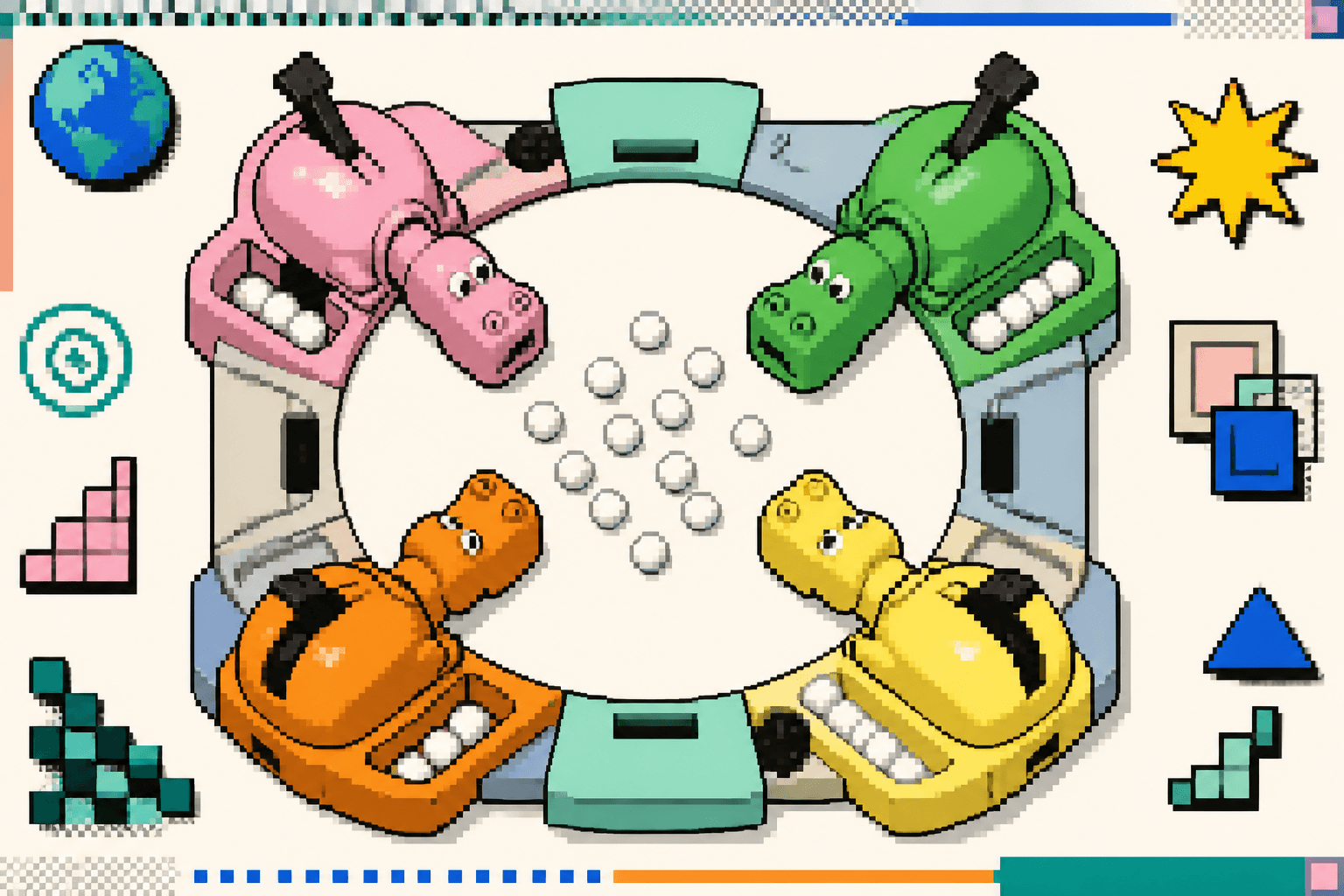
The sound came first.
Not one sound. A wall of them. Four plastic levers being slammed at once by four kids who had forgotten, inside of thirty seconds, that they were in a house. The hippos didn't make noise. The hippos opened their mouths. What made the noise was the mechanism - the little plastic linkage between lever and neck - and the marbles, twenty of them, ricocheting around a hollow circular arena the size of a dinner plate. It sounded like someone had thrown a bag of ball bearings into a dryer and turned it on.
It lasted thirty-eight seconds.
Then it took eleven minutes to find the marbles.
The Setup
Hungry Hungry Hippos was made by Milton Bradley, which is a sentence that feels, now, like the start of a courtroom deposition. Ages 4 and up. Two to four players. Contents: one plastic base, four plastic hippos in four colors, twenty marbles, and a sheet of stickers you were supposed to apply to the hippos to give them faces.
The stickers were always wrong. The eye was never centered on the eye socket. Somebody's older brother had done it in 1991 and now the yellow hippo looked like he was high.
The ritual was this. You unfolded the four hippo stations - each one a plastic head on a long neck, connected at the back to a tail-shaped lever - and clipped them onto a round white base. You opened the little drawer under the base and poured the marbles into the arena. You picked your color.
Everybody wanted green.
Everybody wanted green. If you got yellow you had drawn the short straw and you were already losing before the first marble dropped.
Nobody knows why. Maybe because green was the Zubaz color, the Nickelodeon color, the frog color, the whatever. Green was the thing. If you got green you had already won something. If you got yellow you had drawn the short straw and you were already losing before the first marble dropped.
- Green (Lizzie): The one everybody wanted. If you were the oldest kid, you got green. If you weren't, you learned how adults negotiated.
- Orange (Henry): A respectable second. Orange had a slightly better mouth angle. I have no proof of this. I was nine.
- Pink (Harry): The one the youngest sibling got stuck with and then defended for the rest of their life.
- Yellow (Homer): The one nobody wanted. Yellow was the leftover. Yellow was fine, I guess.
The Strategy
There was no strategy.
Or rather, there was exactly one strategy, and it was mash the lever as fast as you can. That was the game. The hippo opened its mouth when the lever went down and closed its mouth when the lever came back up, and if a marble happened to be in the mouth at the moment it closed, you kept the marble. That was the mechanism. There were no advanced techniques. There were no feints. The game was mashing the lever, and the kid who mashed fastest, won.
The game was mashing the lever. The kid who mashed fastest, won. The physics ended there.
Some kids tried to invent strategy. You wait, they'd say, breathless. You wait until the marble lines up with your hippo and then you go. This was nonsense. The marbles were moving at approximately the speed of a scared mouse. You could not wait for anything. By the time you had identified a marble as yours, three other hippos had closed on it, and the only hippo that got it was the one whose lever was going the fastest.
The lever had a travel distance of maybe an inch and a half. You pumped it with your index finger, hundreds of times a minute, like you were trying to resuscitate a very small flat animal. Your finger went numb. You did not care. There were still marbles.
The Failure Modes
The game broke constantly.
The hippos were made out of hard plastic, and the levers were held on with small plastic pins, and the pins were not engineered for the kind of child who was willing to break a game to win it. The first failure was always the same. A hippo's mouth got stuck open. You'd press the lever and the mouth would move freely but the spring that was supposed to pull it shut had come loose, and now your hippo was just sitting there with its jaw hanging open, which, incidentally, is also how we played the game.
The second failure was a marble getting jammed. A marble would wedge itself between the arena wall and the back of a hippo's neck at exactly the right angle, and now none of the hippos could extend fully, and you had to turn the whole thing upside down and shake it, which produced a sound like somebody pouring dry beans into a tin can.
The third failure was the stickers peeling off. The hippo's eye would find its way, mid-mash, onto the arena floor, and the yellow hippo, already the losingest hippo, was now also blind.
- The marble under the couch. (Always.)
- The lever that stuck. (By game three.)
- The hippo that would not return to its base. (Someone sat on it.)
- The arena sliding off the carpet mid-game, dumping marbles into a heating vent. (Guess who.)
- The spring. The spring was never recoverable. The spring was always gone.
The Marbles
The marbles.
Listen. You do not know where they are. You never knew where they were. Every Hungry Hungry Hippos game, every single one, every household, every basement, every cousin's playroom, was missing marbles. The box said twenty. You had, at any given time, sixteen. Two had gone under the couch. One had gone into the register. One had gone into a shoe, and that shoe had been donated to Goodwill in 1998, and somewhere in the world there is a stranger who owns one Hungry Hungry Hippos marble and does not know it.
The box said twenty. You had, at any given time, sixteen.
The marbles were small, slightly smaller than a standard playing marble, with the glossy finish of a cheap decorative orb. They looked like Mentos. For a brief, bad period in every household with this game, a four-year-old tried to eat one. They were pulled from the kid's mouth by a parent and then, confusingly, returned to the game. We were less precious about choking hazards back then.
Thirty Seconds
Mash the green lever. The other three are mashing too. Whoever eats the most marbles when the arena is empty, wins.
If your finger starts to hurt around marble twelve, that is the correct amount of pain. That is historically accurate.
Why We Played
The game was over in forty seconds. That was its longest game. Its shortest game was fifteen seconds, which happened when one kid - call him Kevin, because there was always a Kevin - realized he could reach across the board and mash two levers at once. This led to a fight. The fight lasted longer than the game. The fight almost always lasted longer than the game.
And yet we played it again. Twenty seconds of pure plastic noise, then eleven minutes of marble hunting, then we'd set it up again and do it one more time, and if your dad was downstairs reading the paper and he heard the sound start up for the third time he would yell something incoherent through the ceiling and we would ignore him and go harder.
What It Was Actually For
It wasn't about winning.
I mean, it was. Everybody wanted to win. Winning meant marbles, and marbles meant you were the fastest, and being the fastest meant you had something over your siblings until dinner. But the actual point of Hungry Hungry Hippos, the thing we were doing when we played it, was making noise. We were four kids in a living room with permission to be as loud as we could be, as hard as we could be, for forty seconds at a time. It was sanctioned chaos. It was the only game designed, structurally, to produce a sound that would make an adult leave the room.
Most of the games we played were quiet. Memory. Candy Land. The Game of Life. All of them were stare at a board and take turns. Hungry Hungry Hippos was permission to flip the table. It was a game where sitting still cost you. Where thinking cost you. Where every evolved human instinct that said pace yourself, consider the options, plan ahead was punished. The game rewarded one thing, which was going faster than you could think.
That was the appeal. You were allowed, for forty seconds, to be a dumb fast animal. You were allowed to not strategize. You were allowed to just mash.
Nobody keeps Hungry Hungry Hippos.
I mean - it still exists. You can buy a new one. They still make it. But the one you had, the one with the yellow hippo whose eye had come off, the one with the stuck spring and the fourteen marbles - that one is in a landfill. It got donated or broken or repacked into a box in a basement and then that basement got cleaned out and the game went to Goodwill and nobody bought it because its box was taped shut with three different kinds of tape and the Goodwill was selling it for $2.
I think about where those marbles are. They're somewhere. Somebody vacuumed them up and threw them out. Somebody found one in a couch cushion in 2004 and had no idea what it belonged to and threw it away. There are, scattered across America, tens of thousands of stray Hungry Hungry Hippos marbles in heating vents, behind baseboards, in the kind of place where things end up when nobody is paying attention. A small, decentralized reserve of plastic orbs, waiting for nothing in particular.
I liked that game. I liked the noise. I liked that I was allowed to mash.