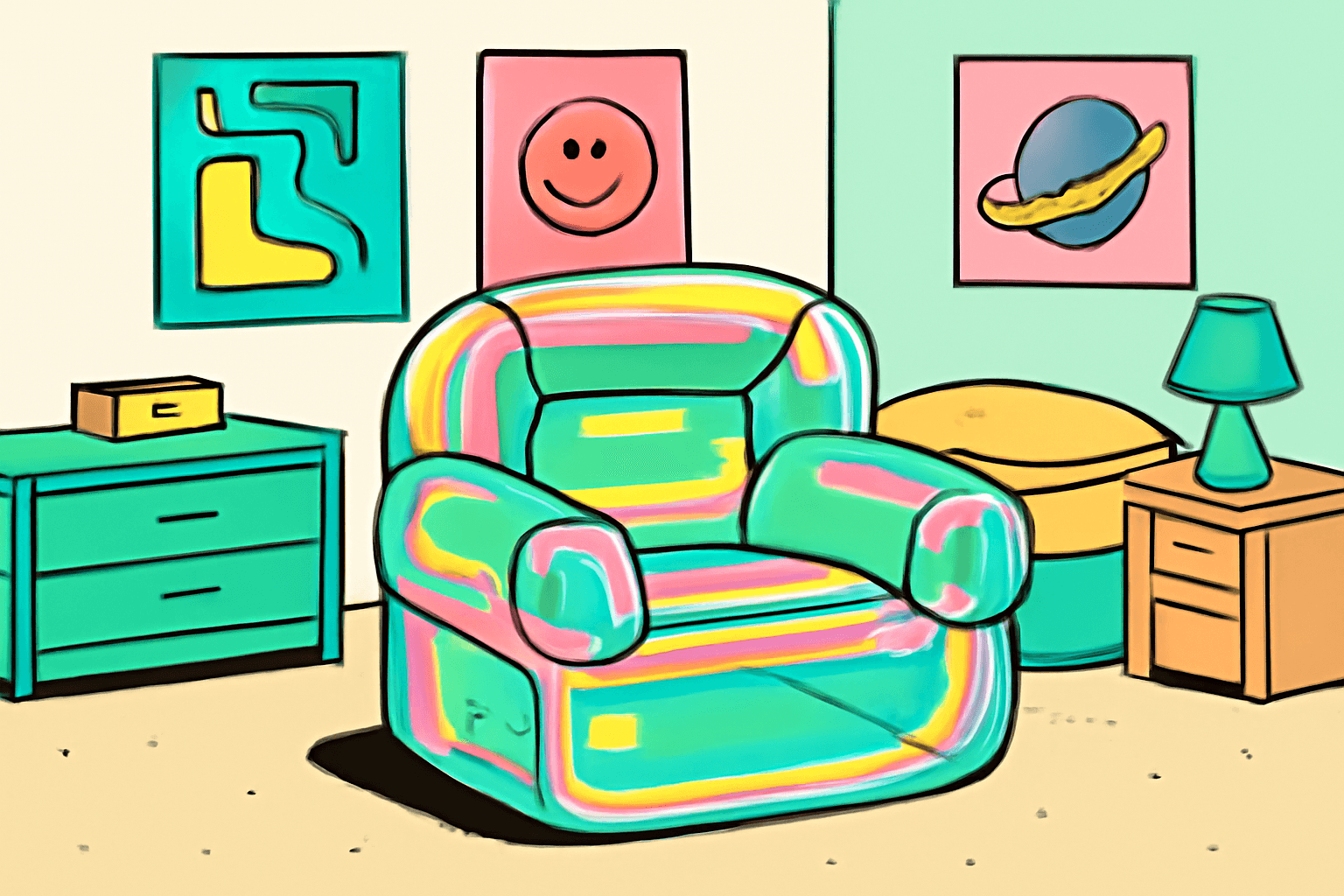
The chair was clear. Completely transparent, like a jellyfish that had been inflated with a bicycle pump and placed in the corner of your bedroom. It was from dELiA*s - page forty-something, right between the butterfly clips and the platform sneakers - and it cost thirty-five dollars, which in 1998 money meant you had to campaign for it like it was a Senate seat. You circled it. You dog-eared the page. You left the catalogue open on the kitchen counter, strategically, like a lobbyist.
And then one day it showed up. In a box. Flat.
Because that was the thing about inflatable furniture that the catalogue failed to communicate. It didn't arrive as furniture. It arrived as a folded sheet of PVC in a box the size of a pizza. You had to make it into a chair. With your lungs. Or with the pump, if you were lucky enough to get one that actually worked, which you were not.
The Inflation
The pump was a joke. A small plastic foot pump, usually, the kind that wheezed more than it inflated. You'd stomp on it for twenty minutes and the chair would look like a half-filled water balloon with ambitions. So eventually you'd abandon the pump and go mouth-to-valve, which meant blowing directly into a piece of plastic that tasted like a shower curtain.
You'd blow and blow and blow until you saw spots. Your cheeks hurt. Your ears popped. You had to take breaks where you just lay on the floor and stared at the ceiling, lightheaded and vaguely regretting your life choices. Your little brother would offer to help and somehow let all the air out of one chamber while you were working on another. The whole process took the better part of an afternoon.
You'd blow and blow and blow until you saw spots. Your cheeks hurt. Your ears popped. The catalogue had not mentioned any of this.
And then, finally, it was done. A chair. Sort of. It sat in your room like a giant transparent mushroom, wobbling slightly, smelling like a pool toy. You sat down in it and the vinyl made a sound that no human should have to explain to their parents. A long, slow, unmistakable squeak that sounded exactly like what you think it sounded like. Every time you shifted. Every single time.
The Sitting Experience
Let's talk about what it actually felt like to sit in an inflatable chair. It was terrible. It was genuinely, memorably terrible.
In the winter, the vinyl was cold. Like sitting on a trash bag full of refrigerated air. Your body heat never warmed it up - it just made you cold. In the summer, which is when most people owned these things, the vinyl was a different kind of nightmare. It stuck to your skin. Your bare arms, your legs if you were wearing shorts - everything adhered to the surface like cling wrap on a bowl of leftover pasta. When you stood up, it peeled off your skin with a sound that was somehow worse than the sitting-down sound.


You'd sweat. That was the other thing. Sitting on sealed plastic in a room without air conditioning - which described most of our bedrooms - meant you were essentially sitting in a humidity chamber. The sweat would pool in the little creases of the chair. You'd stand up and there'd be a damp outline of your body, like a crime scene in a very sad police procedural.
And the whole time you were sitting there, sweating and squeaking, the chair was sinking. Slowly. Imperceptibly at first, but definitely sinking. By the time you finished watching one episode of TRL, your butt was three inches closer to the floor. You'd have to get up, find the pump, stomp on it for a while, realize the pump was broken, blow into the valve again, get lightheaded again, and sit back down. This cycle repeated daily.
The Death
Every inflatable chair died the same death. Sometimes it was fast - the cat walked across it and a single claw turned thirty-five dollars into a pile of garbage. Sometimes it was slow - a pinhole leak you couldn't find, the chair deflating overnight like a soufflé with depression, so that every morning you'd wake up basically sitting on the floor inside a vinyl taco.
My chair lasted about ten days. My friend Megan's lasted even less because she had two cats and a younger brother who thought it was a wrestling mat. She patched it with a Band-Aid, which tells you everything you need to know about the engineering standards we were working with. The Band-Aid held for about four hours.
The chairs all ended up the same way. Deflated, folded, stuffed in a closet. Then eventually dragged to the curb on trash day, looking exactly like what they were - a flat sheet of plastic that had briefly pretended to be furniture. No ceremony. No eulogy. Just landfill.
The chairs all ended up the same way. Deflated, folded, stuffed in a closet. Then dragged to the curb on trash day, looking exactly like what they were.
The Translucent Moment
But here's the thing I keep coming back to. The inflatable chair wasn't an isolated incident. It was part of something bigger - this obsession the late 90s had with transparency. With seeing through things. The Bondi Blue iMac came out in 1998 and it was translucent, and suddenly everything had to be translucent. The Game Boy Color went see-through. Phones went see-through. You could buy a transparent toaster. We wanted to see the guts of everything, the wires and the mechanisms, as if visibility was the same thing as understanding.
The inflatable chair fit right into that. It was furniture you could see through. Furniture that revealed itself completely - no wood grain, no upholstery, no mystery. Just air. You were sitting on air and you could watch yourself sit on air and somehow that was supposed to be cool.
And it was cool. That's the part that's hard to explain now. It was genuinely, unironically cool. When you saw that chair in the dELiA*s catalogue or in the window at Limited Too, nestled between the body glitter and the mood rings, something in your twelve-year-old brain said yes. That is the future. That is what my room needs. That clear, squeaky, slowly deflating chair is the object that will transform my space from a child's bedroom into something else. Something older. Something that says I have taste.
What We Were Really Buying
We weren't buying furniture. Obviously. A thirty-five-dollar bag of air is not furniture. We were buying the version of ourselves that the catalogue promised - the girl in the photo, sitting cross-legged on her inflatable chair, talking on her clear phone with the neon guts, surrounded by a lava lamp and a bead curtain and a poster of Hanson or the Backstreet Boys. That girl was never sweating. That girl's chair was never deflating. That girl didn't have a cat.
The catalogue was a lie, but it was a beautiful lie, and we all agreed to believe it together. The whole aesthetic - the inflatable, the translucent, the neon, the glitter - was a shared hallucination. We looked at a piece of pool furniture and collectively decided it was a chair. We looked at discomfort and called it design.
I think about that chair sometimes. Not with fondness, exactly. More like the way you think about a sunburn - you remember the feeling, the specific wrongness of it, and you can almost feel the vinyl peeling off the back of your thighs. The squeak. The slow sink toward the floor. The faint chemical smell that never fully went away.
Somewhere in a landfill, that plastic is still intact. PVC doesn't biodegrade. It'll be there for centuries, long after anyone remembers what it was or why we wanted it. A clear chair, holding nothing, sitting in the dark. Still not decomposing. Which, if you think about it, means it actually did last forever. Just not in the way we hoped.