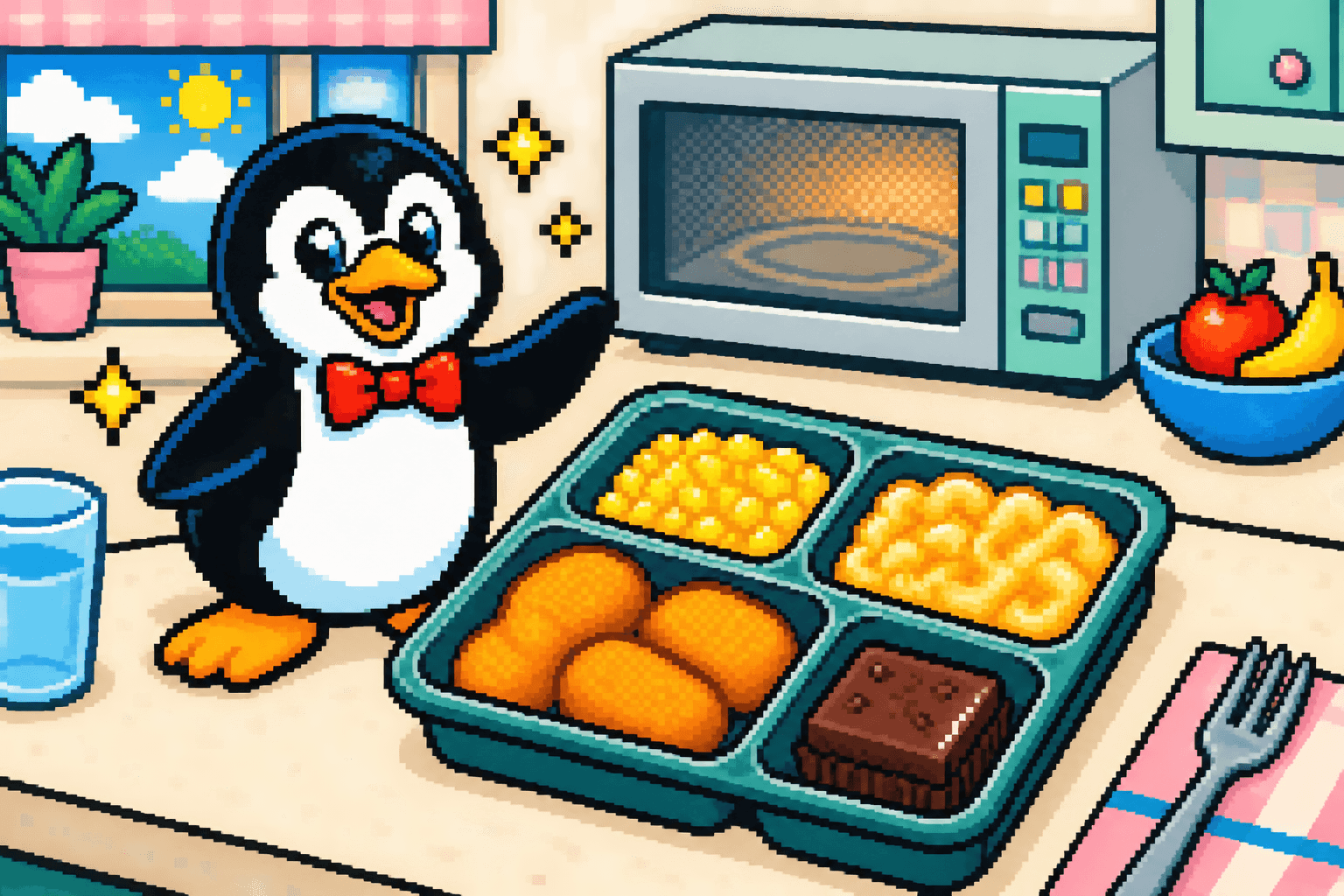
You were nine. It was a Tuesday. Your mom was on the phone with your aunt about something involving your cousin and a car, and dinner, tonight, was whatever you could get out of the freezer and into the microwave without asking.
You pulled the Kid Cuisine out from behind a bag of frozen peas. The box was cardboard and had a picture of a cartoon penguin in a red bow tie standing next to a tray, doing a thumbs up, next to the words Magical Cheese Stuffed Crust Pizza or Chompin' Chicken Breast Nuggets or one of the other five names they had. You did not read the name. You had made this decision at the grocery store, on a different day, and it was final.
You took the plastic tray out of the box. You peeled the film halfway back, per the instructions on the side of the box, which said to peel it halfway because the corn compartment needed to breathe. You put it in the microwave. You set it to four minutes on high.
You watched the tray spin.
The Penguin's Name Was KC
His full name was KC the Penguin. He was the mascot.
He was on every box, doing something wholesome and slightly deranged. Surfing on a chicken nugget. Skiing down a mound of mashed potatoes. Playing hockey with a hamburger. He wore the red bow tie in every appearance, which was the only thing you could rely on. Everything else about him was in flux.
He was, in retrospect, a strange choice. Penguins are cold. Penguins live in cold places. The visual grammar of a penguin is I am at home in this ice, and Kid Cuisine, as a product, was fundamentally about the failure of a microwave to fully heat a compartmentalized tray of frozen food. KC the Penguin was, in a sense, an in-house witness to the crime. He was the guy standing next to the freezer saying I like it here.
You did not think about any of this at nine. You liked him because he was on the box, and the box meant dinner, and dinner meant you had gotten to pick.
KC the Penguin was, in a sense, an in-house witness to the crime. He was the guy standing next to the freezer saying I like it here.
The Four Compartments
The tray had four compartments, and they had four completely different jobs.
The main compartment was the entree. Nuggets. Fish sticks. Little rectangular corn dogs. Something breaded and roughly beige. This was the compartment the box put on the front, in a soft-focus glamour shot, on a plate that had gravy and a sprig of parsley and looked, in a real sense, like a totally different meal.
The second compartment was the starch. Usually mac and cheese. Sometimes mashed potatoes. Once, briefly, tater tots, which were called Krispy Krunchers or Krispers or Krunchers, depending on the year. This compartment was the largest by volume and the hardest to heat and the reason the whole tray took four minutes instead of two.
The third compartment was the vegetable. It was always corn. Sometimes it was billed as sweet corn or golden corn or, in one especially ambitious year, corn niblets, but it was corn. The corn was in the corn compartment. This compartment was the size of a shot glass.
The fourth compartment was the dessert. And this was where the entire product lived.
Try It
Peel the film halfway. Microwave. Poke each compartment when the timer's done. You'll find the cold spot. It's always in the mac.
The Dessert Was the Whole Reason
The dessert compartment was a tiny square in the corner of the tray. It held a brownie the size of two dice, stacked. It sometimes held a soft-serve chocolate chip cookie shape. It once held something described as Cosmic Chocolate Pudding that arrived in a foil-lidded cup and was not, technically, part of the tray.
Whatever was in there, you ate it first.
You ate it first even though the box said not to. The box said dessert, at the end, in the same way that a real dinner had a real dessert served after a real meal. The box was pretending Kid Cuisine was a normal meal. The box was lying.
You ate the brownie while the rest of the tray was still steaming. You ate it standing up, at the counter, with a fork you had grabbed from the drawer without looking, because you knew where the forks were. Then you sat down and looked at the remaining three compartments, and you understood, in a way you did not have language for, that the meal was over. The rest was accounting.
The box was pretending Kid Cuisine was a normal meal. The box was lying.
The Cold Spot
The mac and cheese always had a cold spot.
I want to be exact about this. It was not that the mac and cheese was cold. The top layer was hot. The top layer was sometimes too hot, and had a thin skin on it where the cheese sauce had crossed some polymer threshold and become a plastic film you could lift off with a fork tine. Under the skin, for about a quarter inch, the sauce was hot and glossy and orange. Under that, at the exact center of the compartment, on the axis of rotation of the microwave itself, there was a small cylinder of pasta that was still frozen.
You would find it. You would push the fork down into the compartment, and the tines would hit something firm, and you would push harder, and the frozen cylinder would surrender and split, and a small puff of cold air would come out, and a single piece of macaroni, still fused to another piece by a bridge of ice, would come up on the fork.
You would put it in your mouth anyway. You would chew the hot and the cold at the same time. The cold would win, briefly, on the way down. Then the whole compartment would be room temperature for the last four bites, because that is how thermodynamics works, and by the end you were eating something that was neither hot nor cold and was not, in a strict sense, food.
The Ritual of the Peel
Peeling the film was the whole opening ceremony.
You did it wrong the first time. You pulled the film off entirely, and the corn spat boiling water across the ceiling of the microwave, and your mom said Jesus, what did you do, and you said I did what the box said, and she said did the box say to take the film all the way off, and it had not, and you knew it had not, and you also knew that reading directions was a thing that happened to other kids.
The correct procedure was: peel halfway. Peel from the corner opposite the dessert compartment, back toward the middle, so the film formed a little flag over the entree and the starch, while leaving the corn and the dessert exposed. The dessert did not need the film off, but the box said to leave it off, and the box was, at this point, all you had.
After microwaving, you peeled the rest of the film. You did this with your bare hand. You did this while the tray was 190 degrees. You burned the pad of your thumb on the film in the exact same way, at the exact same moment in the process, every single time, and you did not learn.
- Dessert (the whole reason)
- Corn (small, hot, dependable)
- Entree (predictably beige, sometimes rubbery)
- Mac and cheese (skin on top, ice in the middle)
- The little plastic ridge between the mac and the corn where sauce always pooled and you couldn't quite get it with the fork
The Toy
Some of them had a toy.
I want to be careful here, because memory is unreliable, and I have talked to people who insist there was never a toy in a Kid Cuisine, and I have talked to other people who describe with total specificity a small paper puzzle taped to the inside of the box that let you make a pop-up airplane. Both of these things are, I believe, true. It depended on the year. It depended on the promotional partnership. There was, at various points, a Pokemon tie-in with a foil-stamped sticker. There was a Rugrats tie-in with a temporary tattoo. There was, in the year I remember most vividly, a cardboard periscope you could punch out of the box and assemble.
The cardboard periscope did not work. The mirrors were foil stickers glued to cardboard flaps, and they showed you, at best, a blurry, silvered impression of the ceiling. But you crawled around the living room with it anyway, holding it above the couch, trying to spy on your sister. And your sister saw you, because the periscope did not conceal you, because the periscope was a folded box, and she said what are you doing, and you said nothing, and you both went back to your rooms, and the periscope stayed in the couch cushions for three months.
The Argument
I want to give the counter-argument, because it deserves airtime.
The counter-argument is that Kid Cuisine was ultra-processed frozen food, marketed at children, sold as a solo meal to be prepared and eaten without adult supervision, with a nutritional profile that was, generously, similar to a fast-food kids' meal, and with a serving size that was, less generously, a snack presented as dinner. It taught a generation of kids that the shape of dinner was a compartmentalized plastic tray and that dinner was a thing you microwaved for yourself, alone, while your parents were on the phone with your aunt about your cousin and the car.
You could also argue that the tray, the film, the compartments, and the individual servings were all, structurally, an argument for the total disaggregation of the family meal, and that they helped a generation of parents feel it was reasonable to hand a nine-year-old a box, point at the microwave, and go take a call in the other room. This is not, on its own, a monstrous outcome. Parents are tired. Aunts have complicated cousins. Sometimes you need the freezer to solve a problem. But Kid Cuisine was, at scale, a small piece of infrastructure for the disappearance of a specific kind of shared meal, and it worked.
The dessert compartment, in particular, was a cynical addition. It was there to close the sale in the grocery store. A parent with a full cart and a whining kid at the freezer door would read includes brownie and think fine, and the brownie was, in nutritional terms, the reward for eating the rest of the tray, but every kid I have ever spoken to about this ate the brownie first, and the manufacturers had to know this, and they included it anyway, because the box was not for kids to read. The box was for parents to read while kids were pointing at it.
The Other Side
But here is the thing.
You got to pick.
I say this with confidence, because I have been to a lot of dinners since, and most of them, I did not pick. Somebody else picked. Somebody made the thing, and put it on the plate, and put the plate in front of me, and I ate what was there. That is what a family dinner is, mostly, and it is fine, and it is often better than what a nine-year-old would pick. But it is not picking.
At the grocery store, in the frozen aisle, at the door of the freezer, there was a moment where your mom said do you want one of these for a night this week, and you looked at the row of Kid Cuisine boxes, and you read the entree names, and you weighed the desserts, and you chose. You put a specific box in the specific cart. Your name was on it, in a metaphorical sense. Your box.
Three days later it was Tuesday, and your box was in the freezer, and you were the one who took it out, and you were the one who peeled the film, and you were the one who set the timer for four minutes, and you were the one who ate the brownie first. The whole sequence, from the aisle to the eating, was yours. Nobody handed you anything. Nobody put a plate in front of you. You were, for eleven minutes on a Tuesday, the head of a very small household of one, and the head of a very small household of one gets to eat dessert first.
You were, for eleven minutes on a Tuesday, the head of a very small household of one, and the head of a very small household of one gets to eat dessert first.
The Successor
Kid Cuisine is still on the shelf.
The tray is a little different now. The compartments are shallower. The dessert is smaller. KC the Penguin is a little more angular, a little more branded, less loose in the line work. The film peels the same way. The mac and cheese, I am told by a niece who eats one occasionally, still has a cold spot in the middle. That has not been solved. That will not be solved. That is a structural feature of a plastic tray full of pasta, sitting on a rotating turntable, being bombarded with 2.4 GHz microwaves that penetrate about an inch. Physics is not going to give in on this one.
The rest of the frozen kids' meal category has moved on. There are now Lunchables Uploaded. There are Kraft frozen mac and cheese cups with a hot pocket in the middle. There are Yummi Bites for a slightly older kid who wants a boba tea with it. Kid Cuisine sits in the freezer next to these, on the same shelf, in a slightly outdated box, and it is not, I think, the growth engine of the frozen-meal category anymore.
The niece I mentioned does not like Kid Cuisine, on balance. She likes the brownie. She thinks the entree is, quote, weird. She thinks the mac and cheese is, quote, fine. She thinks the corn is corn. She has, in three years of eating them occasionally, never once eaten a full one. She eats the brownie and about half of the mac and then she is done, and the rest goes in the sink, and her mom, my sister, throws it out.
I asked her if she liked KC the Penguin. She said who is KC the Penguin. I pointed at the box. She said oh, that guy, he's fine, I don't really look at the box.
The Cold Cylinder
My last Kid Cuisine was around 1998. I don't remember which one. I remember it was a Sunday night, and my mom was doing laundry, and I was watching something on Nickelodeon that had a laugh track. The brownie was already gone. I had eaten it on the couch, with my fingers, before the tray had cooled. I was working on the mac and cheese. My fork hit the cold cylinder. I pushed. It broke. I ate it. I did not think about it. It was the exact shape of the compartment, and it was still cold in the middle, and I ate it while a laugh track was playing, and I did not tell my mom, and I did not ask for help, and it did not occur to me that a well-made dinner would not have a frozen pasta cylinder in the middle of it. I thought this was what mac and cheese was.
My niece, on the other hand, poked the cold spot with her fork last Christmas, showed her mom, and said this is frozen, and her mom said give it here, and put it back in for another minute, and the cold spot went away, because a functional adult was involved. This was, I think, a better outcome for the mac and cheese.
But something small was lost. Not the cold spot. The knowledge that the cold spot was, in a specific sense, yours. That the mac and cheese was your problem, and the microwave was your tool, and the outcome, hot and cold in the same bite, was the price of admission. Which, if I'm being honest, was low. The whole tray cost a dollar sixty-nine in 1997 and required about eleven minutes of my life, and in exchange I got a brownie, a small periscope that did not work, and the specific dignity of a nine-year-old who has made dinner for himself. That was a good trade.
I would take it again. I would still eat the brownie first.