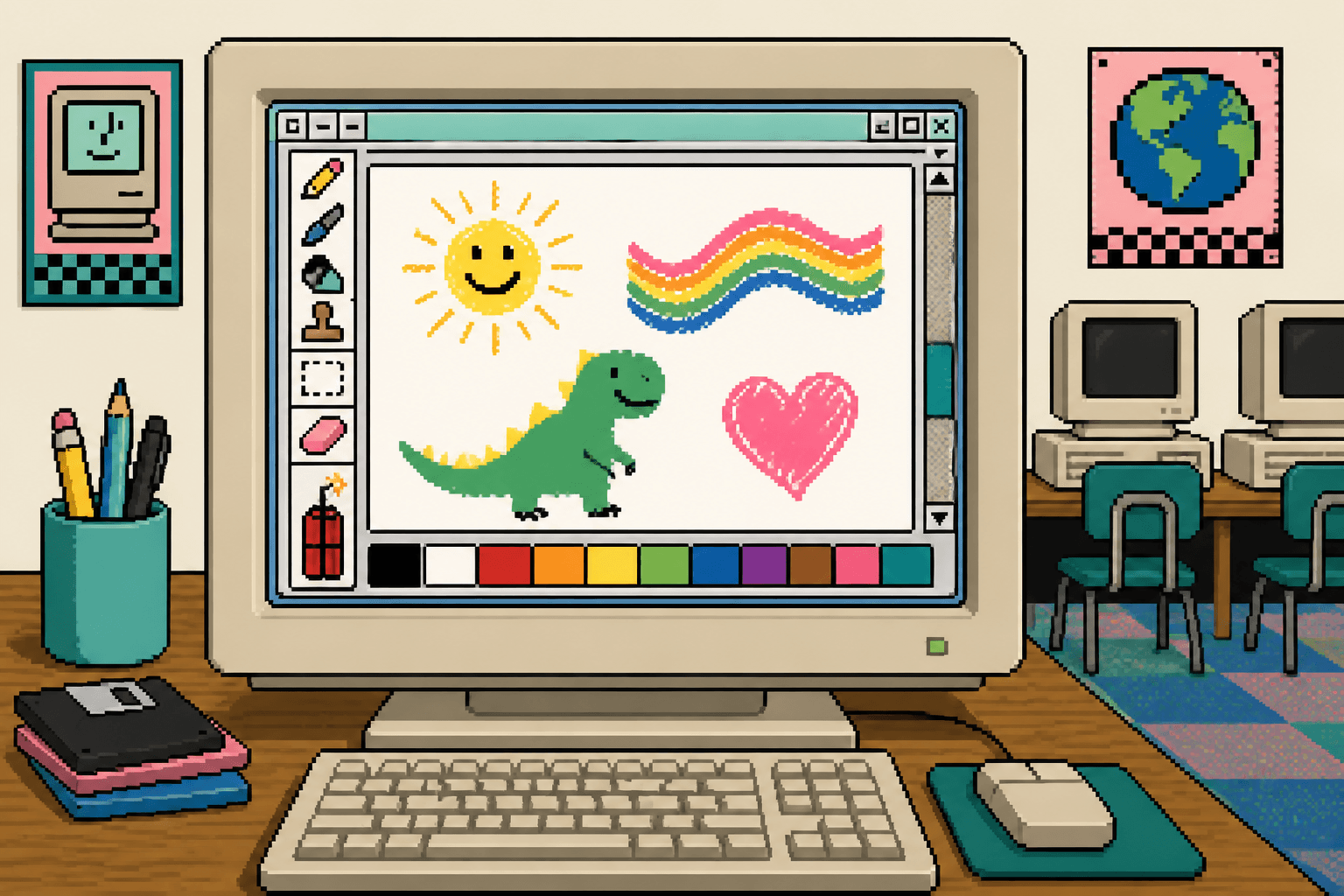
You were in the computer lab on a beige carpet square. The headphones, if you had them, were the orange foam kind that smelled faintly of forty other kids. The teacher had said "free draw" because she was tired and the lesson plan had a fifteen-minute gap and Kid Pix was already on the desktop. You double-clicked the icon. The computer made a sound like a small cartoon being born.
You picked the pencil. You drew a sun. The pencil went tick tick tick the whole time, like a little radio playing inside the monitor. You picked a stamp. The stamp went boing. You stamped a dinosaur. You stamped a heart. You stamped a cat. Each one had its own sound. Each sound was perfect.
Then you clicked the stick of dynamite.
The Software
Kid Pix was made by a guy named Craig Hickman, originally for his five-year-old son, and then by Broderbund, who put it on a CD-ROM and shipped it to every elementary school in North America between 1989 and 1996. It came in a yellow box. The box had a smiling sun on it. The CD-ROM inside was the same beige as everything else in 1993.
It was a paint program. That's what it was for, technically. You could draw lines and color in shapes and save your file to a floppy disk and bring it home and your mom would look at it on the family computer and say, "Wow, honey." This was the official use case.
It was a paint program for children. One of the buttons was labeled DYNAMITE. You clicked it. The whole drawing went up.
That was not what Kid Pix was. Kid Pix was a sound machine. Kid Pix was a slot machine that paid out in noises. Every tool, every brush, every stamp, every undo, every save - everything you could possibly do in Kid Pix - was hooked up to a different sound effect, and the sound effect was the reward, and the drawing was the receipt.
The Pencil
The basic pencil was the most boring tool. You knew this. You used it anyway, because you had to start somewhere, and because the pencil made the tick tick sound that was somehow exactly the right sound for a pencil to make even though pencils don't actually make any sound at all.
You drew a stick figure. You drew a house with a triangle on top of a square. You drew the squiggle that was supposed to be smoke coming out of the chimney. Every line came with its little electronic tick, like the computer was clicking a tiny stopwatch in the background to time how long you were going to be a child.
The line was thick and a little jagged and the color was whatever you'd clicked in the palette at the bottom, and the palette had eight chunky squares of pure 1993 - the red of a fire truck, the blue of a Mr. Sketch ocean, the yellow of a Crayola sun. You could not select a custom color. The eight colors were the eight colors. This was not a problem.
The Stamp
The Stamp tool was the upgrade. You clicked Stamp and a tray of tiny pictures opened up, lined up like a sticker book. Dinosaurs. Cats. Suns. Hearts. Stars. Hot air balloons. A piece of pie. A pair of sneakers. A tiny clipart of a child holding a balloon, which is the kind of thing that would now require a content warning and a brand-safety review and a meeting, but in 1993 was just Stamp #14.
You clicked a stamp. You moved your mouse over the canvas. You clicked. The stamp appeared. The computer said boing.
You did it again. Boing.
You did it forty times across the entire page. Boing boing boing boing boing. Each one in a slightly different place. Each one with the same little chirp, like the computer was a parrot who had only learned the one word but was extremely proud of it.
This was, you understood, art.
The Wacky Brush
The Wacky Brush was the dangerous one. The Wacky Brush was where you found out that the program had been holding back. You clicked Wacky Brush and you got options - little submenus full of insane choices that no sensible adult would have approved. The Drippy Paint. The Rainbow. The Echoes. The brush that drew tiny smiley faces. The brush that left a trail of little stamps. The brush that just put random noise on the canvas like the program was sneezing.
You'd pick one. You'd drag your mouse across the canvas. Something completely unhinged would happen. Twinkles. Sparkles. A rainbow that pulsed. A trail of identical alien faces. The computer would chirp the entire time, a continuous cascade of little electronic bells, each one slightly different, like every pixel had its own opinion.
The Wacky Brush taught a generation that "creative tool" could mean "the computer is going to do something weird and you don't get to know what until it happens."
You'd hit Wacky Brush. You'd never go back to the pencil. The pencil was for losers. The pencil was for kids who took the back-cover word search seriously. You were a Wacky Brush kid now. You were going to spend the next ten minutes turning your house-with-a-chimney into a glittering hellscape and you were going to love every second of it.
The Dynamite
Here is the part that, in retrospect, was completely insane. There was a button. The button was a tiny picture of a stick of dynamite. You clicked the button. The cursor became a little fizzing fuse. You clicked anywhere on your drawing. The computer made the sound of an explosion - a real one, with bass, a deep wet BWAAAAAOOOOM that the cheap little speaker in the back of the Macintosh LC was barely engineered to produce. The screen flashed white and red and yellow. And your drawing was gone.
Not undone. Not erased into white. Detonated. Your sun, your dinosaur, your forty boings of stamp work, your fifteen-minute Wacky Brush masterpiece - blown into pixelated confetti and then wiped to a blank canvas, replaced with nothing, accompanied by an explosion sound effect approximately the volume of the kid in the corner who was also stress-testing the dynamite tool. The whole computer lab would boom. Heads would turn. The teacher would look up. The teacher would not say anything. Because the dynamite tool was part of the software. The dynamite tool was sanctioned. Broderbund had shipped it. Apple had approved it. It was on the curriculum.
I think about this a lot. The default "clear canvas" in Microsoft Paint was a menu item. File > New. In Kid Pix, it was a stick of dynamite that exploded your work. The same operation, designed twice. One time, by a committee. One time, by someone who had ever met a child.
The Mixer
The Mixer was a separate tool but it operated on the same principle. You clicked the Mixer. The Mixer would do something completely unpredictable to your canvas - mirror it, kaleidoscope it, scramble it, polka-dot it, drag it across itself. There were dozens of effects and you didn't know which one was about to fire and that was the point.
You'd click the Mixer like you were pulling the handle on a slot machine. Each result was a tiny gift. Sometimes the gift was beautiful. Sometimes the gift was that the cat stamp you'd just placed was now eighteen cats arranged in a spiral. You couldn't undo a Mixer effect, not really, because Kid Pix's undo was also a sound effect - a little rewinding cassette noise - and after one undo you were back to the canvas before, but the canvas before wasn't quite right either, because the vibe had changed, because once you'd seen the eighteen cats you couldn't unsee them.
The Save
You saved your file. The save dialog had a typewriter graphic on it. The save made a sound like a typewriter. You typed a filename - DRAWING, or DRAWING2, or DRAWING2GOOD - because file naming was not a skill you had at age eight and the OS didn't let you use spaces and you were going to get an error anyway because the floppy disk was full from when you saved DRAWING2OK last week.
You'd take the floppy home. You'd give it to your mom. She'd put it in the family computer. The family computer didn't have Kid Pix. The drawing wouldn't open. Your mom would say "Hm" and put the floppy on the kitchen counter and it would live there for two months and then disappear, which was the lifecycle of every Kid Pix masterpiece, ever, anywhere in the world.
The Argument
Here's the part of this post where I'm supposed to say something about how Kid Pix Was Actually Important, how it Shaped a Generation of Creatives, how the sound design was Pioneering and the UX was Visionary and the moment-of-delight model was decades ahead of its time. And all of that is true, I guess. Craig Hickman invented something genuinely new. The sounds were good. The stamps were good. The Wacky Brush was the closest thing the early 90s had to a meditation app.
But I also think Kid Pix was a piece of software that taught a generation of children that the computer should be funny. That clicking a thing should make a noise. That the noise was the reward. That the work was incidental. That the tool was the toy. That if you really wanted to, you could blow it all up and start over and the explosion would have its own sound effect and nobody would mind.
I don't know if that was good for us. I am a thirty-six-year-old who refreshes my email for the chime. I know people who learned to expect a little ding every time they tapped a screen. I look at a UI that doesn't make a sound when I click something and I get suspicious, like maybe the button didn't work. Kid Pix did this to us. Or Kid Pix prepared us for what was coming. Or both.
The drawing was the receipt. The sound was the point. The dynamite worked.
The drawing was always the receipt. The sound was always the point. The dynamite always worked.
The Aftermath
There's a current version of Kid Pix. It's called Kid Pix Deluxe Home Edition or Kid Pix 3D or Kid Pix Studio or something with a colon in it. It has more stamps and better resolution and probably runs on an iPad. I have not used it. I don't want to. I want the 1993 one - the one on a Mac LC with a 13-inch CRT and the tiny speaker that was not engineered for explosions but produced them anyway. The one where the Wacky Brush had eight options and four of them were broken on the lab machine and you didn't notice because the other four were enough.
I want the version where you could blow up your own work, on purpose, and the computer would help you, and the computer would celebrate you for doing it. With a boom. With a flash. With the kind of sound effect that, twenty years later, your brain would still hear when you delete a Slack message you regretted sending.
I drew a sun in Kid Pix last week. Not the real one. A web version some person made out of love. I picked the pencil. The pencil went tick tick tick. I picked the cat stamp. The cat went boing. I added a heart. The heart went boing in a different key. I covered the canvas in Wacky Brush rainbows. The rainbows twinkled.
Then I clicked the dynamite. I clicked my own drawing. The screen flashed yellow and red. The speakers in my laptop, which were considerably better than the speaker in a 1993 Mac LC, produced an explosion that startled my cat. The drawing was gone.
I sat there for a second. I felt something I haven't felt in a long time. A specific kind of dumb joy. The kind that doesn't come with a notification. The kind you have to click the dynamite to find.
I drew another sun.