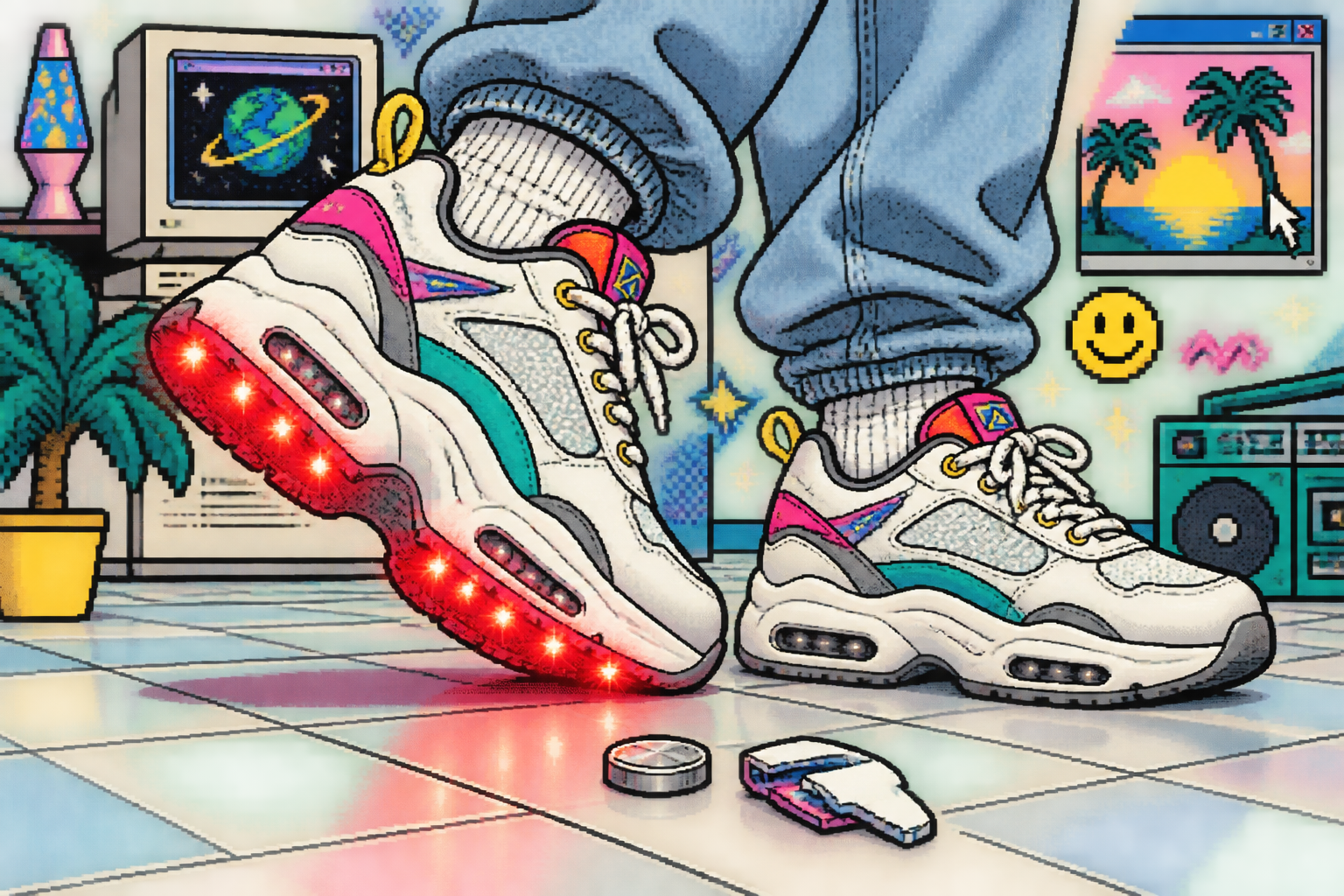
You were seven. You were at a K-Mart. Your mom had said one pair, and I mean it. The shoe aisle was fluorescent and long and smelled like new rubber. You walked to the end, past the Velcro Reeboks and the plain white Keds, and you stopped in front of a plastic riser that held a single sneaker at eye height, tilted like a museum piece.
Inside the sole of the sneaker were three tiny red LEDs.
You picked it up. You turned it over. You slammed the heel down on the display shelf.
The lights flashed.
The Riser Was the Whole Sales Pitch
L.A. Gear did not need advertising. L.A. Gear needed one shoe on a riser, at kid height, at any big-box store in America. That was the ad. A seven-year-old walked past, saw the shoe, whacked the heel against something, and watched three LEDs pulse red for about a second and a half.
The store personnel let this happen. There was no other option. If you had tried to enforce a do not touch the display shoe rule at a K-Mart in 1993, you would have had to hire another employee to do only that. The single-shoe riser existed to be picked up and stomped and put back and stomped again by children who did not intend to buy anything and by children who intended to spend the next fourteen days ruining their parents' lives until they did.
You were the second kind of child.
L.A. Gear did not need advertising. L.A. Gear needed one shoe on a riser at kid height, at any big-box store in America.
The Ask
The negotiation happened in the car on the way home.
Your mom, who could see this coming from the moment you asked to go down the shoe aisle, opened with those are more expensive. This was true. The Light Gear pair was thirty-four dollars. The plain Reebok next to it was twenty-two. A twelve-dollar delta in 1993 was a real number, and your mom, who worked in the accounting department at a place that made industrial fasteners, knew it.
You countered with but I'll wear them every day.
She countered with you'll grow out of them in six months.
You countered with I'll take really good care of them, which was a phrase that meant nothing, that you had said about the previous six things, and that both of you knew was a rhetorical placeholder for please.
She said she'd think about it.
You knew, from the specific way she said think about it, that she was going to buy them. You knew because think about it was said in the same tone as we'll see, which was the tone that in your house meant yes, but I need to feel like I'm considering it.
Three days later there was a plastic bag with a shoebox in it, on the kitchen counter, and you stopped breathing for a second.
The Specific Stomp
The shoes worked, but they worked on a particular gesture.
A normal walking step did not always trigger them. The switch inside the heel was a small tilt sensor - in some early models, a mercury bead in a tube, and in later ones, a piezoelectric disc that responded to sharp impact. Both of these needed a specific amount of downward force to close the circuit. A regular kid walk, which is a series of shuffles and half-steps and one skip every three yards, did not always deliver it. The lights would fire sometimes and not others, in a pattern that felt random, and that made the shoes feel possessed.
You quickly learned the real gesture. It was a slight hop, landing heel-first, with a stomp on the descent. If you did it right, all three LEDs fired in a chase pattern, back to front, and stayed lit for about a second before fading.
You were doing this gesture in the checkout line at the grocery store. You were doing it in the church parking lot. You were doing it in the hallway of your house at eleven o'clock at night, sneaking to the bathroom, and your dad, from his bedroom, said stop stomping, and you said I'm just walking, and you were not just walking, and he knew, and he let it go.
A regular kid walk, which is a series of shuffles and half-steps and one skip every three yards, did not always deliver it. The lights would fire sometimes and not others, in a pattern that felt random, and that made the shoes feel possessed.
Try It
Stomp. Watch the chase. Watch the battery. Cut open the sole if you want to see what was actually in there.
The Ban
Some schools banned them.
The stated reason was distraction. The real reason was that thirty second-graders stomping for the duration of a spelling test made a room impossible to teach in. Every silent moment during a lesson was cracked open, at intervals, by a kid across the room who had felt his lights had not fired sufficiently in the last four minutes and needed to correct the balance.
The ban was uneven. Some teachers enforced it. Some pretended not to see it. One specific music teacher, who had otherwise been kind, seized the shoes on your feet at a school assembly and made you sit through it in sock feet, and then handed the shoes back to your mom in the parking lot with the words she can wear them at home, and your mom nodded like she agreed, and then in the car said what a bitch, which was the first time you had ever heard her use that word about an adult, and it made her briefly the coolest person alive.
- The K-Mart aisle where you first saw them
- The church parking lot after mass
- The hallway of your house at 11 p.m.
- The linoleum square in the kitchen (best acoustics)
- The dentist's waiting room
- Anywhere adults were trying to have a conversation
- Not: the classroom, per the note sent home Wednesday
The Battery Was Soldered In
I want to be exact about this, because it matters.
The little coin cell inside the heel - a CR2032 or an SR44 or similar, depending on the model and the year - was not designed to be replaced. It was soldered directly to a small PCB that also held the piezo switch and a driver chip and the three LEDs. The whole assembly was cast into the midsole in a way that made it, functionally, disposable at the battery level. When the cell died, the shoe did not stop being a shoe. It stopped being a light shoe. It became an ordinary sneaker that had a small dark bulge in the heel where a party used to be.
The battery lasted about six to eight months of hard use, or roughly the life expectancy of a seven-year-old's foot in a given shoe size, which was, in a real sense, the engineering brief. The shoe was designed to be an event. The event was designed to end at approximately the same moment you outgrew it. This is how you knew, later, that consumer electronics were sometimes disposable on purpose. You'd already lived it. On your feet. In second grade.
The shoe was designed to be an event. The event was designed to end at approximately the same moment you outgrew it.
The Six-Month Point
You always knew the exact day the batteries started to die.
The chase got sluggish. Instead of three LEDs firing in order, sometimes only two fired. Sometimes one. Sometimes all three lit up, dim, at the same time, and then one hung on for an extra half-second like it was catching its breath. The stomp still worked, mostly. But the reliability was gone. You could not perform on demand. You had to sell it.
You started stomping harder to compensate. This did nothing, mechanically - the switch was already closing - but it felt like you were doing something. You started aiming for specific surfaces: the tile in the entryway, the aluminum threshold at the school door. You were, without knowing it, moving from demonstrating a product to coaxing a failing electronic through the last of its charge, which is a skill you would use again, later, on flashlights and cell phones and, eventually, laptop batteries you had promised yourself you would replace.
One morning you stomped and got nothing. You stomped again. Still nothing. You slammed your heel against the kitchen tile so hard your mom looked up from the coffee pot, and you got a single, sad, half-blink out of the front LED, and then it, too, was done.
The shoe was now a shoe.
The Argument
I want to give the counter-argument, because it deserves airtime.
The counter-argument is that L.A. Gear Light Gear was, functionally, a piece of disposable electronic waste marketed to children and sold at a premium over the same shoe without lights, and that the whole product category - the light-up shoe, the pump shoe, the roller-skate shoe, the shoe with the compass on the tongue - was a way of extracting an additional twelve dollars per kid per year from parents who were not, structurally, going to say no to a seven-year-old who could physically demonstrate that the toy worked at the checkout register.
You could also argue that the mercury tilt switches in the early runs were a genuine environmental problem. Millions of these shoes were sold. Millions ended up in landfills. Each contained a small amount of mercury. In 1994, Illinois and Minnesota both banned the sale of mercury-switch light-up shoes. L.A. Gear switched to piezo. They did not, as far as I can tell, recall the earlier ones. Somewhere out there is a Superfund line item that includes a size-two sneaker.
You could also argue that the shoes taught you, at seven, that the flashy thing costs more, breaks first, and cannot be repaired. That is a real lesson, and it was delivered to a child. I don't know that a child needed it that early.
The Other Side
But here is the thing.
The lights worked.
I want to say that clearly, because most of what I remember from being seven is a blur, and the flash of three red LEDs on a beige linoleum floor is not a blur. It is a specific image. It is my heel. It is my shoe. It is a small piece of red light I was, at that moment, personally in charge of.
Kids do not, in most parts of their lives, get to make light. They do not press a button and cause a flash. They do not, in a room, produce a visual effect that everybody in the room turns to look at. Adults do that. Adults control the lights. Adults have keys and switches and the ability to make a slide projector work. Kids do not have any of those things.
Except in this one specific case. In this one specific pair of shoes. With this one specific gesture.
For six to eight months, you could stomp your foot and the world, briefly, lit up. Not the whole world. A patch of it, about the size of your heel, in red, for a second. That was the offer. That was what thirty-four dollars in 1993 bought.
You spent it on that.
For six to eight months, you could stomp your foot and the world, briefly, lit up. Not the whole world. A patch of it, about the size of your heel, in red, for a second.
The Successor
The shoes are back.
Skechers makes them now, in Twinkle Toes and S-Lights and a dozen other sub-brands. So does every knockoff on Amazon. Some of them are USB-C rechargeable. Some of them have RGB LEDs that cycle through the full spectrum in patterns you can pick from an app. The batteries, in the good ones, are user-serviceable. The bad ones are still soldered in, and still die at six months, and still get thrown away.
The shoes are, in most ways, better. They are also, in one important way, worse.
They do not turn off. That is the thing. The 90s pair had a switch that only closed when you stomped, which meant you were the source of the light. You did the thing, the light happened. Cause and effect. The new ones have accelerometers and motion sensors and, in some cases, a permanent low-glow mode. They light up on their own, in your kid's closet, at 2 a.m., because someone bumped a shelf. They light up when the kid is just walking. They light up on Bluetooth pairing. The link between the gesture and the flash - the link that made the 90s pair feel personally powered - is gone.
You bought a pair for your niece last Christmas. She wore them once, at the mall, and asked you if she could turn them off, because they were making the other kids stare.
You did not know how to answer that.
The Shoes Are in a Landfill in Ohio
My pair got thrown out in 1994. I don't remember the day. I remember the sequence: the batteries died in March, and I wore them anyway until I outgrew them in July, and my mom put them in a paper bag with some other outgrown shoes and left the bag at a Salvation Army donation bin behind a Kroger in Broadview Heights. Salvation Army does not, as a rule, resell dead light-up shoes. Not because they are broken - because who wants a used sneaker with a small dead computer in the heel. So the bag went into the actual trash, and then into an actual truck, and then into an actual landfill in Ohio, where the shoes, along with a soldered CR2032 that had once, briefly, been the most important object in a second-grade classroom, remain.
My nephew has a pair now. His are Skechers. His are USB-C. He can charge them from a wall wart in the kitchen while he eats dinner. His flash green and blue and purple and cycle through six patterns. He wears them, mostly, without stomping. The stomp, he tells me, is not necessary. The shoes light up when he walks.
I said, oh.
He said, do you want to see them do rainbow?
I said, sure.
He tapped a small button on the tongue of the shoe. The LEDs pulsed through the spectrum in a slow, professional gradient, in a pattern that was legitimately impressive, and that was, in the specific way that mattered to me at seven, wrong. I did not tell him this. I said, oh, cool. He nodded. He turned them off with the button on the tongue.
I thought, briefly, about the K-Mart riser. About the specific weight of the demo shoe in my hand. About the sound my heel made on the display shelf. About the way the three LEDs, from the factory, fired in the same order every time, and about how, for eight months, I had been the switch.
He asked if he could go play his tablet. I said sure. He went upstairs. The shoes sat by the front door, dark, waiting for the next person to walk near them.