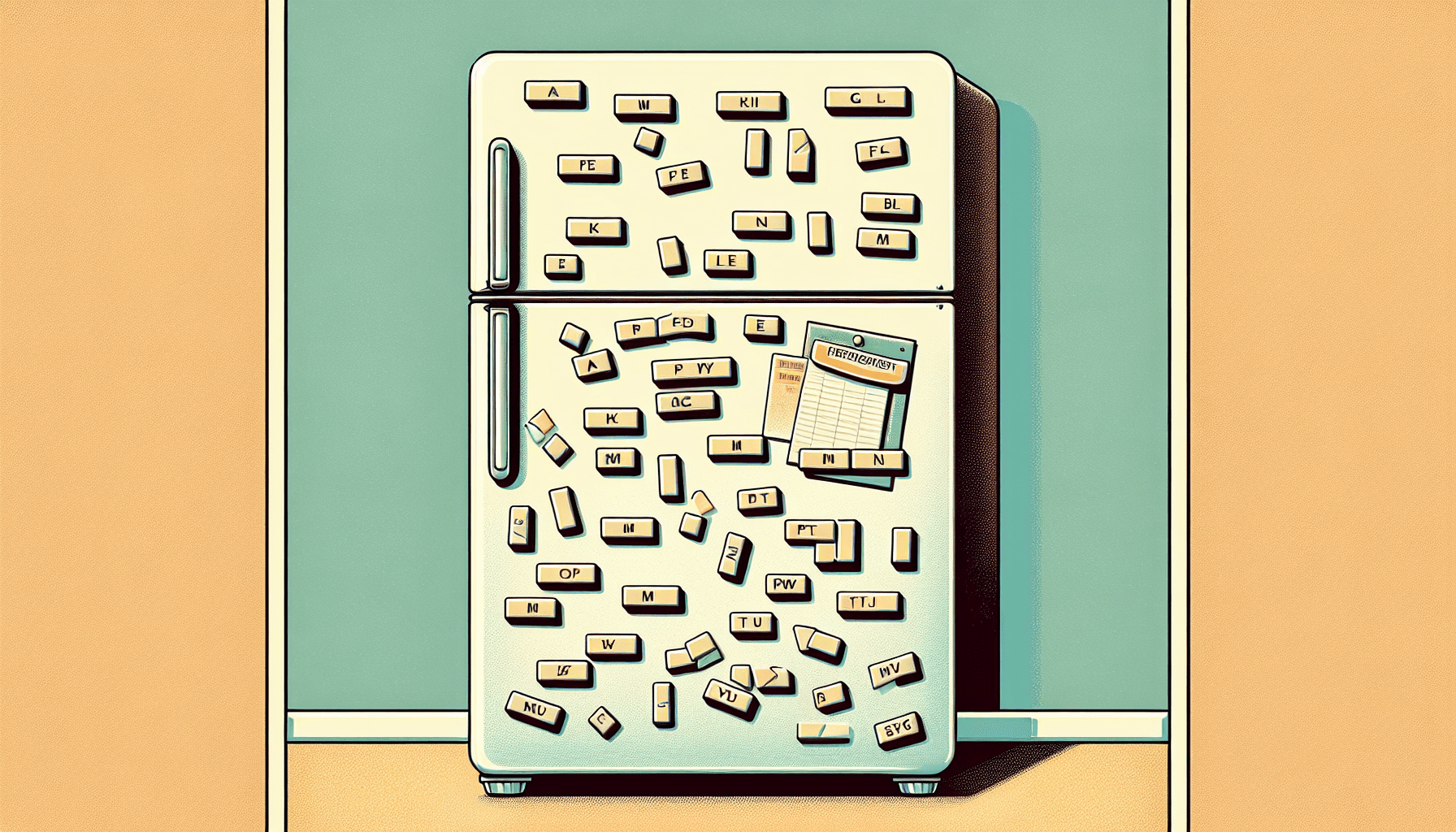
You walked into someone's kitchen for the first time and the first thing you read, before you said hi, before you took off your jacket, was the fridge.
the languid sausage dreams of summer.
The person whose apartment it was - a coworker, a friend of a friend, the new boyfriend everyone was being weird about - would catch you reading it and look both proud and a little embarrassed, the way people look when you compliment a tattoo they got at twenty. They didn't write that. Their roommate did. Or their roommate's girlfriend, who had been over last weekend and apparently this is what she does. Either way, they hadn't moved it. Nobody moves a finished poem. That was understood.
The Kit
It came in a box about the size of a thick paperback. Inside: a folded sheet of perforated cardstock, maybe six pages thick, each page covered in a grid of tiny rectangles. You popped the words out one at a time, accordion-style, and your thumb hurt by tile number forty. A flexible magnetic backing came in a separate sheet, slightly tacky on one side. You had to peel a strip of paper and press it onto each cardstock word. Nobody did this carefully. By the end you had 400-some little white tiles, mostly straight, mostly aligned, all individually magnetic, all stuck together in a single brick that you immediately dumped into a plastic bag because there was no good way to store them.
The font was Times Roman. Lowercase. Black ink on cream paper. Each word about the size of a pencil eraser. They looked like they'd been pulled from a tiny serious newspaper that only published in single words.
The font was Times Roman. Lowercase. Black ink on cream paper. They looked like they'd been pulled from a tiny serious newspaper that only published in single words.
The original kit was invented in 1993 by a Minneapolis songwriter named Dave Kapell, who got the idea because he kept getting stuck writing lyrics and thought maybe if he chopped up a thesaurus and laid it out on the table, his stuck brain would unstick. He sneezed and the words went everywhere. He bought magnetic tape. He stuck them to a cookie sheet. His friends came over and started arranging them and forgot to leave. Within two years there was a kit at every Urban Outfitters in America.
The Vocabulary Was a Trap
Here is what the original Magnetic Poetry kit did not contain enough of: verbs.
It contained enough nouns to describe a small Romantic poet's entire emotional landscape. Sky. Sea. Moon. Heart. Mouth. Tongue. Wind. Rain. Fire. Music. Voice. Eye. Life. Death. It contained adjectives for that same poet's interior weather: languid. lazy. raw. wet. bitter. soft. mad. It contained the word milk and the word butter and the word sausage and the word bread, because Kapell apparently wrote a lot of breakfast poems.
But the verbs were a closed shop. Ache. Cry. Dream. Sing. See. Feel. Want. Need. Sleep. Kiss. That was basically it. Maybe a run and a fall. You could not write a sentence in which something happened. You could only write a sentence in which something yearned.
This shaped the poems. Every magnetic poem ever written sounded like it had been translated from a language whose grammar didn't include action. Things did not occur. They were only. They ached. They wanted. They dreamed of other things. The whole magnetic-poetry oeuvre, taken as a body of literature, sounds like a sad European film about a woman who looks out windows.
You'd notice this halfway through arranging your first poem and reach for a verb you needed - jump, eat, write, hold - and it would not be there, and you'd have to use fall or want or kiss instead, and your poem would suddenly be about loss when you'd been trying to write about a sandwich.
The Performance
The kitchen was a stage. The fridge was the proscenium. The magnets were the cast. Every roommate, every guest, every overnight visitor was an unwilling audience and an optional contributor, and the social rules around this were unspoken but absolute.
You did not disturb a poem someone else had finished.
You did not, under any circumstances, take a word from someone else's finished poem to use in yours. If you needed love and somebody had used it in their the moon is a soft love that breathes arrangement, you used kiss instead. You worked around. You showed respect.
You could add to a poem. That was permitted, sometimes. If your roommate had written i ache for the slow sweet sausage of summer and you came home from a date and added but i would settle for cheese, that was a tribute. That was a callback. That was you saying: I see what you wrote, and I am responding in kind. The poem was a thread.
You did not, under any circumstances, take a word from someone else's finished poem to use in yours. You used something else. You worked around. You showed respect.
You could remove a poem only if it had been there for so long it had become wallpaper. There was a statute of limitations, maybe three weeks, after which a poem became fair game and could be scrambled back into the loose pool. Nobody knew the exact rule but everyone enforced it. If you scrambled a poem before its time, you would hear about it. Possibly that night. Possibly in the form of a passive-aggressive new poem written specifically about you using only the words you had taken from the previous one.
The Migration
Words moved. Not because anyone moved them. Because the universe was working against you.
The fridge had a slight slope. The magnets were not heavy. Over the course of a week, love would slide an inch to the left and tilt downward at three degrees. Over the course of a month, half the loose vocabulary would have migrated to the bottom right corner of the fridge, where it pooled like sediment. Some words slipped off the bottom edge and lived behind the fridge for the duration of your lease. When you finally moved out and pulled the appliance away from the wall, you'd find a small ecosystem back there: dust, a single sock, the words only, beneath, and whisper, and a coupon from 1996.
Other words ended up on the dishwasher. The toaster. Once, memorably, the inside of someone's car door. The magnets did not care where they were. They would stick to anything ferrous and stay there indefinitely, occasionally being knocked into the kitchen sink by a passing elbow and going down the disposal, where they would not be retrieved.
The kit shrank, slowly, every month. You started with 400 words. By year two you were down to maybe 280. The was always missing. You needed the constantly. You'd spend ten minutes searching for a the, give up, and write a poem that just started moon is a.
Was It Poetry
Probably not. Mostly not. The constraint was so tight and the verbs so few that almost everything came out sounding like a perfume ad. raw beautiful winter mouth. languid kiss of the wild road. I dream the white sky. You'd write something, step back, and feel a brief flush of pride that lasted exactly until you read it again ninety seconds later, at which point it sounded like the back of a candle.
But sometimes - rarely, occasionally - someone would line up six words on a fridge and you'd stop in the middle of pouring milk and think, huh. Not that's beautiful, exactly. More like, I wouldn't have put those next to each other and now I can't unsee it. Someone wrote the only sleep is winter on my fridge in 1998 and I still think about it. They were probably drunk. They probably forgot they wrote it. It was probably the third arrangement they tried. But it landed.
That was the whole pitch. Not that you'd write something good. That you might, by accident, line up the right four words. The kit didn't make you a poet. It just lowered the floor far enough that anyone could trip over a line.
- A finished poem is sacred for three weeks
- You may add to a poem; you may not edit it
- Words on the floor are pool words, free to use
- The word the is communal property
- The first person to make a sex pun on a freshly opened kit owes everyone a beer
- If you find a word behind the fridge after moving out, it goes in the new kit at the new place. This is the law.
The Disappearance
The kits got worse. By the late 90s there were themed sets - a Shakespeare set, a Dog Lover's set, a Romance set with even more kiss and moan than the original. The Romance set ruined fridges across America. People put them up and then realized that their parents were going to visit, and now the only way to hide moan thrust nipple from your mother was to rearrange them all into a poem about gardens, which took an hour, after which there was no the left and your mom asked why your fridge said moan thrust garden.
Then everyone moved into apartments with stainless steel fridges. Magnets did not stick to stainless steel. The whole format was over without anyone announcing it. The kits got shoved into a drawer. The drawer got moved into a box. The box got moved into a closet. The closet got moved into a different apartment, where the new fridge was also stainless steel.
I have a kit in a drawer. I checked, before writing this. About 180 words left. The is still missing. Love and moon and only are present and accounted for. Sausage somehow survived three moves. The magnetic backing has lost some of its grip - they slide down a vertical surface now if you put them on one, which I tested by sticking a few to my filing cabinet and watching them descend at the rate of about an inch a minute.
I don't know what I'm supposed to do with them. I'm not going to throw them out. They were given to me by someone who is no longer in my life, or I bought them at the campus bookstore in 1999, or I inherited them from a roommate who left them when she moved to Portland. I don't remember which. But they were on the fridge of every apartment I lived in between twenty and twenty-eight, and through them I learned the names of constellations of feeling I would not otherwise have had words for, because the words were sitting there, in lowercase Times Roman, asking to be picked up.
The kit didn't ask anything else of you. You didn't have to be good. You didn't have to finish. You didn't even have to mean it. You just had to put two words next to each other and see what happened, and if nothing happened, you put a third one down and tried again. That's a low bar for art. It might be the only honest one.
I think maybe what I miss isn't the poems. It's the fridge as a place where something was always being written. A surface that asked, every time you walked past it for a glass of water, anything to add? Most days you didn't. Some days you moved a the. And occasionally, when you weren't trying, you wrote down something true.