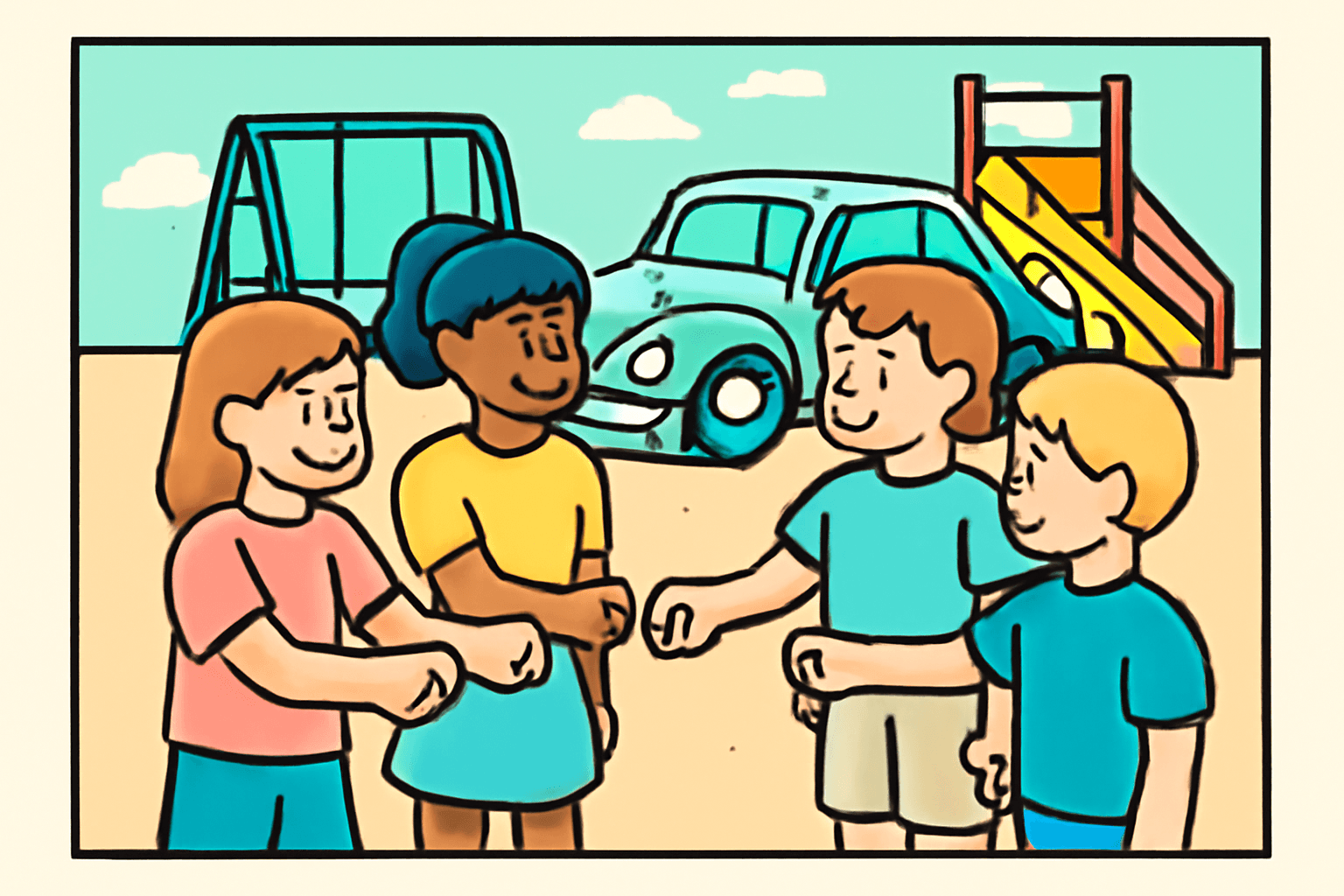
Somebody punched me in the arm last week. I was walking through a parking lot with my brother, and a yellow Volkswagen Beetle rolled past, and before I could even process the color, his fist was already in my shoulder. "Punch buggy yellow," he said, like we were eleven. We are not eleven. We are in our thirties. It didn't matter. The protocol is the protocol.
That's a meme. Not the way we use the word now - not a picture of a cat with block letters or a guy looking back at another woman while his girlfriend glares. The original kind. The Richard Dawkins kind, if you want to get technical about it, which nobody in 1994 did. An idea that replicates itself, jumping from brain to brain, mutating slightly along the way, surviving because it's sticky and fun and just useful enough to keep passing along.
The 90s were full of these. We just didn't call them memes. We didn't call them anything. They were just things we did.
Punch Buggy, No Punch Back
The rules of Punch Buggy were simple and non-negotiable. You see a Volkswagen Beetle. You punch the nearest person in the arm. You say "punch buggy" followed by the color. You add "no punch back" if you were smart, because without that verbal clause, retaliation was legal.
That was it. That was the whole game. No app. No scoreboard. No official rules posted anywhere. You learned it from somebody - an older kid, a cousin, a friend in the back of the bus - and then you knew it forever. It installed itself in your brain like a piece of software you never agreed to download, and from that day forward, you could not see a Beetle without your fist tightening involuntarily.
It installed itself in your brain like a piece of software you never agreed to download, and from that day forward, you could not see a Beetle without your fist tightening involuntarily.
Some families played it with the old Beetles only. Some played it with the new ones when they came out in 1998. Some had elaborate sub-rules about convertibles being worth double, or about what happened if two people called it at the same time. Every car ride was a low-grade combat zone, and every passenger window was a surveillance post.
The beautiful thing was that nobody invented Punch Buggy. Or if someone did, they're completely anonymous. It just existed, everywhere, in every suburb and school district, with minor regional variations that nobody ever formally catalogued. It was open-source before open-source was a concept.
Jinx
If two people said the same word at the same time, you were legally required to say "jinx." The person who got jinxed could not speak until someone said their name. If they spoke before being unjinxed, consequences varied by jurisdiction - sometimes it was a punch, sometimes a Coke, sometimes just the pure social shame of having broken a rule everybody understood.
Think about how weird that is. Two children accidentally synchronize a single word, and one of them is now silenced by a binding verbal contract that neither of them signed. And everyone around them enforces it. Not because anyone told them to, not because there's a teacher or a parent backing it up, but because the meme says so, and the meme is law.
Some kids took it extremely seriously. I watched a kid in my fifth-grade class sit in total silence for an entire lunch period because nobody would say his name. He just sat there, red-faced, eating his sandwich, pointing at things. The rest of us could have freed him at any moment. We chose not to. The meme demanded sacrifice, and we were faithful servants.
- Standard jinx: First person to say "jinx" wins. Loser is silent until their name is spoken.
- Jinx, you owe me a Coke: The premium version. Now there's a financial penalty.
- Double jinx / triple jinx: An escalation arms race that could theoretically continue forever.
- Pinch, poke, you owe me a Coke: A physical-contact variant with a rhyming legal framework.
The Circle Game
You make an OK sign with your hand - thumb and index finger forming a circle, other three fingers extended - and you hold it below your waist. If someone looks at it, you get to punch them. That's the game. That's the entire game.
The strategy was everything. You'd rest it casually on your knee during class. You'd flash it while handing someone a pencil. You'd arrange it on a desk and ask someone to look at something near it. The whole point was misdirection - getting someone's eyes to travel downward and land on the circle before they realized what was happening.
The defensive meta-game was equally complex. You learned to be suspicious of anyone whose hand was below table level. You developed peripheral vision specifically for detecting circle-shaped hand formations. You became, in a very small and very stupid way, a counterintelligence operative.
The Game (Which I Just Lost)
There was also The Game. The rules: if you think about The Game, you lose. When you lose, you have to announce it. When you announce it, everyone who hears you also thinks about The Game, and they also lose. It's a self-propagating thought virus with no win condition and no way out. You are playing The Game right now. You will be playing it forever. I'm sorry.
The Game was maybe the purest meme that ever existed. It had no physical component. No object, no gesture, no skill. It was just an idea that, once it entered your head, could never fully leave. It lurked in the back of your mind like a sleeper agent, waiting for someone to mention it, at which point it would activate and ruin everyone's day in the mildest possible way.
It was just an idea that, once it entered your head, could never fully leave. It lurked in the back of your mind like a sleeper agent.
Bloody Mary and the Bathroom Mirror
Every school had some version of this. You go into the bathroom. You turn off the lights. You say "Bloody Mary" three times into the mirror. Something terrible happens. Nobody could agree on what the terrible thing was - she appears, she scratches you, she pulls you into the mirror, she kills you - but everybody agreed that the ritual worked, and almost nobody was brave enough to actually try it alone.
This wasn't really a game. It was a dare wrapped in a ghost story wrapped in a meme. And it spread the same way everything else did: kid to kid, mouth to ear, on the bus, at the lunch table, at sleepovers where the bathroom was right there and someone always eventually said let's do it.
The meme survived because it was untestable in any satisfying way. If you did it and nothing happened, you probably did it wrong. If you didn't do it, it was because you were scared, which meant it was real. The logic was airtight if you were nine.
Cooties
Cooties weren't a disease. They were a social technology. A way for kids to navigate the terrifying, confusing reality of boys and girls existing in the same space. If a girl touched you, you had cooties. If a boy touched you, you had cooties. The only cure was the cootie shot - that thing where someone draws a circle on your arm and pokes it, while reciting "circle circle dot dot, now you've got your cootie shot."
The cootie meme was a framework. It gave kids a vocabulary for something they didn't have words for yet - the weird electricity of being near someone of the opposite sex when you were six or seven, before you had any idea what to do with that feeling. Cooties were the placeholder. The variable name before the value was assigned.
Why They Worked
Internet memes spread because algorithms push them into your feed. These memes spread because they were good. They were well-designed, even though nobody designed them. They were simple enough to learn in thirty seconds, robust enough to survive a million imperfect transmissions, and fun enough that you wanted to teach them to someone else immediately.
They had no creator. No copyright holder. No official version. They existed in the commons, owned by everyone and no one, maintained by the collective behavior of millions of kids who had never met each other and never would. Every school in the country was running the same software, and nobody ever pushed an update.
That's what makes them different from internet memes. A Twitter meme exists in a specific post, made by a specific person, at a specific time. You can link to it. You can screenshot it. You can watch it get born, go viral, get strip-mined for engagement, and die, all within about seventy-two hours.
Punch Buggy lasted forty years. The S lasted longer. The circle game is still going. Nobody owns them, and nobody can kill them, because they don't live on any server. They live in the space between people - in the back seats of cars, in school hallways, in the weird shared consciousness of every kid who ever had a long bus ride and a sore shoulder and a friend who wouldn't stop scanning the road for Beetles.
They lived in the space between people - in the back seats of cars, in school hallways, in the weird shared consciousness of every kid who ever had a long bus ride and a sore shoulder.
My brother and I walked back to the car after he punched me. I didn't see another Beetle for the rest of the day. But I was looking. I'm always looking. The meme is still running, decades after installation, and there is no uninstall option. I don't think I'd use it if there was.