They came in a cardboard box the size of a toaster. On the front of the box was a kid - maybe eight, maybe ten, wearing a tank top and bike shorts - leaping six feet in the air with a grin on their face and their arms spread wide, like they'd just stepped off the surface of the moon and found that gravity was optional and a little embarrassed about it. There was a starfield behind them. There were small-text boast lines. There was a word, on the side of the box, in big bubble letters: MOON. And there was another word, smaller, next to it: SHOES.
Inside the box were two plastic platforms the color of a hospital waiting room.
The Shoes
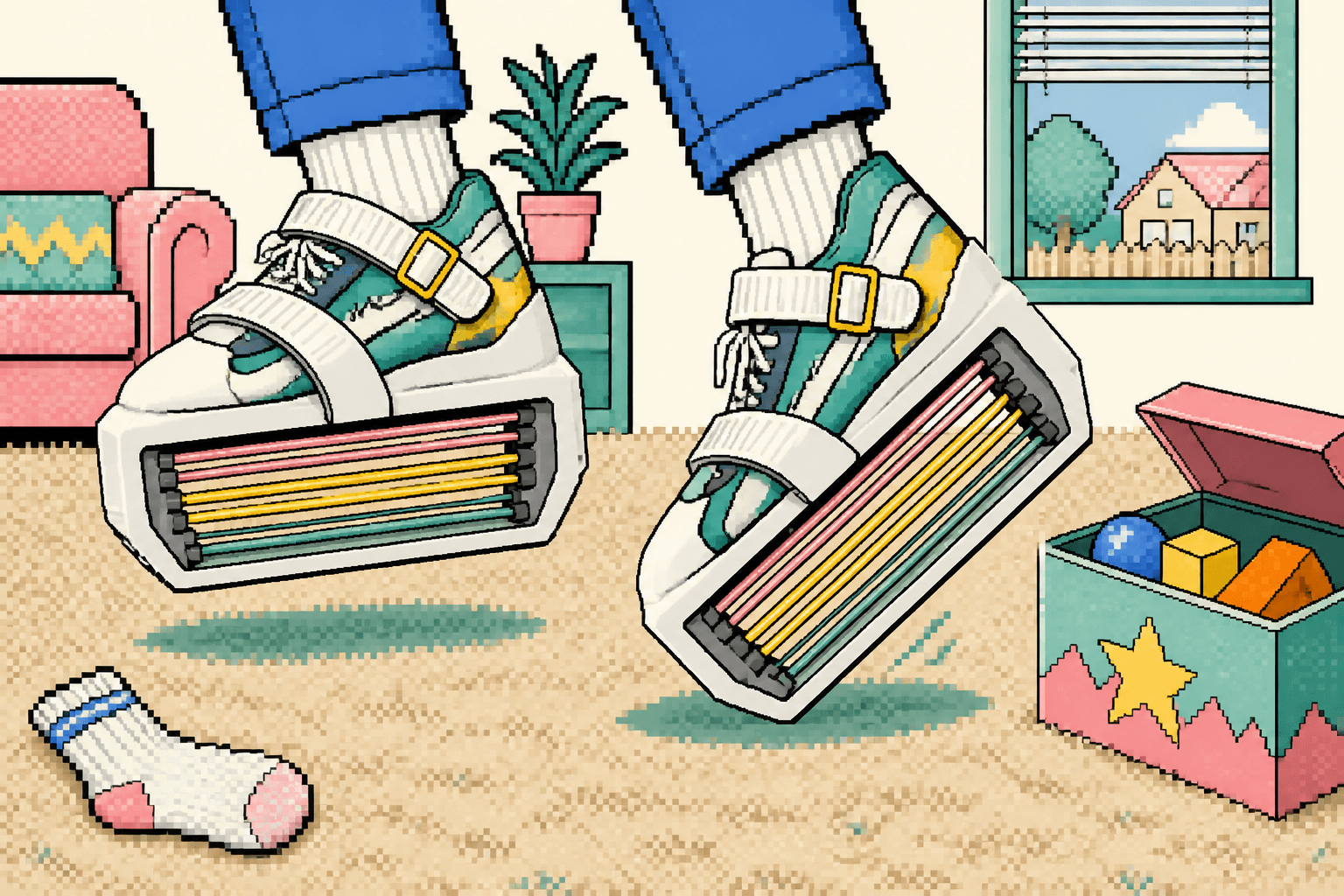
They were not shoes. They were plastic frames you strapped over your actual shoes.
Each one was about the size of a shoebox cut in half, maybe four inches tall, made of hard injection-molded plastic in colors that implied a children's science museum. White. Neon green. A kind of translucent blue that had been engineered to look futuristic in 1994 and that looks, now, exactly like the plastic that shampoo bottles were made of. There was a flat top where your foot went. There were straps - fabric straps, usually, with velcro and plastic snap-together buckles - that wrapped around the top of your shoe and the heel of your shoe and tried, not always successfully, to hold the apparatus in place.
And then there was the underside.
The underside was where the Moon came from. Instead of a sole, there was an open rectangular cage, maybe an inch and a half deep, criss-crossed by a web of thick industrial rubber bands. Six or eight of them, stretched taut from one side of the frame to the other, creating a little trampoline mat the size of a paperback book. The idea was that when you stepped down, the rubber bands would compress. When you lifted your foot, they would spring back. And in between, you would be lifted, briefly, above the surface of the Earth.
The box was not technically lying.
The underside was where the Moon came from. A web of thick industrial rubber bands, stretched taut, creating a trampoline the size of a paperback book.
The Physics
Here is what actually happened when you put them on.
You sat on the floor. You put your sneakers inside the plastic frames. You cinched the velcro and clipped the buckles and listened to a parent say are those on right from the next room without looking up. You stood up. The first thing you noticed was that you were now four inches taller than you were a minute ago, which is a lot for a child to be. The second thing you noticed was that the floor was no longer where you remembered it being. You stepped. The rubber bands compressed. You stepped again, with the other foot. The rubber bands compressed on that side. You did not, in any meaningful sense, bounce. You walked. You walked like an astronaut, maybe - if astronauts walked while being slightly embarrassed about it - but you did not leap.
The rubber bands were not strong enough to send a child upward. They were strong enough to make walking weird. That was the physics. Moon Shoes were not a trampoline. They were a pause between your foot and the ground.
But here's the thing: the pause was enough. The pause was a whole world. Because when you stepped down and that tiny pocket of give absorbed your foot and then slowly uncrumpled under you, your brain insisted that something extraordinary had happened. You were in contact with the floor via mechanism. There was engineering under your feet. You could feel the rubber bands flexing. You could feel your weight redistributing. Every step was an event.
So you bounced anyway. You bent your knees and you hopped and you pretended. And the shoes gave you maybe two inches of lift - if you were small, and if the rubber bands were new, and if the carpet underneath was flat - and you came down thinking I flew.
The Carpet
Moon Shoes were designed for a hard, flat surface and sold to kids who lived on carpet.
If you've forgotten what a 1990s suburban living room floor was like: imagine a short, dense, shag-adjacent beige-brown weave, placed over a concrete slab, that absorbed any shock before it could be transferred back up. Imagine trying to dribble a basketball on it. That is the texture Moon Shoes were asked to work against. The rubber bands would go down, and the carpet would go down a little further, and there was no clean rebound. Your Moon Shoe would just sort of sigh at you, politely, and then let you walk to the next spot where the same thing would happen.
The kitchen was better. The kitchen had linoleum. On linoleum, you actually got a little snap back. But the kitchen was also where the parents were, and the kitchen had corners and appliances and a tile edge that caught the frame of the shoe and sent you sideways. So kids tried the garage, which worked. And kids tried the driveway, which also worked, but the frames scraped on concrete and the rubber bands got dirty and your parents said not outside. And eventually you went back to the living room and the carpet, where the shoes did nothing much, and you bounced anyway, and that was fine.
The Failures
The failures were specific.
A rubber band would break. Not on the first day, usually, but by day four or day ten, one of the eight rubber bands under one of the two shoes would go, and the trampoline mat would sag on one corner, and now you were walking in shoes that leaned to one side. You could get them replaced. There was, somewhere in the box, a little bag of extras. But nobody could figure out how to restring them. The rubber bands were threaded through the plastic frame in a specific pattern and the little bag of extras did not come with instructions and so, instead, you wore shoes with a tilt.
A strap would come undone. The velcro was fine when it was new. By week three the velcro had picked up carpet fibers and dog hair and whatever else lived in the gap between the floor and the baseboard, and it stopped holding, and you'd be mid-bounce and feel the frame start to slide and look down to discover that your left Moon Shoe was now on your left ankle instead of your left foot.
You would roll an ankle. This was the headline failure. The plastic frame was wider than your actual foot by about an inch on each side, which meant that any wobble - any small misstep off the trampoline rectangle - would plant you not on a flat sole but on a plastic edge, and the plastic edge would give, and your foot would roll, and you would put a hand down to catch yourself and give yourself a carpet burn on the heel of your palm, and that would be it for the day.
You put a hand down to catch yourself and give yourself a carpet burn on the heel of your palm, and that would be it for the day.
The shoes would not go back in the box. Not because the box was damaged, but because once you took the shoes out of the Moon Shoes packaging, the packaging deflated, and there was no repacking it. The shoes lived loose, from then on, in the toy closet, surrounded by Legos and loose Monopoly money and the plastic base of a Lite-Brite that had become separated from its light source years ago. You would find one, sometimes, when you were looking for something else, and you would put it on, and you would hop twice, and then you would put it back.
The Marketing
The ads were doing a lot of heavy lifting.
The commercials showed kids leaping off coffee tables and clearing couches and bouncing from one end of a basement rec room to the other like it was a trampoline park. The box art had the kid floating, hair blown back, defying several laws of thermodynamics. The copy said things like FEEL THE BOUNCE and WALK LIKE AN ASTRONAUT and SOFT, SPRINGY CUSHIONS LET YOU JUMP TO NEW HEIGHTS. None of this was true. All of this was aspirational. The actual product was, physically, a pause - a tiny mechanical hesitation between you and the floor - and the marketing was trying to convince you that the pause was lift.
And it worked. We believed. Not because we were stupid, and not because the ads were especially clever, but because we were children, and children want to fly, and here was a thing with rubber bands under it that came in a box with a starfield on the front. You don't say no to that. You put them on. You bounce. You decide that two inches is six feet. You go to school the next day and tell your friend about it and your friend asks can I try and you say yeah, come over, and when they come over they also bounce two inches, and they also decide that two inches is six feet, and you have invented a shared delusion with your friend and nobody is going to correct you, because nobody else cares.
I don't know where mine went. Not the way I know where other things went - the Tamagotchi I left on a school bus, the Game Boy I traded for a stack of Pokemon cards, the Lisa Frank folder I lost in a locker. The Moon Shoes just stopped being around. I remember the box. I remember the weight. I remember the specific feeling of standing on a kitchen floor and feeling the rubber bands compress under my heel. I don't remember when I decided I was done with them, or whether I decided anything at all, or whether they just drifted into the back of a closet like most toys eventually do.
What I remember most is the first step. The first step was the whole point. You'd stand up after buckling them on and shift your weight to one foot and the rubber bands would absorb a little of you and then give it back, and for a second you'd think: oh. Oh, this is going to work. That second was what you bought. Everything after was just the long, slightly embarrassing project of finding out that the second was all there was.
And honestly - the second was pretty good. The box was lying, but the box was also right. There was a Moon in there, somewhere. Not the one you were promised. A smaller one. A kitchen-floor one. Made of eight rubber bands and a plastic frame and the specific hope that a seven-year-old brings to anything shaped like a box with a starfield on the front.
That hope was the actual product.
The shoes were just the packaging.