The teacher put the box on the table and twelve kids became animals.
Not immediately. There was a brief, civilized moment - maybe two seconds - where everyone looked at the box of Mr. Sketch scented markers and pretended they were going to share. That they were going to take turns. That the fat, chisel-tipped markers inside were communal property and not, in fact, the most valuable currency in the entire third-grade economy.
Then somebody grabbed the red one and the whole thing fell apart.
The Box
They came in a flat cardboard tray, twelve markers laid out in a row like little soldiers. Each one was fat - fatter than a regular marker, fatter than a crayon, the kind of thick that made your whole hand wrap around it like you were gripping a small baseball bat. The caps were the color of the marker inside, which sounds obvious but was actually critical intelligence. You could scan the box from across the table and know instantly whether cherry was still available or if someone had already taken it. Which someone had. Someone always had.
The caps had a little ridge on them that clicked when you pulled them off. A satisfying snap. And then - the smell. Not a hint of a smell, not a suggestion. A wall of scent that hit you the second the cap cleared the tip. These markers weren't messing around. They were engineered by someone who apparently believed that a child's marker should be scentable from three desks away, and they were right.
The teacher put the box on the table and twelve kids became animals. There was a brief, civilized moment where everyone pretended they were going to share. Then somebody grabbed the red one.
Each marker had its scent printed right on the side in small text that nobody ever read because you didn't need to read it. You knew. You knew from the color, from the cap, from the faintest whiff when someone uncapped one across the room. You had the entire scent catalog memorized by October of whatever school year you first encountered them, and that knowledge never left your brain. It's still in there, taking up space that could be used for your dental insurance login.
The Hierarchy
Here's what nobody had to teach you but everybody understood: the scents were not equal. There was a ranking. It was not written down. It was not discussed in any formal way. But every kid who ever opened a box of Mr. Sketch markers arrived - independently, without coordination - at roughly the same conclusion about which ones were good and which ones were punishment.
The top three - cherry, blueberry, watermelon - were gone within seconds of the box opening. If you got one of those, you held onto it. You didn't put it back in the box to use another color. You used it until your part of the drawing was suspiciously red, or you set it beside you on the desk with your hand casually resting near it, a bodyguard for a marker.
The middle tier - grape, orange, mint - were perfectly fine. Good smells. No complaints. You'd use these without protest and sniff them a normal number of times, which was somewhere between two and eleven.
And then there was the bottom. Cinnamon and licorice. The markers that stayed in the box long after every other color had been claimed. The last two picked in dodgeball. If you ended up with the brown marker, you made a face. If you ended up with the black one, you made a different face - the face of someone who has been given something technically functional but spiritually upsetting.
The Sniff
Here's where it gets weird. Or rather, here's where we acknowledge that it was always weird and we just didn't care.
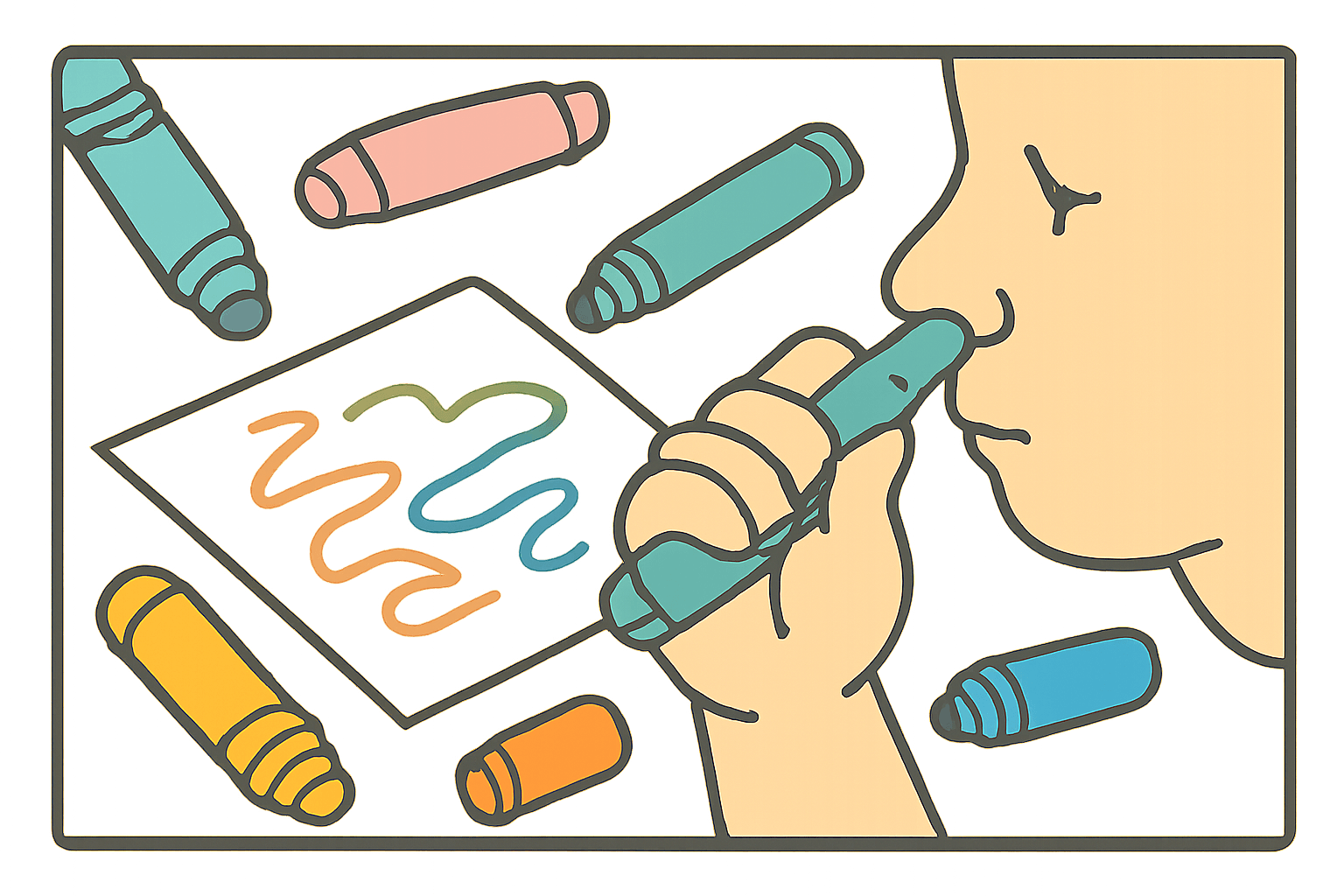
You didn't smell these markers the way you'd smell a flower or a candle. You didn't hold them at a polite distance and gently inhale. No. You pulled the cap off and you put the marker directly under your nose - sometimes touching your nose, sometimes actually in contact with the inside of your nostril if we're being honest - and you breathed in like you were coming up for air after being underwater.
You put the marker directly under your nose and breathed in like you were coming up for air after being underwater. This was standard operating procedure. Nobody questioned it.
This was not considered unusual behavior. This was standard operating procedure. The teacher would hand out the markers and for the next thirty seconds, the entire class would be sitting there with markers pressed to their faces, eyes half-closed, sniffing with the intensity of a sommelier at a wine tasting, except they were eight and the wine was a fat marker that smelled like fake blueberry.
And then there was always That Kid. You know the one. The one who didn't just sniff the marker but kept sniffing it. Who held the cherry marker under their nose for the entire art period. Who wasn't drawing at all, really, just sitting there in a cloud of artificial cherry scent like a tiny, motionless dragon guarding a hoard. The teacher would eventually say something - "Tyler, the markers are for drawing" - and Tyler would nod and slowly lower the marker and then, thirty seconds later, it was back. Right under the nose. Tyler knew what he was about.
The Drawing Was Secondary
This is the part that gets lost when people talk about Mr. Sketch markers as an art supply. They were not an art supply. They were a scent delivery system that happened to also make marks on paper.
The actual drawings you made with them were terrible. The tips were too fat for detail. The chisel edge meant your lines were either weirdly thick or weirdly thin depending on the angle, and you never got the angle right. The ink bled through every piece of paper the school provided, which meant whatever was on the desk underneath now had a mirror-image ghost of your drawing on it. If you were drawing on a worksheet, the back of the worksheet was destroyed. If you were drawing on construction paper, you had about ninety seconds before the paper got soggy and started pilling.
None of this mattered. The drawing was the excuse. The smell was the experience.
You'd pick up the cherry marker and take a long, satisfying inhale, and then draw one small line, and then smell it again. The ratio of sniffing to drawing was probably four to one. Five to one on a good day. The finished product - a lopsided house, a sun with too many rays, a family of stick figures standing on a stripe of green grass floating in white space - smelled incredible. You could press your face into the paper and get a faint whiff of every color you'd used, a bouquet of fake fruit and regret.
The Discourse
The scent hierarchy wasn't just private knowledge. It was social currency. You could bond with someone over a shared love of blueberry. You could start a legitimate argument about whether grape belonged in the top tier. You could establish your entire personality by being the kid who actually liked the cinnamon one - a controversial stance that marked you as either brave or broken, nobody was sure which.
"Smell this one."
That sentence was spoken ten thousand times in every elementary school in America between 1990 and 2002. Sometimes it was an invitation - smell this, it's amazing, you're going to love it. Sometimes it was a trap - smell this, and then they'd hand you the licorice marker and watch your face crumple like a paper bag.
I was in an art supply store last year and I saw them. Same box. Same flat cardboard tray. Same fat markers in a row, caps color-coded, the word "Scented!" printed on the packaging like a promise and a warning.
I picked up the box and I opened it and the smell hit me before I'd even pulled a cap off. Just the ambient scent of twelve markers in a confined space, a sweet, chemical, unmistakable cloud that transported me so fast and so completely that I actually looked around to see if anyone had noticed me time-traveling in the marker aisle.
I pulled the cap off the red one. Cherry. I held it up and I breathed in and it was exactly the same. The exact same fake-sweet, too-strong, not-quite-cherry cherry smell that I hadn't smelled in twenty years but that my brain had apparently been keeping on file this whole time, perfectly preserved, waiting.
I stood there for a while, holding a marker under my nose in a store, like Tyler. Like every kid who ever understood that some things don't need to be useful or productive or even particularly good. They just need to smell like cherry. And you just need to stand there and breathe it in and remember what it felt like when that was enough.
I bought the box. I don't have kids. I don't draw. They're in a desk drawer now, next to a stapler and some batteries. Sometimes I open the drawer and the smell drifts up and I'm eight years old, reaching across a table, hoping nobody's taken the red one yet.
Somebody always has. But that's okay. Blueberry was right there the whole time, waiting to be everyone's very close second.