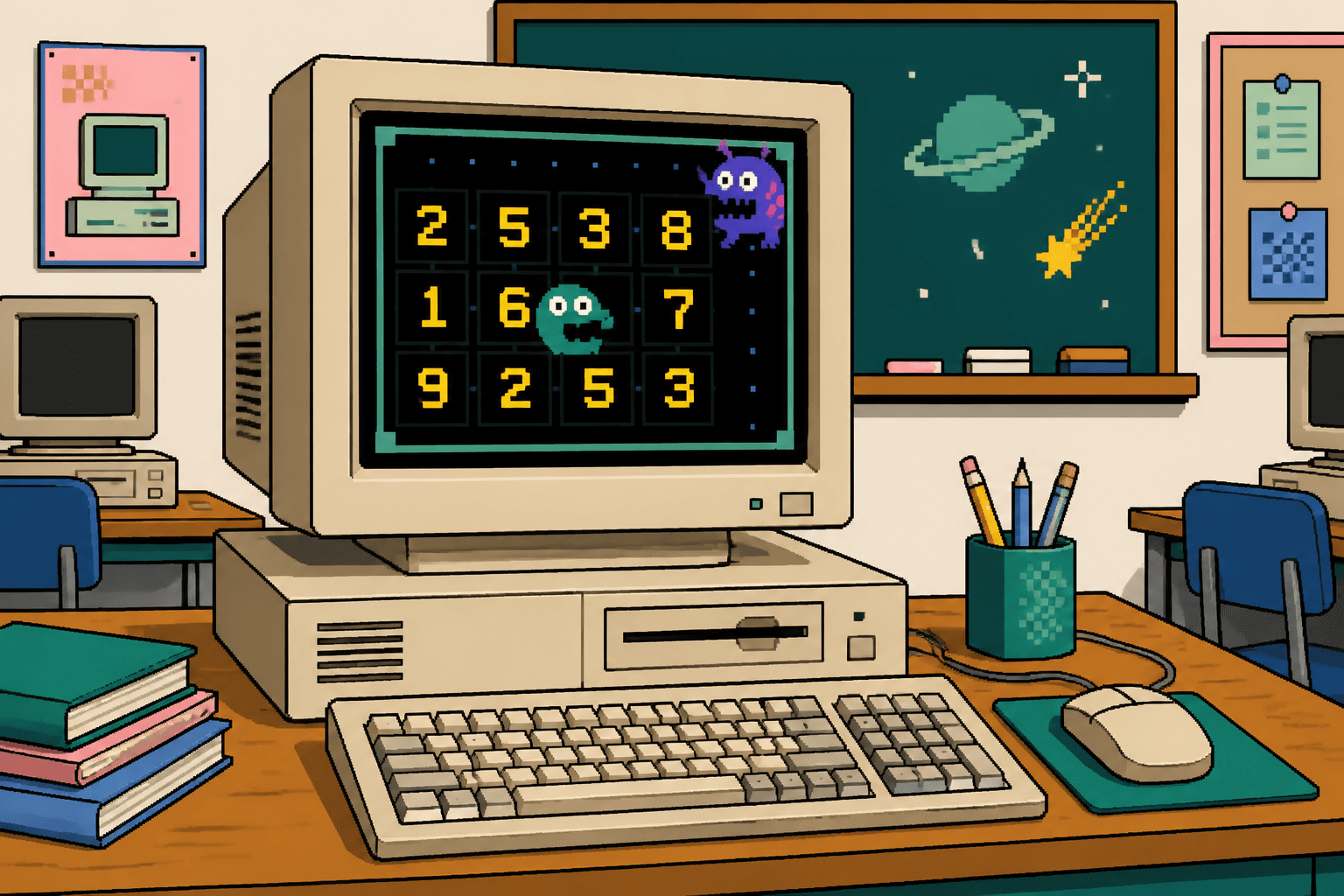
The Muncher was a green blob with a mouth.
That was it. No arms. No legs. No name that anyone I knew ever said out loud. He was called the Muncher in the manual and just you in the game, and you moved him around a grid of numbers with the arrow keys, and when you were sitting on top of a number that fit whatever the top of the screen said, you pressed the spacebar and he opened his mouth wider than physically possible and he ate the number, and something in the corner said CORRECT, and you were now a person who had done math today.
Then a purple monster came in from the side and tried to kill you.
The Grid
The premise was arithmetic. Or the game was pretending it was arithmetic. It was actually spatial reasoning under a time constraint, with the arithmetic as the filter.
The top bar said something like MULTIPLES OF 3, or GREATER THAN 6 x 4, or PRIMES, or FACTORS OF 24. Below it, a five-by-five grid, and in each cell a number. Some of the numbers were correct. Some were not. Your job, as the green blob, was to move to each correct cell and eat it. When you had eaten all the correct ones, the grid was cleared, the level went up, the numbers got harder, and the troggles arrived.
The troggles had not been there in the first thirty seconds. That is important. The game gave you a grace period. The game let you feel, briefly, like you had it under control. Then the troggles arrived.
The Troggles
I need to talk about the troggles.
They were purple. They came in from the sides of the grid. There were, depending on the level, one or two or three of them, and they were not, in the strict sense, monsters. They were classified in the manual as creatures, which is what a game design document says when it does not want to commit to whether the players will be afraid.
They moved around the grid on the same rails you did. They ate numbers, sometimes eating the correct ones before you got to them, which was infuriating in a way that only a piece of educational software can be. If they got to your cell, they ate you. The screen flashed. The Apple II speaker made a sound. You had lost a Muncher.
The troggle was not, in the strict sense, a monster. It was classified in the manual as a creature, which is what a game design document says when it does not want to commit to whether the players will be afraid.
There was one troggle that looked like a beehive with legs. There was one shaped like a small purple squid. There was one that was, essentially, a mouth on legs, and I have always suspected that this one was some kind of evil cousin to the Muncher himself, and that the whole thing was a family drama that we, at nine, were not equipped to understand.
The Sound
The sound of Number Munchers was the sound of an Apple IIe speaker beeping through a plastic box the size of a domino.
When you munched a correct number, you got a two-note ding, cheerful, curt. When you munched an incorrect number, you got a low flat BLEEEP that meant no, and the Muncher played a small animation of getting sad and dying, and the sad-and-dying Muncher was the closest thing to an emotional performance ever produced on the Apple II platform. Nobody at MECC was trying to make you feel bad. But your Muncher had died, and it was your fault, because six was not a prime, and you should have known that, and now the room was going to see your score at the end.
The Grid Itself
Arrow keys to move. Space to munch. The troggle takes a few seconds to show up, and then he is faster than you think he is. You have three Munchers. You are, briefly, whatever grade you were in when you last played this.
Was It Actually Math
Here is the argument I have been having with myself while writing this.
Number Munchers was, arguably, math. You did in fact identify multiples and factors and primes. If you played the game for an hour, you did more arithmetic than a worksheet would have gotten out of you, and you did it faster, because you were running from a troggle. The gamification of drill was, at some level, working.
But you were not learning math in the way the teacher had promised your parents you were. You were learning how to recognize a number that fit a category faster than a purple beehive could reach it. Which is a real skill, and possibly a more useful skill than long division, but it is not what the district had budgeted for. You were, in essence, being trained as a mid-level pattern matcher in a system where the wrong pattern got you eaten.
Which, in retrospect, was extremely useful preparation for the rest of your working life.
- MULTIPLES OF 3
- FACTORS OF 24
- PRIMES
- GREATER THAN 6 x 4
- EQUAL TO 12
- LESS THAN 10 + 7
- The one where the numbers had decimal points and you gave up
- The one that was fractions, which nobody made it past
The Grade You Got
There was no grade. That was the trick.
You played Number Munchers on Wednesday afternoons in the computer lab, thirty minutes at a stretch, and when the timer went off Mrs. Whatever hit the light switch and everyone had to save. It was not tested. It did not go on your report card. You did not get a certificate, unless it was one of the specific weeks where the teacher had printed one out on the dot matrix printer with your name on it and MATH MUNCHER OF THE MONTH in a font that had eleven ink dots per letter and would smear if you carried it home in the rain.
Number Munchers was, structurally, a bribe. It was the reward for doing the math on the worksheet. The Muncher was the payoff. The troggle was the risk. The classroom was the currency.
The lack of a grade was the whole point. Number Munchers was, structurally, a bribe. It was the reward for doing the math on the worksheet in the morning, or for finishing the reading, or for behaving during the science lesson about magnets. The Muncher was the payoff. The troggle was the risk. The classroom was the currency. And the deal was: if you did your job at the desk, you got thirty minutes to be the little green blob with the mouth. If you didn't, you sat at your desk and watched other kids get up and walk single-file out the door.
- The classroom teacher had a headache
- It was raining and recess had been canceled
- Standardized testing was next week and someone had decided the computer would help
- The regular teacher was out and the substitute did not know what to do with you
- It was one specific Thursday a month when it was your class's turn and this was reason enough
- Mrs. Whatever had been assigned lab duty and was doing her nails
The Muncher Persists
You cannot really play Number Munchers anymore. You can, if you want, and it is not hard to find. There is a browser emulator. There is a phone app. There are YouTube videos where a grown adult with a good microphone plays through all fifty levels and explains the strategy. But you cannot play it the way you played it, because you are not sitting in a room full of second graders on a Wednesday afternoon, and the machine is not a beige plastic Apple IIe with a green-on-black monitor, and the sound is not coming out of an internal speaker the size of a cracker.
You cannot recreate the room. Which is fine. Everybody who tries to recreate the room ends up disappointed.
But the Muncher is still there, somewhere, on a server in a museum somewhere, sitting on the number 9 with a category above his head that says PRIMES, waiting for someone to press space and reduce him, one more time, to a small pile of pixels.
He does not seem to mind. He was designed for this.
The last thing I remember is that you got extra points for eating a troggle. This was possible, though the game did not advertise it, because the troggles moved on the same grid you did, and if you were on a number and the troggle came to your cell, you got eaten. But if the troggle was standing on a wrong number and you moved to that cell first, you ate the troggle instead.
This was, structurally, cheating. You were not supposed to eat troggles. You were supposed to eat numbers. But the game let you do it anyway. And if you were the kind of kid who figured out that the wrong numbers were, from a certain angle, a trap for the troggles, you were going to grow up to be a certain kind of person, and I do not entirely know what that says about me. But I know that at the age of eight I once, in front of an entire second-grade class, ate three troggles in a row by luring them onto the number 15 when the category was PRIMES, and I remember it more clearly than I remember most of what happened this April.
The game gave you a bonus for that. It did not say anything else about it. It just gave you the points.