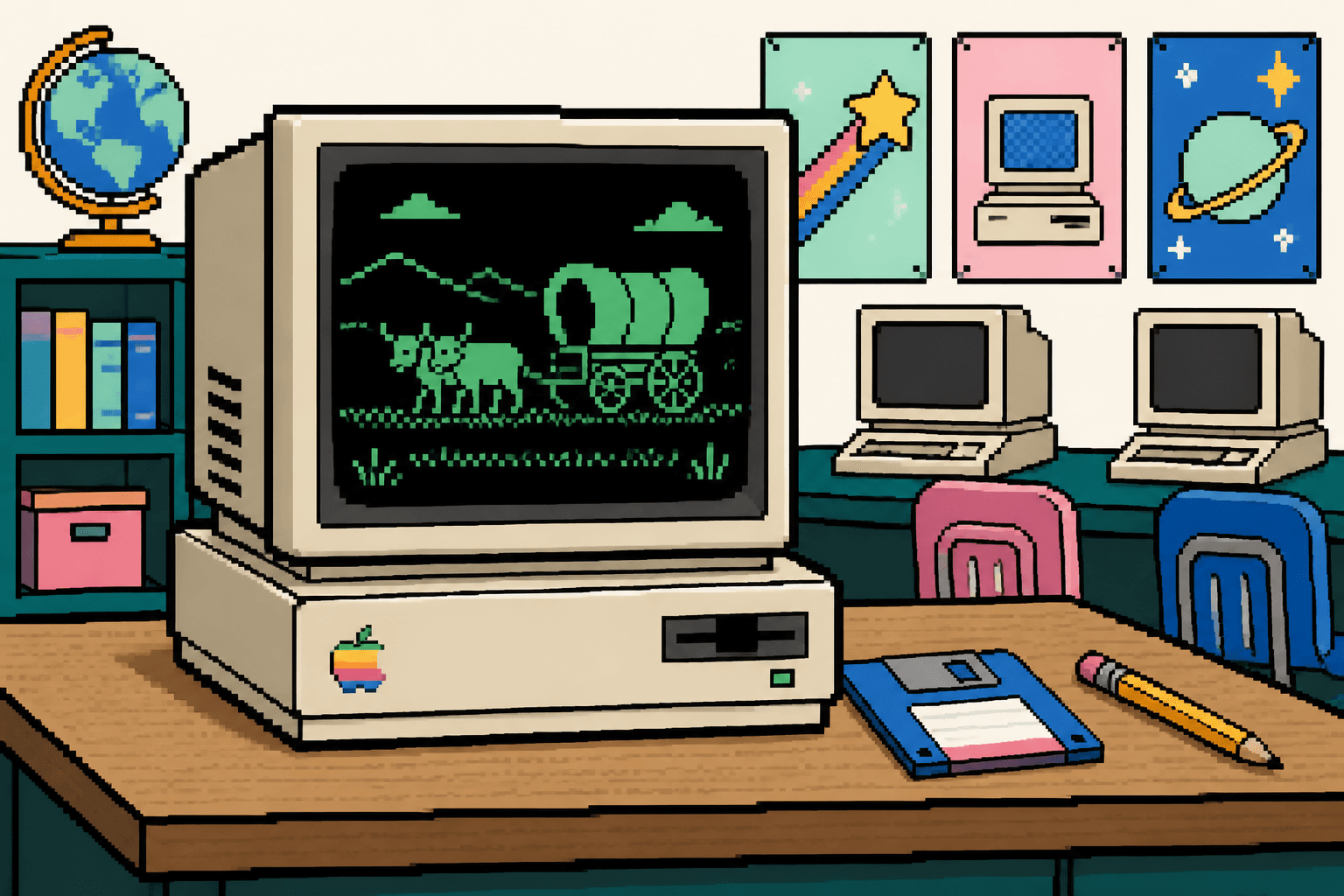
It was a Tuesday in November and the substitute had wheeled the cart in. Eight beige Apple IIes, each on a separate desk, each humming at a slightly different pitch. A black 5.25 inch floppy went into a slot the size of a sandwich. The drive made a sound like a dental tool. The screen went black. Then green letters fell into place from the top of the screen, one row at a time, and the room got very quiet.
THE OREGON TRAIL. In a font that was somehow already older than we were.
The teacher said something about learning the difficulties of westward expansion and then sat down at her desk to grade quizzes. We did not learn about westward expansion. We learned how to kill a buffalo.
Naming the Party
The first decision was who you were. Banker, carpenter, farmer. The banker had the most money and the lowest score multiplier, which meant any kid who wanted to brag at the end picked farmer and any kid who wanted to win picked banker. Most of us picked banker.
The second decision was who came with you. Five blanks. Five names. This was where the game got personal.
You'd type in your name first. Then your best friend, who was sitting two computers down and could see what you were doing. Then your other friend. And then, for slots four and five, the kids you needed dead.
Tyler. Then Jared. Tyler had taken your jacket at recess. Jared had said the thing about your mom. Now Tyler and Jared were in your wagon, eating your rations, and the game would handle the rest. The game was a small mercy. The game would do it for you.
You named the wagon party after the kids you needed dead. The game would handle the rest.
You knew, at some unspoken level, that one of them would die in the first hundred miles. Snake bite, dysentery, fell out of the wagon. It didn't matter which. The point was that the game had a Random Tragedy Engine and you could aim it at someone specific. This was the most useful piece of software an eleven year old had ever encountered.
The Stated Mission vs the Actual Game
The cart, the oxen, the supplies, the map. The trail running from Independence, Missouri to Willamette Valley. The little box that told you the weather and the number of miles per day. The teacher's lesson plan was somewhere in there. Pace yourself. Manage your rations. Trade with other travelers. Learn what it took to settle the West.
Nobody was doing any of that. Everybody was hitting the spacebar to fast forward to the next stop, then the next stop, then the next stop, until the green prompt at the bottom of the screen said HUNT FOR FOOD? and we all leaned forward.
The hunt was the actual game. The rest was packaging.
The Hunt
You pressed Y. The screen redrew. Now you were a tiny green stick figure in the corner of a black field, with a crosshair you could move around with the arrow keys and a spacebar that fired one bullet. Across the field, animals would walk in from the right side. Rabbits, fast and almost worthless. Deer, slower and worth more meat. Buffalo, lumbering, dead center, worth their entire body weight in score.
There was no music. There were no graphics, really. Just the green skitter of pixels moving left, and the dull thump when your shot landed, and the buffalo collapsing into a small horizontal bar of green that did not move.
You shot the buffalo. Then you shot another buffalo. You shot until the ammunition meter said zero and the screen reset and a single line of green text appeared at the bottom.
YOU SHOT 1,442 POUNDS OF MEAT.
You felt good. You had done a thing. You had provided for your family.
Then came the next line.
YOU WERE ABLE TO CARRY 100 POUNDS BACK TO THE WAGON.
The Hundred Pound Cap
This was, in retrospect, the most important sentence in the entire educational software industry of the 1990s.
The game would let you shoot as much as you wanted. It would not stop you. It would not warn you. It would let you empty your ammunition into a herd of buffalo and feel like a hunter, and then, only after you had committed to the killing, would it inform you that none of it mattered. The wagon could carry one hundred pounds. The buffalo weighed eight hundred. The other seven hundred pounds was, in the dry phrasing of the original screen, left on the prairie.
The phrasing was sterile. The implication was not. Somewhere, off camera, that meat rotted. The vultures ate. The grass got fertilized. You had killed an animal the size of a small car for one hundred pounds of dinner, and you had no way to undo it.
This was the first time I understood the concept of waste. Not the kind you got lectured about. The other kind. The kind where the game has rules and you have wants and the gap between them is just dead buffalo.
You had killed an animal the size of a small car for one hundred pounds of dinner. The other seven hundred pounds was, in the dry phrasing of the original screen, left on the prairie.
The game never explained the cap. There was no reason it had to be one hundred pounds. The wagon was full of clothes and bullets and spare wagon parts, and presumably there was room for one more saddle of buffalo, but there wasn't. The number was the number. The number was a wall.
A lot of the lessons of childhood are like this, looking back. The wall is the wall. Nobody is going to tell you why.
You Have Died of Dysentery
The other famous screen.
The tombstone. Pixel chiseled. RIP. A single tuft of grass underneath. Above the grass, the name of the dead kid. Below that, the cause of death, which the game pulled from a fixed list.
- Dysentery (most common, most famous, least understood)
- Cholera
- Typhoid fever
- Measles
- Snake bite
- Drowned at the river
- Broken leg
- Exhaustion
- Died at the river crossing (separate from drowning, somehow worse)
Then the prompt: DO YOU WANT TO LEAVE AN EPITAPH?
You did. You always did. You could type sixteen characters or so, and your sixteen characters were going to be the entire legacy of whatever poor pixel kid had just died of cholera near Fort Kearney, and you took the responsibility seriously. You typed HE STUNK. You typed NO LOSS. You typed something specifically mean about Tyler that the substitute would later be called over to look at, and you would get a what is this and a sigh and a request that you delete the file, which you would pretend to do.
The game preserved the epitaphs in some local registry. Other classes, on other days, would boot the same disk and see the same gravestone with the same message. HE STUNK haunted that disk for years. A pixel ghost in a one floppy graveyard.
Dysentery, by the way, is severe diarrhea. We did not know this at the time. We thought it was a special kind of trail disease that only happened on the way to Oregon. The teachers did not clarify. The teachers had given up.
The River
Then there was the river.
You would arrive at a river and the game would offer you four options: Ford the river. Caulk the wagon and float it across. Take the ferry. Wait for conditions to improve.
The ferry cost money. Waiting cost time. Caulking the wagon worked maybe half the time. Fording the river worked sometimes and got everyone killed the other times, and you couldn't tell from the river itself which kind of river it was. The game gave you depth and width and current speed in clean little numbers, and the numbers were a lie, because the numbers were not what determined whether you lived. A coin flip determined whether you lived. The numbers were there to make the coin flip feel like a decision.
We always tried to ford. We were eleven. Patience was for the ferry, and the ferry was for cowards, and time was for adults. We forded.
Sometimes you made it. Sometimes the wagon tipped and an ox drowned and Tyler drowned with it. The game told you, with great matter of factness, that Tyler was now dead, and you scrolled down to the tombstone, and you typed FINALLY, and the next river was sixty miles ahead.
The Defense
Look. The Oregon Trail was, structurally, an educational lie. The MECC engineers had made an action game and dressed it up in vocabulary words. Westward expansion. Settler. Wagon train. Independence. Those were real terms with real history behind them, and the game used them as set dressing for a buffalo hunting simulator with a tombstone generator. Whatever the teachers had hoped we would learn was not what we were learning.
But.
I know what dysentery is now, and I learned the word from a dead pixel kid. I know that the Oregon Trail was real, and I know it ran from Missouri to the Willamette Valley, and I know the rivers were the worst part. I know that some people did not make it. I know they buried a lot of children at the side of the trail. I learned these things because the game made me feel them, even in eight colors, on a screen the size of a paperback, with sound effects that mostly went blip.
I did not learn dates. I did not learn the names of the wagon trains. I did not learn the politics of the territory. I learned the texture. The texture was we left a lot of people on the way and we never went back for them.
Which is, maybe, the part the textbook couldn't have told us anyway.
The Drawer
I haven't made it to Oregon in any version of this game. Not the Apple II version. Not the deluxe color edition we got in fifth grade with the CD ROM. Not the browser ports. Not the iPhone reissue. I have always died west of Fort Laramie, of a thing the game thought was funny.
I don't think the game thought it was funny. I think the game was telling us, in the only way an Apple II could tell us anything, that this had happened to actual people. That people had died, and other people had typed a few sentences about them, and then the trail had continued, because the trail did not care.
The buffalo is still on the prairie. The hundred pounds of it that we could carry made it to the wagon. The other seven hundred is where we left it.
Some of us are still trying to figure out how to come back for it.