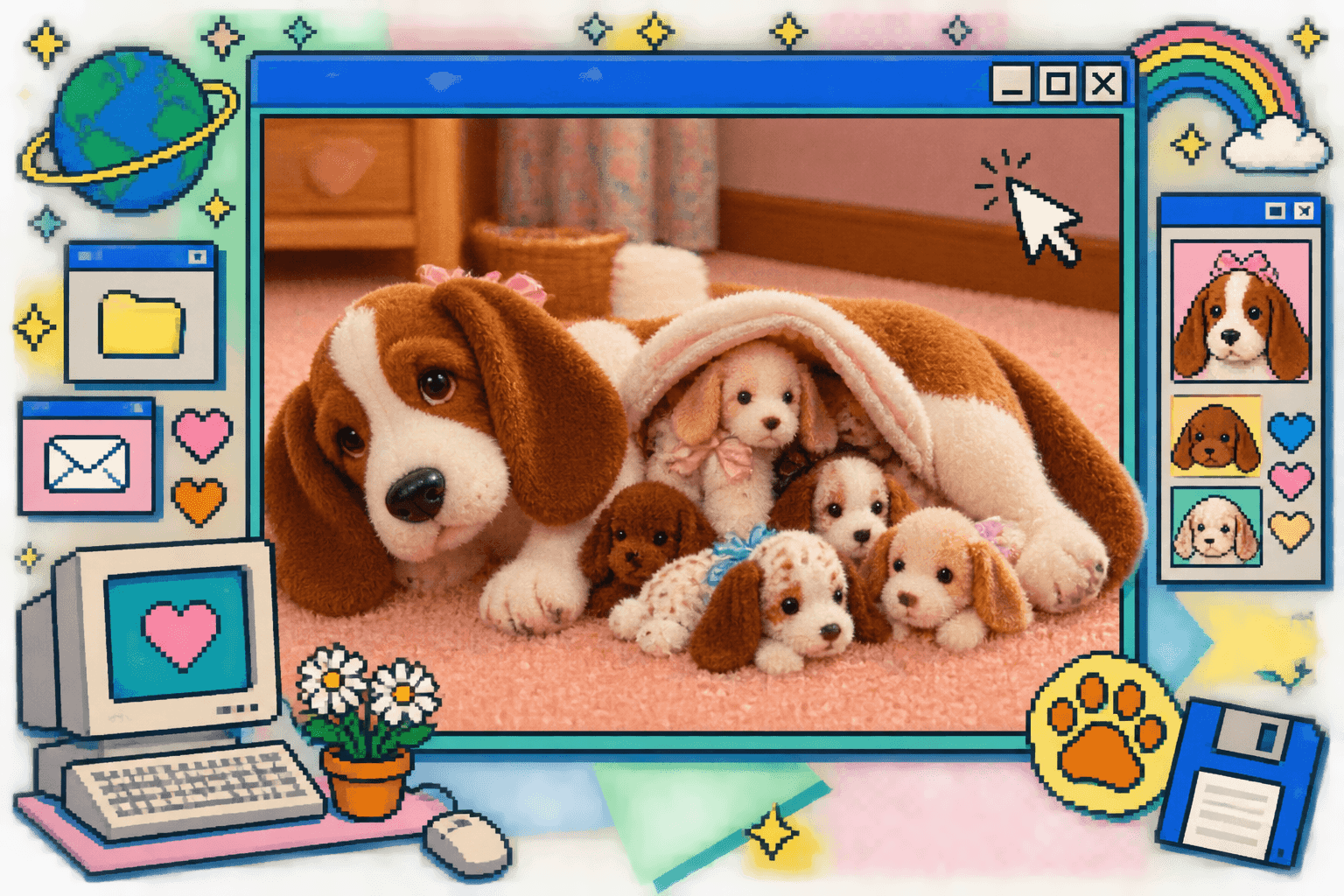
You were six. It was Christmas morning. Your grandma had bought it the week before at a Kay-Bee Toys in a mall two towns over, and she had wrapped it herself, badly, with the ends of the wrapping paper meeting on the top of the box in a diagonal seam held down by three overlapping pieces of Scotch tape.
You knew what was inside before you opened it. Everybody knew. The box was a rectangle the size of a shoebox turned on its side, and the front had a die-cut window, and through the window you could see, at a slight angle, the top of a plush basset hound in a red satin bow. The word PUPPY was on the side of the box in a bubbly font. The word SURPRISE was underneath it, in a slightly smaller font, with an exclamation point.
You did not open the box first. You opened everything else first, because that was the ritual, and your mother had a specific order she liked - socks and pajamas from the top of the pile, then a middle round of medium presents, then the big one at the end. Puppy Surprise was the big one. Puppy Surprise had earned that spot because Puppy Surprise contained, in a Velcro pocket sewn into her belly, a variable number of tiny plush puppies, and the variable number was the whole point.
The box said three OR FOUR OR FIVE.
The commercial had hinted at six.
Nobody knew what you would get until you opened her.
The Product Was a Small Casino
Let me be exact about the mechanic, because it is the whole essay.
Puppy Surprise, launched by Hasbro in 1992 under the Tyco toy label (which Hasbro later absorbed, the way Hasbro absorbed most of the toy category by 1998), was a plush mama dog - usually a basset hound, sometimes a cocker spaniel or a golden - with a slit sewn into the underside of her belly. The slit was closed with a strip of Velcro. Behind the Velcro was a pouch. Inside the pouch was a litter.
The litter was not the same in every box.
Each Puppy Surprise on the shelf at Kay-Bee Toys contained three, four, or five puppies. The box said so, explicitly, in a font that was pretending to be casual but was, structurally, disclosing the odds of a lottery to a parent who had not asked. The commercial, which ran on Saturday morning cartoons in a specific rotation that hit you between Muppet Babies and Beetlejuice, said the same thing but sang it. How many puppies are inside? Three, or four, or FIVE.
The rumor - the whispered, playground, my-cousin-in-Toledo-got-one rumor - was that some boxes had six. Nobody I knew had ever confirmed this. Nobody I knew had ever met a person who had confirmed this. But the rumor persisted, because the rumor was structurally necessary. A distribution that terminates at five is a distribution with no upside. A rumor of a rare sixth puppy converts the toy from a small purchase into a small purchase with a dream, and the dream was worth the shelf space.
A distribution that terminates at five is a distribution with no upside. A rumor of a rare sixth puppy converts the toy from a small purchase into a small purchase with a dream, and the dream was worth the shelf space.
Try It
Tug the pouch open. Wait for the Velcro to give. Count what falls out. If you got three, that's the base draw. If you got five, brag. If you got six, you are lying, but so was the commercial.
The Unzip Was a Ceremony
You did not unzip Puppy Surprise alone.
You took her out of the box - and the box, unlike a lot of toys, was easy to open, because the box wanted you to open it fast, because the box knew that the actual product was the moment after the box - and you sat on the living room carpet, and everybody who was in the house at the time gathered around you, because everybody had, at some level, been thinking about the pouch since the moment they saw the die-cut window.
Your grandma was in her chair. Your mother was on the couch. Your father was standing behind the couch, holding a coffee mug and not sitting down, because he was not a sitting person on Christmas. Your older sister was, technically, not looking, because she was thirteen and had gotten a Discman and could not be seen to care about a plush dog, but she was also, in a strict sense, looking.
You put your hand on the Velcro pouch. You pushed a little. It gave a small crinkling noise, the noise Velcro makes when it is thinking about coming apart but has not decided.
You pulled.
The noise it made was not a rip. The noise it made was a specific, dry, papery rrrrrrp, which is the noise of a hundred small hooks letting go of a hundred small loops in sequence, from left to right, with a small pause in the middle where a stubborn stretch of Velcro decided to hold on for one more second before giving up. It was the noise a six-year-old would remember for the rest of her life, and it was the noise a marketing team in East Aurora, New York had spent, in some sense, real money to get right.
You looked inside.
The Count
There were puppies in there.
They were smaller than you had expected. Each one was about the size of a lime, with a stitched-on face and a satin bow tied around its neck (girls) or a satin collar around its neck (boys). Each one had a color. Each one had, on the bottom of one foot, a small plastic tag that said PUPPY SURPRISE and, in tiny print, Made in China.
You pulled them out one at a time. You put them on the carpet in a row.
One.
Two.
Three.
You reached in for a fourth. Sometimes there was a fourth.
You reached in for a fifth. Rarely there was a fifth.
You reached in for a sixth, always, even if there had been five, because the rumor of the sixth was, mechanically, load-bearing. You pushed your whole hand into the pouch, past the wrist, up to the elbow, feeling around the corners of the belly, checking behind the seam, and the pouch was, in every case, empty of any sixth puppy, but the check was mandatory.
You looked up. Your grandma said how many did you get. You said five, or four, or three, and your grandma said oh, five, that's a lot, or oh, four, nice, or oh, three, that's still a good litter, in a tone that was calibrated, whatever the number, to make you feel like you had drawn well.
You pushed your whole hand into the pouch, past the wrist, up to the elbow, feeling around the corners of the belly, checking behind the seam. The check was mandatory.
The Odds
I want to sit with this for a second, because it is worth sitting with.
The box said three, four, or five. It did not say the odds. It did not say that three was more common than five, or that five was more common than three. It did not say that four was, in a strict statistical sense, the modal outcome. It gave you a range, and it let you assume the range was uniform, and the range was, almost certainly, not uniform.
I have not been able to find, anywhere on the internet, an official Tyco or Hasbro statement of the actual per-litter distribution. I have looked. There is a subreddit for 90s toys where somebody has claimed, without a citation, that five-puppy litters were roughly one in five boxes. Somebody else in the same thread has claimed it was one in twelve. Somebody else has claimed the store-brand cocker spaniel version had different odds from the flagship basset hound. I cannot verify any of this. The distribution is folklore.
What I can tell you is that every kid I have spoken to about this remembers their number. They remember it exactly. They remember whether they got three or four or five, and they remember whether their friend got more or less, and they remember whether they told anybody at school on the first day back after Christmas break, and they remember whether they were believed.
The number was, for a small window of your life, a statistic about you. It was a thing that had happened to you and only to you, and it was not something you had done. You could not have gotten more by wanting more. You could not have gotten fewer by trying to. The number was the number, and it was assigned by a factory worker in the mid-1990s who was, quite possibly, hitting a per-shift quota that specified a certain mix, and the mix arrived in a box that arrived at a Kay-Bee Toys that had two hundred boxes on the shelf, and your grandma had picked one of them, essentially at random, on a Wednesday, the week before Christmas, because the box she picked was near the front.
The Rest of the Family
There was a whole product line.
Kitty Surprise was the same body plan with a cat, and it had the same Velcro pouch, and it had the same random litter, and the kittens were smaller than the puppies because the mama cat was smaller than the mama dog, but everything else was the same. Kitty Surprise came out the same year, from the same team, and it sold, per what I can find, slightly less well, because dogs test better with the six-year-old demo. I do not know why. Nobody I have asked knows why. It is possible that at six, you understood dogs to be more of a family animal than cats, and Puppy Surprise was, in its architecture, a family drama.
Pony Surprise was the same idea but with a plush horse and, per the box, a foal or two. The plush horse was the size of a shoebox, and the foals were the size of golf balls, and the whole thing was, structurally, a joke - a mama horse who had given birth to two foals the size of golf balls and stored them in her stomach was a violation of every visual convention of the source material, and nobody I knew owned one. I have to assume they exist.
Bunny Surprise was the Easter tie-in. I remember one at a friend's house. The bunnies had bows on their ears.
Puppy Surprise Newborns was the follow-up product, released a couple of years later, and it was smaller, and the litter was a fixed number (three, always three), and the puppies did not have bows, and the mama did not have a Velcro pouch - she had a zipper - and the whole thing was, in some deep way, worse. The variance was the game. Removing the variance and calling it newborns was, I think now, a marketing team giving up on the gambling mechanic because a parents' group had complained.
- Puppy Surprise (basset hound, three to five, ceremony intact)
- Kitty Surprise (three to five, slightly smaller stakes)
- Bunny Surprise (Easter, bows on ears, fewer)
- Pony Surprise (foals the size of golf balls, absurd)
- Puppy Surprise Newborns (fixed litter, zipper, joyless)
The Argument
I want to give the counter-argument, because it deserves airtime.
The counter-argument is that Puppy Surprise was a toy that ran a small lottery on a six-year-old, and that the whole design was, in retrospect, a training program for exactly the kind of variable-reward mechanic that would, twenty years later, be the whole business model of every free-to-play mobile game on your kid's iPad. Puppy Surprise taught you to sit on a carpet and open a sealed container and feel a small burst of excitement when the container revealed a slightly-better-than-baseline outcome. Puppy Surprise taught you to check for the sixth puppy that would never come, and to keep checking, because the rumor of the sixth was the whole hook.
You could argue that the six-year-old brain does not need to be trained on variable rewards, because the six-year-old brain is a variable-reward machine by default, and Puppy Surprise was just harnessing a thing that was already there. A kid who does not have Puppy Surprise still opens birthday cards hoping for a bigger check inside. A kid who does not have Puppy Surprise still checks the pockets of a coat she has not worn since spring to see if there is a dollar in there. The mechanic is native. Puppy Surprise did not invent it. Puppy Surprise just packaged it in a plush basset hound and charged nineteen ninety-nine.
But it also gave you, at six, a specific and repeatable experience of reaching your hand into a container to see how many you would get. That is loot-box behavior, and the loot box is now a thirty-billion-dollar industry that gets kids in trouble at fifteen for spending their allowance on Fortnite skins, and the through-line from the Velcro pouch to the Fortnite skin is, I think, real. Not the whole story. Not the only cause. But real.
The unzip was a gambling ceremony. We just had not learned to call it that yet.
The Other Side
But here is the thing.
You got the puppies.
I say this with confidence, because I have played a lot of loot boxes since, and the thing about the loot box, the modern loot box, is that the loot is a picture. It is a skin, a color, a small pattern of pixels that lets you show up in a match looking slightly different from the other kids. The loot box gives you a receipt, and the receipt gives you a permission to look a certain way in a shared virtual space, and the permission expires when the game does.
Puppy Surprise did not do this. Puppy Surprise gave you the actual objects. Whatever number of puppies were in the pouch, they were now yours. They were on the carpet. They had faces. They had names, once you thought about it for a few minutes - and you thought about it for a few minutes, because naming was part of the ceremony. Biscuit. Rusty. Daisy. Cocoa. Buttons. You lined them up. You gave the smallest one the name that felt like it belonged to a smallest one. You put them in a plastic Easter basket and carried them around the house.
The puppies were not consumable. They did not despawn. They did not require a subscription. Nobody at Hasbro could take them away from you by patching the game. They sat in the pouch of the mama dog for the rest of your childhood, and the mama dog sat on the shelf above your dresser, and the Velcro on the pouch got weaker every year until, by the time you were nine, the pouch would not close all the way and one of the puppies would fall out and land on the carpet in the middle of the night, and you would step on it in the morning barefoot on the way to the bathroom, and it would be one of the small hard indignities of childhood, but it would be your indignity, because it was your puppy, and the mama dog was your mama dog, and the whole small family lived in your bedroom because your grandma had, on a Wednesday, at a Kay-Bee Toys, picked a box.
The puppies were not consumable. They did not despawn. Nobody at Hasbro could take them away from you by patching the game.
The Kid Who Got Five
There was always a kid who got five.
She sat two rows over in Ms. Kroeger's first-grade class, and on the first day back from Christmas break she told the whole table that her Puppy Surprise had five, and everybody said no way, and she said yes way, and one of the boys said his cousin got six once, and she said that was a lie, and he said it was not, and then Ms. Kroeger said everybody sit down and get out your journals, and the argument stopped mid-sentence, and it did not resume for the rest of the day.
I remember, because I was at that table. I got four. I was okay with four. Four was, I understood even then, a fine number. But four was not five, and five was not six, and the kid who claimed six was not, on close inspection, credible, but the kid who claimed five was maybe telling the truth, and the kid who claimed five got to be, for about eleven minutes of first grade, the most interesting person at the table.
She was the same kid who, later in the year, got the Barbie Dream House. She was on a run.
The Successor
Puppy Surprise is still around.
Just Play, the toy company that now owns the brand, relaunched Puppy Surprise in 2016 with a slightly updated mama dog - shinier fur, a bigger head-to-body ratio, more of an anime look around the eyes - and the same Velcro pouch and the same variable litter. The current box says three or four or five. The odds are, as far as I can tell, still not published. There is a YouTube unboxing subculture around it now. There are children on YouTube, in front of ring lights, unboxing Puppy Surprises for other children, and the other children watch the unboxing, and the algorithm serves them another unboxing, and the loop is complete.
The current Puppy Surprise has, per the parents' reviews on Amazon that I have read for research purposes, one important difference from the original. The Velcro is louder. It has, apparently, been re-engineered to make a bigger, crisper rrrrrrp when you open it, because the market research says the unzip is what the kid remembers, and the unzip is what closes the sale on the second one.
They are not wrong. The unzip is what I remember.
What Happened to Mine
My Puppy Surprise is in a box in my parents' attic, next to a Beanie Baby collection that never appreciated and a stack of Lisa Frank folders that my mother would not let me throw out. I know this because I asked. My mother said yes. She said, do you want it, and I said, maybe, and she said, when you come home for Thanksgiving I can bring it down, and we both, I think, understood that I was not going to take it. It would sit in my house, on a shelf, and it would look at me, and I would feel bad about the sagging Velcro pouch, and eventually I would put it in a bag for Goodwill, and I would feel worse about that. Better to leave her in the attic.
I remember what I got. Four. Three girls and a boy. The boy was cream-colored with a small brown patch on his back that was not, technically, a design feature - it was a factory quirk where a piece of brown fabric had been sewn in by mistake, or where a color had bled during a wash cycle, or where somebody in the assembly line had grabbed the wrong piece from the wrong bin. I loved the boy the most, because he was defective, and I understood, at six, that a defective thing was, in a specific sense, the thing that was mine. Nobody else had one exactly like him. If somebody at school had shown me their four, I would have shown them my three girls and I would have shown them the boy with the brown patch, and I would have won, without saying anything, because he was proof that my box had been mine and not anybody else's.
I named him Cocoa. He is, presumably, still in the attic. He is, presumably, still cream-colored. The patch, I hope, is still on his back. If I go get her out of the attic at Thanksgiving, I will check. If the patch is still there, I will keep him. I will let the mama dog go to Goodwill, and I will keep the boy with the patch on his back, because the patch is the whole reason.
A parent bought a plush dog. A child opened a pouch. A factory mistake made one of the puppies uniquely mine. A grandma, on a Wednesday, at a Kay-Bee Toys in a mall two towns over, reached out and picked up the box with him in it, without knowing what she was picking. The whole thing was, in a strict sense, a lottery. I still won.