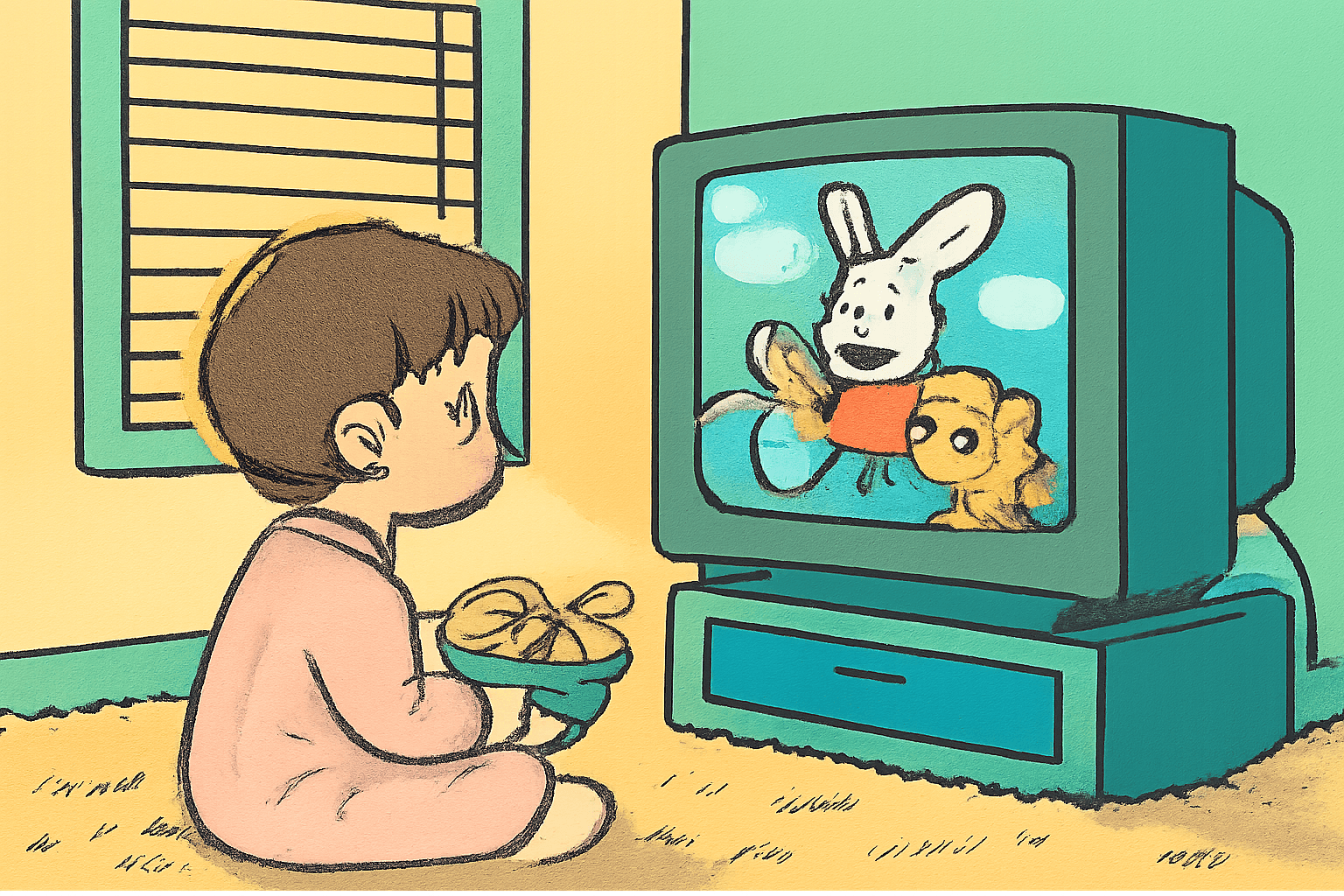
The carpet was cold.
You knew because you'd been sitting on it since 7:58 AM, cross-legged in pajamas that had definitely been worn Thursday night too, holding a bowl of cereal that you'd poured yourself in the dark kitchen because nobody else was awake yet. Your parents wouldn't stumble out for another hour and change. The whole house was yours. The TV was yours. And in about two minutes, the Fox Kids block or the Kids' WB lineup or the ABC Saturday morning slate was going to start, and you were going to watch every single second of it, because that was the deal.
Nobody told you to be there. You just knew.
The Schedule Was the Whole Point
Here's what's hard to explain now: the shows didn't exist any other time.
You couldn't just watch X-Men whenever you felt like it. You couldn't pull up Animaniacs on a phone at lunch. If you wanted to see Batman: The Animated Series, you had to be in front of a television on Saturday morning at the exact moment it aired, or you were waiting a full week. Seven days. An eternity when you're nine.
That constraint did something to your brain. It made the cartoons matter in a way that unlimited access can't replicate. Missing an episode because you had a dentist appointment felt like a genuine tragedy. You'd ask your friends at school on Monday, "Did you see it? What happened? Did Wolverine do the thing?" and you'd live vicariously through their retelling, which was always bad, because ten-year-olds are unreliable narrators.
The shows didn't exist any other time. If you weren't in front of the TV at 9 AM, you missed it. That was the whole contract.
And the networks knew what they had. They programmed those three hours like generals moving armies. The strongest show went at the top of the lineup, at 8 AM, to lock you in. Then they stacked the next two hours with a mix of sure things and new experiments, knowing you weren't going to change the channel once you were committed. The remote was across the room. The cereal was in your lap. You were staying.
The Cereal Industrial Complex
Let's be honest about the other half of this. Saturday morning cartoons were a delivery mechanism for sugar.
Every commercial break was a parade of things you were about to start screaming at your mother about in the grocery aisle. Cookie Crisp. Rice Krispies Treats cereal, which was somehow a real product that existed. The cereal mascots were cartoon characters themselves, basically indistinguishable from the shows, which was absolutely by design. Tony the Tiger and Cornelius the Rooster and Dig'em Frog all showed up with the same animation style as the programming they were interrupting.
You'd watch a commercial for a cereal with a prize in the box and immediately, urgently need that prize. A glow-in-the-dark spoon. A plastic decoder ring. A tiny CD-ROM with a demo of a game you'd never actually play. The calculus was always: is the prize worth eating the cereal? Usually the answer was yes, even if the cereal was basically colored gravel.
- The Cereal Ad - 60% of all advertising. Always showed the prize for at least three seconds.
- The Toy Ad - Featured kids having the time of their lives with a plastic thing. The "batteries not included" disclaimer scrolled at the bottom at the speed of light.
- The Fruit Snack Ad - Gushers with people's heads turning into fruit. Still unsettling.
- The PSA - "The More You Know" with a gentle piano. Always about reading.
- The McDonald's Happy Meal Ad - Current toy tie-in. You needed it.
The toy ads were almost worse. Every thirty seconds, a new plastic thing was being demonstrated by children who appeared to be having the most fun of their entire lives. The Super Soaker. The Skip-It. The Sky Dancer, which was a tiny plastic fairy you'd launch at terminal velocity into a lamp. You wanted all of it. You couldn't have any of it. Birthdays existed for a reason.
The Shows Themselves Were Incredible
Can we just acknowledge that the actual programming was good? Like, genuinely good?
Batman: The Animated Series had film noir lighting and a score that sounded like Danny Elfman because it basically was. Animaniacs wrote jokes about Kierkegaard and Goodfellas and Bill Clinton that went straight over your head and landed in a box you'd open fifteen years later. X-Men had season-long arcs at a time when adult dramas barely attempted them. Gargoyles was a Shakespearean tragedy in a trench coat. Pinky and the Brain was a lab-mouse vaudeville act. Doug taught an entire generation how to have a crush on someone you'd never actually talk to.
Animaniacs wrote jokes that went straight over your head and landed in a box you'd open fifteen years later.
The rotating networks knew what they were doing. Fox Kids had the edge - Power Rangers and Goosebumps and a certain mid-decade chaos energy. Kids' WB had the personality - Warner Bros. characters cranking out Tiny Toons and Freakazoid and the Animaniacs universe. ABC had the family-friendly sheen. Nickelodeon was off doing its own thing on weekday afternoons and during SNICK, and that's a different essay.
Every network was playing for three hours of your attention, once a week. They brought their best.
The End of the Block
Around 11 AM, something cruel happened. The cartoons ended, and the Saturday afternoon sports coverage began.
Basketball. Golf. Bowling, even, if you were really unlucky. The switch was jarring. One second Captain Planet was heart-combining with his kid lieutenants, and the next, a man in a sweater vest was talking about someone's back-nine at Pebble Beach. This was the sign that the magic window had closed. You'd been banished back to the regular world.
You had choices at this point. You could go outside, which your mother was definitely going to suggest in about twenty minutes. You could ride your bike. You could try to recreate the cartoon you'd just watched with action figures on the living room floor, which was honestly just as good. You could go reread the same Goosebumps book you'd read four times already.
But you'd done the thing. You'd been there. The week's main event was over, and it was only lunchtime, and everything else was just filler until next Saturday.
The Slow Death
The thing nobody tells you about Saturday morning cartoons is that they didn't end all at once. They ended the way a lot of things in the 90s ended - slowly, then all at once, while nobody was really paying attention.
Cable happened. Cartoon Network launched and then Toonami, and suddenly you could watch animation every single day after school. Nickelodeon and Disney Channel stacked their weekday afternoons. The Kids' WB migrated, stretched thin, got absorbed. By the mid-2000s, the federal rules that required networks to air educational programming on Saturday morning had basically killed the block. The big networks quietly swapped cartoons for infomercials and kept-it-moving news shows and live-action teen sitcoms nobody watched.
The last official Saturday morning cartoon block on network TV ended in 2014. There wasn't a funeral. Most of us had stopped checking years earlier, because by then we could watch whatever we wanted whenever we wanted, and we slowly lost the muscle that made Saturday at 8 AM mean anything.
What We Lost
I'm not saying modern kids have it worse. They don't. They have more cartoons, better cartoons in a lot of cases, and infinite access to all of them. That's a real thing, and it's good.
But something's different about being able to watch anything whenever. When you can always have something, you don't wait for it. And the waiting was, I now realize, half of the pleasure. The Friday-night anticipation. The negotiating with your parents about bedtime so you could be sharp in the morning. The alarm clock you set for a cartoon block, which is maybe the purest form of childhood joy. The specific feeling of the house quiet around you and a cereal bowl warming in your lap and Bugs Bunny's voice coming through a tube TV that weighed eighty pounds and would outlive civilization.
I don't need my Saturday mornings back. I need the version of me who set an alarm for them.
He knew what he was doing. He was showing up for the best part of his week. Nobody made him. He just knew.