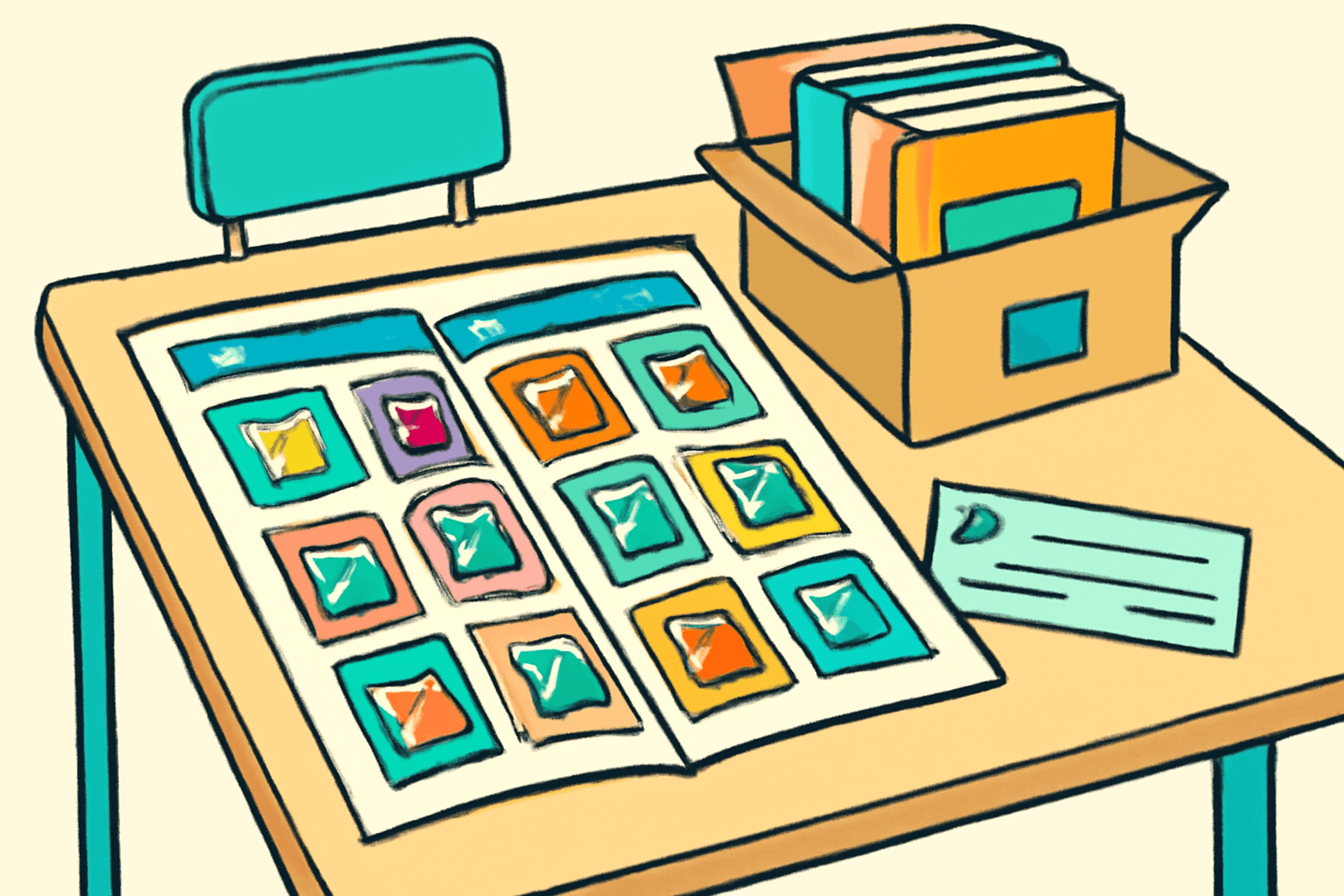
The flyer was printed on the thinnest paper known to science. Somewhere between newspaper and tissue, folded into quarters, already creased wrong by the time it hit your desk. Your teacher passed them out at the end of the day on a Tuesday or a Wednesday - never a Monday, never a Friday - and said something like "bring these back by next week with a check if your parents want to order." She said it like it was nothing. Like she hadn't just handed you the most important document of the month.
You unfolded it carefully. Both sides. Full color, mostly. Tiny cover images of books arranged in a grid, each one with a price that seemed almost fake. $2.95. $3.50. A whole book for less than a Happy Meal. You started circling before you even got on the bus.
The Catalog
The Scholastic Arrow book order - or Tab, or Trumpet, depending on your grade level - was a masterclass in wanting things. Every month a new flyer. Every month a new chance to believe that this time your parents would say yes to everything you circled.
And you circled a lot. You circled books you wanted. Books you'd heard of. Books you hadn't heard of but the cover looked cool. You circled the Animorphs because everyone was reading Animorphs and you needed to know what happened after Jake found out about the Yeerks. You circled Captain Underpants because it was the funniest thing that had ever existed and you didn't care what any adult thought about that.
Every month a new flyer. Every month a new chance to believe that this time your parents would say yes to everything you circled.
You circled Junie B. Jones. You circled Goosebumps, whichever new one had just come out, with the raised bumpy lettering on the cover you could feel with your fingers. You circled the Magic Tree House because you were maybe getting a little old for it but also Jack and Annie were going to ancient Egypt this time and you needed to know.
And then there were the things that weren't books.
The Non-Book Section
This is where the order form got dangerous. Because tucked in among the paperbacks, usually along the bottom or on the back page, were the extras. The posters. The erasers shaped like animals. The mini spy kits. The bookmark that was also a magnifying glass. A pack of scented markers. A doorknob sign that said "KEEP OUT - GENIUS AT WORK."
You circled those too. You circled all of them. The flyer looked like it had been attacked by a red pen in a windstorm.
- Erasers shaped like food (the pizza slice, the ice cream cone)
- Posters of kittens hanging from branches ("Hang in There!")
- A "spy pen" with invisible ink and a tiny UV light
- Scented gel pens that smelled nothing like what they claimed to smell like
- A book light shaped like a dolphin
- Sticker collections you'd use up in one afternoon
- The doorknob signs, always the doorknob signs
Then you brought the flyer home. You presented it to your mom or your dad at the kitchen table like a lawyer presenting evidence. Look. Books. Educational. Please. And they looked at what you'd circled - all seventeen items, totaling somewhere around forty dollars - and they got out a pen of their own.
The crossing-out began.
The Negotiation
This was your first real experience with budget constraints, even if you didn't know to call it that. Your parent went line by line. "You already have this one." Cross. "This isn't a book, it's an eraser." Cross. "What is Captain Underpants." That one could go either way. Sometimes you saved it. Sometimes you didn't.
The Animorphs usually survived. Goosebumps had a decent chance. The poster of the wolf howling at the moon did not. The spy pen did not. The scented markers absolutely did not.
You'd end up with maybe three or four things. Down from seventeen. It felt like a defeat at the time, but your mom would write a check - an actual paper check, folded around the order form - and you'd put it in an envelope and bring it back to school and hand it to your teacher like you were depositing something at a bank. The whole thing felt official. Important.
Then you waited.
The Wait
The wait was its own kind of torture. Two weeks, sometimes three. You'd forget about it for a while and then suddenly remember in the middle of math class and feel a jolt of electricity run through you. The books. Had they come yet? Were they on their way right now, in a truck somewhere, in a box with your name on it?
You'd ask your teacher. She'd say "not yet." You'd ask again two days later. She'd say "not yet" with slightly less patience. The order form had disappeared into whatever system Scholastic used to process ten million checks from ten million parents and turn them into ten million cardboard boxes, and you just had to trust that it was working.
You'd forget about it for a while and then suddenly remember in the middle of math class and feel a jolt of electricity run through you. The books. Had they come yet?
And then one day you'd walk into the classroom and there it was.
The Box
The cardboard box. Sometimes two. Sitting on your teacher's desk or on the floor next to it, with the Scholastic logo on the side and packing tape across the top. The entire class knew what it was immediately. The energy in the room shifted. Kids sat up straighter. Kids who never paid attention were suddenly locked in. Because the box was here and that meant the calling of names was about to happen.
Your teacher would wait until the right moment - sometimes after lunch, sometimes at the end of the day, which was cruel but effective - and then she'd open the box. She'd pull out stacks of books, each one bundled together or paper-clipped to an order slip, and she'd start reading names.
"Sarah." Sarah would walk up and get her stack. Four books and a poster rolled up in a rubber band. She'd carry it back to her desk like she'd won something.
"Marcus." Marcus got three books. One of them was Captain Underpants. Respect.
You'd sit there vibrating. Waiting. Watching everyone else get their names called, trying not to look too eager, completely failing at not looking too eager. And then finally - finally - your teacher said your name.
Your Stack
You walked up there. She handed you your books. Maybe three, maybe four. Whatever had survived the kitchen-table negotiation. They were brand new. That new-book smell, the spines uncracked, the pages crisp. These weren't library books that smelled like other people's houses. These weren't hand-me-downs from your older cousin with the corners bent. These were yours. Bought and paid for. Your name on the order slip.
You'd carry them back to your desk and arrange them. Look at the covers. Read the back of each one. Crack one open just to see the first page even though you were supposed to be doing something else. Your teacher usually gave everyone a few minutes. She understood. She'd been doing this long enough to know that the ten minutes after the Scholastic box opened were a lost cause for instruction.
I think about the Scholastic order form more than I probably should. Not the books themselves - though I still have some of them on a shelf somewhere, the spines faded, the covers soft from rereading. I think about the process. The wanting. The circling. The negotiation. The waiting. The moment your name got called.
There was no tracking number. No estimated delivery window. No push notification that said "Your order has shipped!" You just waited and then one day it was there, and the joy of it was inseparable from the not-knowing. The surprise wasn't what was in the box. You knew what you'd ordered. The surprise was when. And that made walking into the classroom every morning for those two or three weeks feel like it might be the day. Any day could be the day.
My kid orders books online now. They show up on the porch in two days, sometimes one. She tears open the mailer and she's happy, sure. But nobody called her name. Nobody watched her walk to the front of the room. She never sat at a kitchen table circling seventeen things in red pen, knowing she'd only get four, learning for the first time that wanting everything and getting something is actually a pretty good deal.
The box is on the porch. It was never on the porch. It was on Ms. Patterson's desk, and she was reading names, and yours was coming. You could feel it.