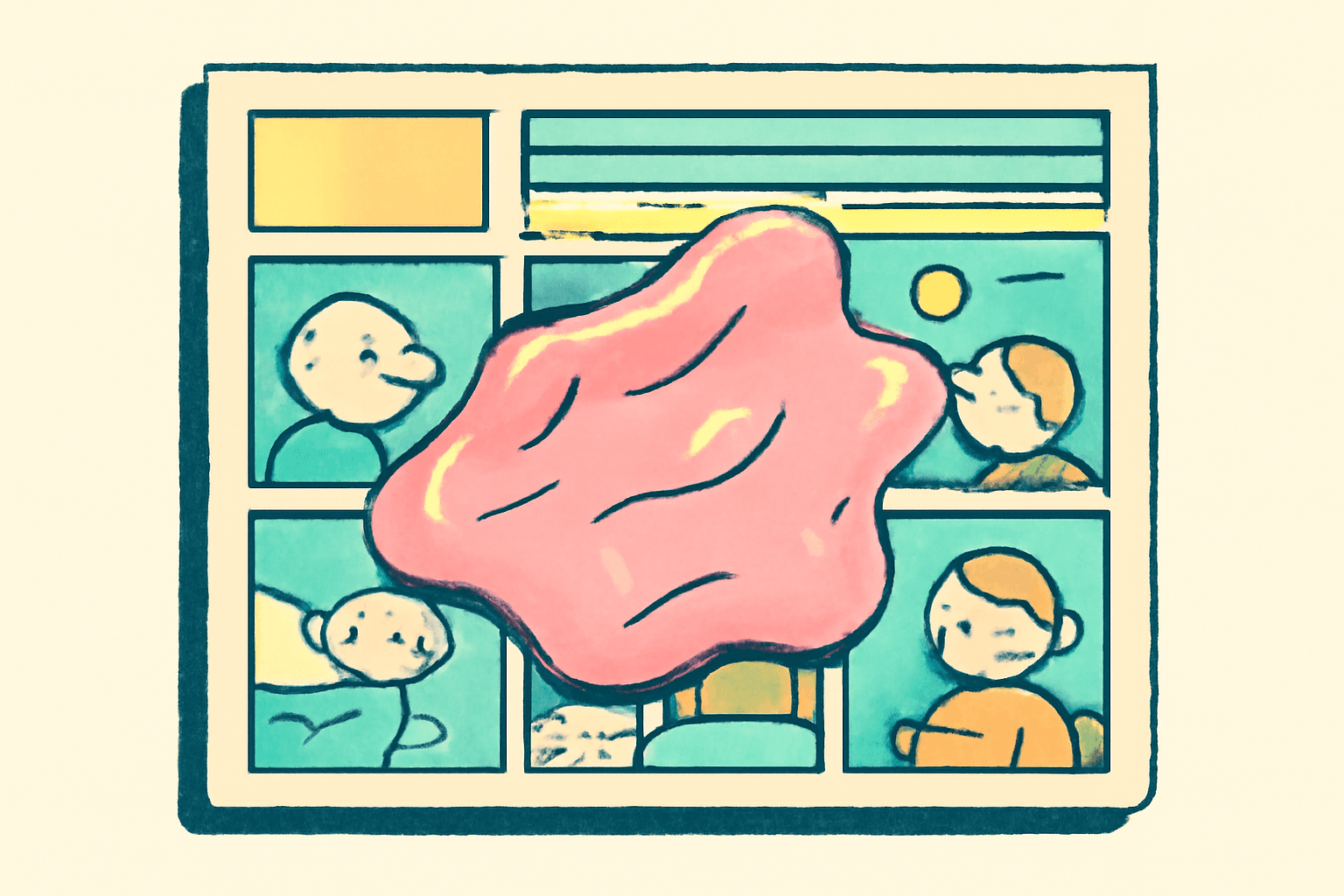
The first time I pressed Silly Putty onto a newspaper comic, I held my breath. I don't know why. Nobody told me to. But there was something about peeling it back and seeing Garfield's face transferred onto that pinkish blob - reversed, slightly blurry, alive on putty - that felt like I had just performed a magic trick nobody had taught me. I was maybe seven. I had discovered image transfer before I knew the phrase "image transfer." And the first thing I did with this power was stretch Garfield's face until he looked like a funhouse mirror version of himself, wide and melting, his eyes drifting apart like they were trying to escape each other.
That was the whole game. That was enough.
The Sunday Ritual
The Sunday newspaper was a shared resource, but the comics section had a clear chain of custody. Dad got it first, because he was Dad and also because he was already at the kitchen table with coffee before anyone else was conscious. Mom got it second, if she wanted it. Then it came to you, slightly wrinkled, maybe with a coffee ring on Beetle Bailey, and you had a window of opportunity before it ended up in the recycling bin or under the dog.
You'd spread the comics across the carpet. The Sunday funnies were in color, which mattered, because the Silly Putty picked up color. Weekday strips were black and white and smaller, and the transfer never looked as good. But Sunday - Sunday gave you a full-color Garfield, a wide-format Calvin and Hobbes, a Dilbert you didn't understand but pressed onto the putty anyway because his tie was red and red showed up well.
I had discovered image transfer before I knew the phrase "image transfer." And the first thing I did with this power was stretch Garfield's face until he looked like a funhouse mirror version of himself.
The technique was simple. You pressed the putty flat against the strip - really pressed, using the heel of your palm - and then peeled it up slowly. Too fast and you got a ghost. Too light and you got nothing. But when you hit it right, the whole panel came up in reverse, slightly faded, like a copy of a copy. And then you stretched it. You pulled Garfield wide. You pulled him tall. You turned Dilbert into something Picasso might have claimed. You made Cathy's face twice as anguished, which honestly felt appropriate.
The stretching was the point. Not the capture - the distortion. You were remixing the newspaper with your hands, making something weird out of something familiar. Nobody called it art. It was just what you did on a Sunday morning when you were nine and the cartoons on TV wouldn't start for another hour.
The Egg
Silly Putty came in a plastic egg. I want to sit with that for a second because it was such a strange packaging choice and nobody questioned it. Not a box. Not a tube. Not a bag. An egg. A solid-colored plastic egg that snapped together at the middle, roughly the size of something a very ambitious chicken might produce.
The egg was important because it was the container. You put the putty back in the egg. The egg went in the junk drawer or the toy bin or that spot on your desk between the lamp and the stack of Goosebumps books. Without the egg, the putty was homeless. It would end up stuck to the carpet, accumulating lint and cat hair until it became something your mom threw away while you were at school.
The putty itself was a material that didn't make sense. It bounced, but it wasn't a ball. It stretched, but it wasn't rubber. It snapped, but it wasn't brittle. It flowed if you left it sitting long enough - come back an hour later and your little ball had become a puddle. It was a solid and a liquid and something in between that scientists probably have a word for but kids just called weird.
And it was always that same pinkish-beige color. Like someone had tried to make a skin tone and missed in the most unsettling possible direction.
The Ecosystem of Hand Things
Silly Putty existed in a broader universe of objects that were hard to categorize. Not quite toys. Not quite tools. Not quite anything with a purpose you could explain to a parent asking why you needed it. They were just - things for your hands.
The Koosh ball was one of these. A rubber core with hundreds of soft rubber filaments sticking out in every direction, like a sea urchin designed by someone who wanted you to be calm. You squeezed it. You tossed it hand to hand. You pulled the filaments and let them snap back. There was no game. There was no objective. It was just a thing that felt good to hold, and somehow that was reason enough to own one.
Newton's cradle lived on your dad's desk at work or maybe on a shelf in the den. Five metal balls on strings. You pulled one back, let it go, click click click click. You pulled two back. Click click click click. You tried pulling all five back at once and the whole thing tangled and you spent ten minutes untangling it and then did the same thing again. It was a physics demonstration disguised as a desk accessory, and nobody who owned one ever got tired of it.
They were just things for your hands. No game. No objective. Just the quiet satisfaction of holding something that felt interesting to hold.
The Slinky was supposed to walk down stairs. That was the commercial's promise. In practice, the Slinky walked down maybe three stairs before collapsing into a tangled heap or launching itself sideways off the staircase entirely. But you kept it around because it felt good to pass it hand to hand, that flowing weight shifting back and forth, a metallic waterfall between your palms. The plastic ones were an insult. The metal ones were the real thing - cold and heavy and satisfying in a way you couldn't articulate.
Stress balls showed up in the mid-90s and suddenly every office had them. Your parents brought them home from conferences and trade shows, branded with company logos you didn't recognize. They were foam, usually, and they were fine. You squeezed them. They came back. That was the whole interaction. The stress ball was the most honest object in this category because it admitted what all the others were secretly doing - giving your hands something to do while your brain did something else.
Then there were the magnetic desk sculptures - those little silver balls and rods you could stack into towers and bridges and abstract shapes on a magnetic base. These lived in the "executive toy" category, which was adult code for "I need to fidget during conference calls but I need it to look expensive."
Before the Word
Here's what gets me. None of these things had a category. There was no word for what they were. The fidget spinner wouldn't show up for another twenty years, and when it did, suddenly there was a whole vocabulary - fidget toys, sensory objects, stimming tools. A whole industry built on the idea that people need things for their hands.
But we already knew that. We'd always known that. We just didn't have the language for it. We had a blob of silicone in a plastic egg and a page of Sunday comics and the instinct to press one against the other and see what happened.
I think about Silly Putty sometimes when I catch myself clicking a pen or spinning my phone on the desk. My hands are still looking for something to do. They always have been. The difference is that now I know why - there are articles and studies and TikToks explaining the neuroscience of fidgeting - and somehow knowing the reason makes it less satisfying than it used to be.
There was something better about not knowing. About just having a weird blob that bounced and stretched and picked up Garfield's face. About pressing it down on the comics page with the morning sun coming through the kitchen window, peeling it back to see what you caught. About pulling the image sideways until it became something new - something that didn't exist in the newspaper or in the putty, but only in the space between them, only for a moment, only in your hands.