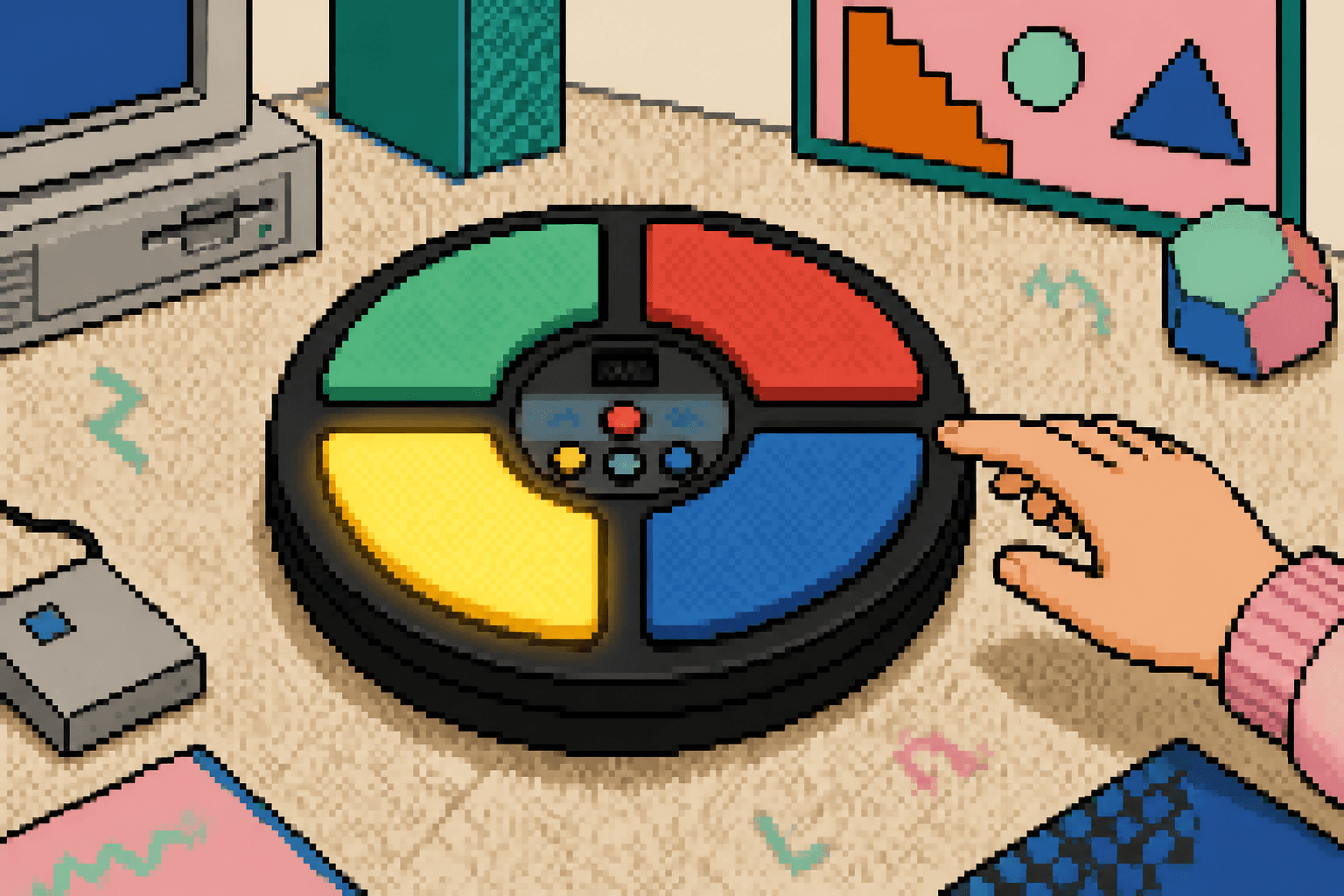
The disc was black. It sat on the carpet like a dinner plate that had been dropped in a hot tub. You slid the switch on the side, and it did nothing for a second, and then somewhere inside it a small speaker cleared its throat.
Boop.
The green quadrant flashed. You had promised yourself, quietly, that this time you were getting to at least ten. You had never gotten to ten. You had once, on an accidental afternoon in fourth grade, gotten to eight, and you had told everyone at recess about it, and nobody had believed you, because Simon was a private humiliation and there were never witnesses to the good runs.
You tapped green. Simon added red. You tapped green, red. Simon added yellow. You tapped green, red, yellow. Simon added blue, and it was slightly faster, and you had already forgotten what round three was.
The Disc
Simon was round and black and slightly heavier than a dinner plate had any business being.
It ran on a 9-volt battery, the rectangular kind with the two little snap terminals on top, and you were never allowed to change it yourself because you would inevitably touch the terminals to your tongue instead, which was the whole reason a 9-volt existed but was also something adults pretended you were not supposed to know. When the battery was fresh, Simon was crisp and loud and merciless. When the battery was dying, Simon slowed down slightly, and the tones sagged, and you got further than usual, and you knew, in your heart, that the run did not count.
The four quadrants were flat plastic wedges, each about the size of your palm, arranged around a small central control cluster. There was a green one. A red one. A yellow one. A blue one. The center had a switch for on/off, a switch for game type, and a switch for skill level, and you never touched any of them except the first. Game type was for adults. Skill level was for people who had, at some point, beaten skill level one, which was nobody you had ever met.
The plastic under the quadrants was translucent. When Simon lit up a color, a little grain-of-wheat bulb somewhere in the guts of the disc turned on, and the whole quadrant glowed, and if you were sitting close enough in a dark room you could see the shadow of the bulb through the plastic. This was, to a nine-year-old, extremely cool. Modern toys do not have this problem. Modern toys are perfect. Modern toys look like they were made by adults.
When the battery was dying, Simon slowed down slightly, and the tones sagged, and you got further than usual, and you knew, in your heart, that the run did not count.
The Tones
The four sounds were not arbitrary.
Each quadrant played a specific pitch, and the pitches formed a simple chord, and the chord was chosen so that no sequence Simon ever played could sound wrong. You could hit green, red, blue, yellow in any order at any tempo and the result would sound like a jingle. It sounded like a jingle when Simon was showing you the sequence. It sounded like a jingle when you were correctly repeating the sequence. It sounded like a jingle right up until the moment you pressed the wrong color, and then Simon made a completely different sound: a low, flat, disappointed braaaaap, roughly the sound a truck makes when it puts itself in reverse in a parking lot, and the disc went dark.
There was no drum roll on the way down. There was no are you sure?. There was no last chance. You pressed blue when you should have pressed yellow and Simon told you, in one flat syllable, that you were done, and then it sat there in silence on the carpet.
Those four tones - the three that were music and the one that was a truck - are still in your head. If you are between the ages of thirty and fifty, you can hum all four right now, and you will hum them roughly on pitch, because Simon drilled them into you at an age when your brain was still doing the packing.
The Rules
There were no rules, really. There was one rule.
Simon played a sequence. You repeated the sequence. Simon added one to the sequence. You repeated the longer sequence. Simon added one more. Repeat forever.
That was it. That was the whole game. There was no scoring system. There was no goal state. There was no winning. You could not beat Simon. Simon did not have an ending. The game was designed, in the way that some 90s toys were designed with a certain flat cruelty, to be played until you failed, and then be played again, and again, and again, and the only measurement of your worth was the number of rounds you got through before you broke. There was no leaderboard. There was no medal. There was, at some level, no record, because you could not prove it. You had to write it on a Post-it, in pencil, and put the Post-it on the desk, and hope that the next person who picked up Simon believed you.
That is roughly what it felt like. Play it long enough and you will remember exactly the round where your brain used to give out. Mine was seven. Sometimes eight. On one legendary afternoon, twelve, and I still don't fully believe it happened.
The Wall
Every kid had a wall.
For most of us, the wall was between round six and round eight. You could get through five without really trying. Round six required paying attention. Round seven was where you started narrating the sequence in your head - green, red, red, blue, yellow, green, red - and Simon sped up, imperceptibly at first, and by round eight your inner narrator was one full color behind your finger, and you were reactively pressing the color that had just flashed instead of the color you had memorized, and then somewhere in the middle of the sequence Simon threw in a color you didn't expect and your finger froze and it was over.
The wall was maddeningly specific. If your wall was seven, your wall was always seven. You did not gradually get better at Simon. You did not train your way from seven to nine over the summer. You hit seven and then, three years later, you were still hitting seven. The wall was a hard property of your brain, like your eye color, and the only way past it was on one of those weird days where everything clicked and you got to twelve and you couldn't explain it and it never happened again.
There was, incidentally, a body of research done by actual psychologists in the seventies and eighties using Simon as a working-memory testbed, because the toy is basically a perfect controlled experiment for how many items you can hold in your head in sequence, and it turns out the answer is about seven, plus or minus, depending on the person, which is why your wall was seven. Milton Bradley had shipped, unintentionally, an over-the-counter cognitive assessment tool disguised as a birthday present. You were being scienced on. Nobody told you.
- Round 4. The kid who wandered off mid-sequence. Not really playing.
- Round 6. The average. The population mean of the fourth grade.
- Round 8. You were paying attention. You were sitting still.
- Round 10. Something is different about you. Please consider medical school.
- Round 12. Almost certainly a lie. Prove it in front of witnesses.
- Round 16. Milton Bradley owes you a t-shirt.
The Bragging Problem
Because there was no scoring and no ending, Simon existed inside a strange social vacuum where the only proof of accomplishment was your own word for it.
You would go to school on Monday and mention, casually, that you had gotten to eleven on Simon over the weekend, and Kevin would say I got to fourteen and Alyssa would say I got to twelve once but it doesn't count because my sister was helping and everybody would nod, and nobody would actually believe any of it, because everybody had also lied about their Simon score at some point that year. The Simon score was a currency that had been printed until it was worthless. By 1995 it was accepted at the schoolyard level that a claim of eight was probably true, a claim of ten was aspirational, and any claim above twelve required a parent witness and a signed affidavit.
The only reliable way to prove your Simon score was to play in front of somebody, right there, on the carpet, in real time. And the second you did that, the wall showed up. It always showed up. Whatever number you had bragged about on Monday, on Tuesday when Kevin was watching, you broke at round six, and Kevin nodded politely, and something small and important died on the beige carpet.
The Argument For
Simon was, if you squint, a legitimately elegant piece of design.
Four inputs. Four outputs. Zero instructions needed. A five-year-old could pick it up and understand the game in one round. There were no menus. There was no accompanying manual you actually had to read. The interface was the toy and the toy was the interface, and the game inside was pure - the platonic form of a memory game, stripped of every unnecessary variable. There was no score. There was no character. There was no story. There was no content. Simon was, essentially, a benchmark test wearing the costume of a toy.
And it did work. If you played Simon regularly, your working memory for sequences of arbitrary items did get slightly better, at least at Simon, and probably a little bit at unrelated things too. There are studies. Simon shows up in a shocking number of psychology papers between 1980 and 2005. Milton Bradley shipped, at scale, one of the most successful pop-cognitive-training devices ever produced, and did it while charging you thirty dollars and putting a starburst on the box that said the electronic sensation!
The Argument Against
Simon was also a device designed to make you feel bad about your brain.
Because the wall was hard - because you could not, no matter how hard you tried, will yourself past the number that was your number - Simon offered you the same experience over and over: play, get about as far as you always got, lose, feel a small dumb disappointment. There was no plateau of mastery. There was no level up. You did not become good at Simon. You became good at hitting your own ceiling faster.
Kids who were competitive about it drove themselves to a low frustration in a way that a modern parent would probably intervene in. You would watch a kid at a sleepover play Simon for forty-five minutes, alone, in the corner, hitting the same number every time, muttering okay this time under their breath, and you knew, at some level, that this was not a healthy way to spend the run-up to a birthday party. But Simon was there. The batteries were fresh. The disc was on. You could not stop.
This is the part of the essay where I would like to argue that this was character-building. That Simon taught us something about persistence in the face of a fixed limitation, about the honest relationship between effort and result. I do not actually believe this. I think Simon just taught us that our brains had a specific number in them, and no amount of trying was going to move the number, and this was possibly the earliest moment in most of our childhoods where a piece of consumer plastic quietly told us something true about ourselves that no adult would have said out loud.
You did not become good at Simon. You became good at hitting your own ceiling faster.
The Disc, At Rest
Every Simon I ever owned ended up in the same place: on top of a bookshelf, then in a drawer, then in a plastic bin in the basement, then at a garage sale, then in the hands of another kid on another carpet, who would slide the switch on the side, and hear the small speaker clear its throat, and get to round six.
The disc did not wear out. That was one of its cruelties. Simon was almost indestructible. The four quadrants were flat and thick and would survive a fall from any height a nine-year-old could produce. The 9-volt slot was on the bottom, sealed with a little plastic door held on by one Phillips screw, and the door survived too. The speaker got quieter over the years, and the little grain-of-wheat bulbs eventually burned out and gave the disc a permanent dead-color problem, but the plastic was the object, and the plastic did not care.
Somewhere, right now, there is a Simon on a shelf in a thrift store in Ohio, with three of four bulbs still working, and it will sit there until somebody wanders in and picks it up and turns it on, and if the 9-volt in it has any charge left it will play three tones and pause, and the person holding it will, without needing to think, know what to do next.
I bought one at a flea market a couple of years ago, and I sat down with it on the living room floor with my nieces, who are seven and nine, and I explained the rules, which took roughly one sentence, and then I turned it on and let the older one go first.
She got to four. She looked at it, annoyed. She said is that all it does, and I said yes, that's the whole game, and she said there's no story, and I said no, there isn't, and she thought about this for a second, and then she reached out and turned it off, and she picked up her tablet.
The younger one, though, sat down on the carpet and turned it back on. She got to three. Then five. Then six. Then seven. Then she broke on seven and immediately started again and got to eight. On the fourth try she got to nine and she looked at me with the exact face I remember making on my parents' beige carpet in 1993 - a face that said I know I can do ten, and this thing is a jerk, and why can I still hear the tones after I close my eyes, and do not talk to me right now, and give me a minute.
I gave her a minute. She got to nine again. Then eight. Then six.
Then she got to eleven, and she stood up, and she went to tell her sister.
I don't know if her sister believed her. I know Simon was still going. I know the batteries were fresh. I know she was going to be back.