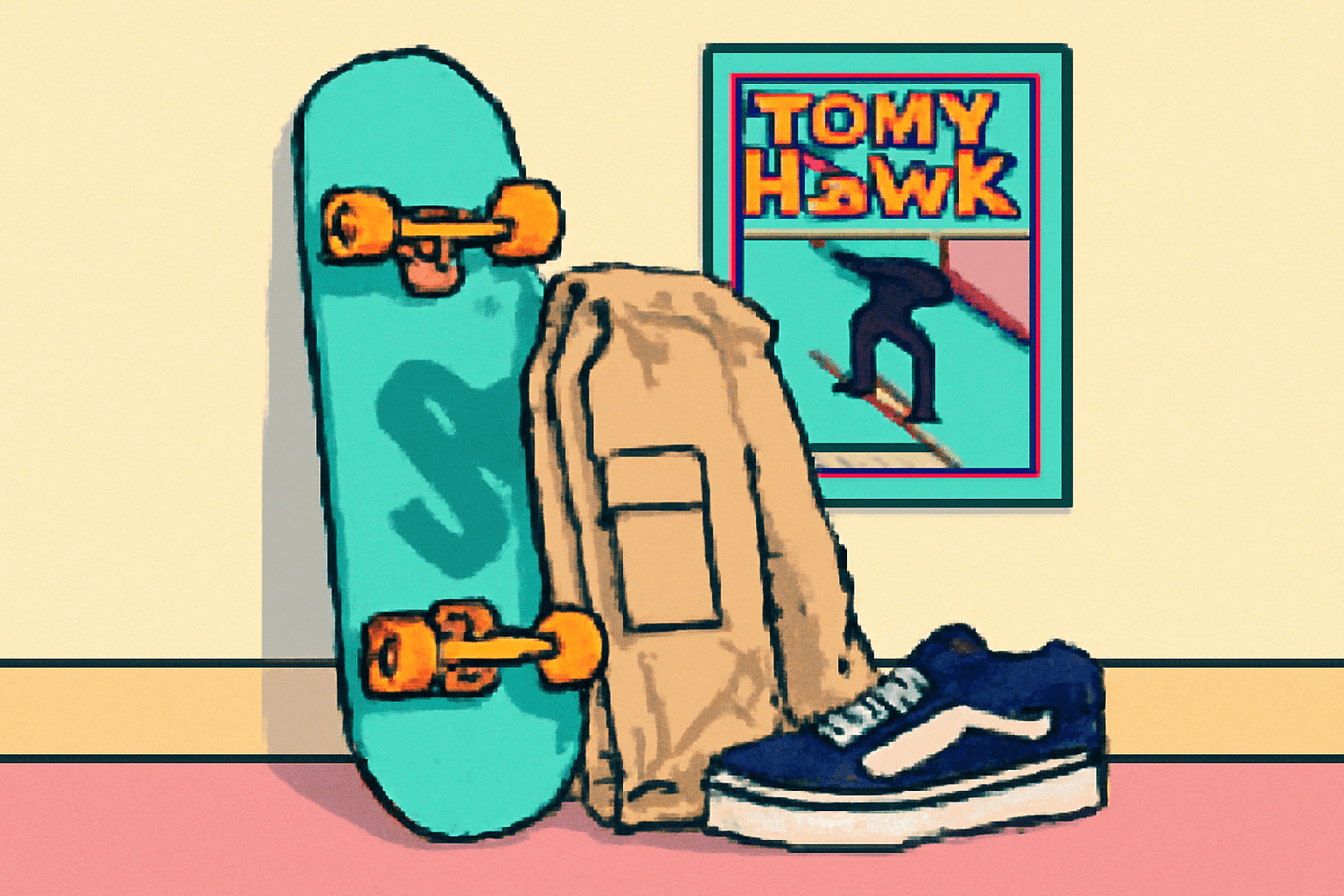
I had a Tony Hawk Birdhouse deck. It was beautiful. Dark blue with that hawk skull logo. I kept it in my room, leaning against the wall next to my dresser like a piece of art. Sometimes I'd sit on it in the driveway, rolling back and forth a few inches, feeling the trucks click on the cracks in the concrete. I owned that board for three years and never once got both wheels off the ground.
I wasn't alone. In 1999, half the boys in my grade owned skateboards they couldn't ride. We carried them around like props in a play none of us had rehearsed. The board was a costume piece. A membership card. You didn't need to skate. You just needed to have one.
The Game Changed Everything
Tony Hawk's Pro Skater came out in September of '99, and within a month every kid in America was an expert on kickflips. Not doing them. Naming them. We could rattle off trick lists like baseball stats - heelflip, varial, 360 shove-it, benihana - without being able to execute a single one. The game gave us the vocabulary of skating without any of the road rash.
I spent entire weekends in the warehouse level, chaining together combos that would have been physically impossible for any human, including Tony Hawk himself. I knew every gap, every rail, every secret tape location. I could nail a 900 on a virtual half-pipe. In real life, I could barely push off without the board shooting out from under me and leaving me on my back in the middle of the street.
We could rattle off trick lists like baseball stats - heelflip, varial, 360 shove-it - without being able to execute a single one.
But the game made you feel like a skater. That soundtrack alone - Goldfinger, Dead Kennedys, Primus - rewired your brain. You'd close your eyes and hear "So Here I Am" and suddenly you weren't a kid sitting on carpet in a suburban living room. You were grinding a rail in Burnside. You were somebody.
The Shoes
You had to have the shoes. That was non-negotiable. And not just any shoes. The right shoes.
DC Shoes with the fat tongues. Etnies. Emerica. Airwalk if you were on a budget and hoped nobody looked too close. And Vans, always Vans - the checkerboard slip-ons or the half-cabs if you were serious about the aesthetic. These shoes were built for grip tape and board control. I used mine to walk to the bus stop and stand around at the mall.
They were enormous. The soles were two inches thick. The tongues puffed out like airbags. They made your feet look like cartoon feet. You'd lace them loosely - never tight, tight was for basketball kids - and let the tongue flop forward. They were the least practical shoes for actual walking that anyone had ever designed. I loved them more than any shoe I've owned since.
The CCS Catalogue
The CCS catalogue was our holy text. It arrived in the mail like a sacrament - thick, glossy, packed with every deck, truck, wheel, and bearing you could imagine. I dog-eared pages. I circled things with a pen. I had a running wish list in my head that totaled somewhere around four hundred dollars, which was roughly four hundred dollars more than I had.
I never ordered a single thing from CCS. Not once. But I studied that catalogue like I was preparing for an exam. I knew the difference between Independent and Thunder trucks. I had opinions about wheel hardness. I could tell you why Spitfire wheels were worth the money. All theoretical knowledge. All completely useless given that my board spent most of its life as a bedroom decoration.
The Skate Park You Never Used
Every town had one. Or at least a spot - a drainage ditch, a loading dock behind a strip mall, a set of stairs outside the library that someone had waxed. And there was always a skate park, or plans for a skate park, or a petition for a skate park.
Ours was a concrete pad behind the rec center with a couple of ramps and a rail. Real skaters used it. You could tell they were real because they could actually do things on a skateboard. They were older, or at least seemed older. They had scraped knees and frayed shoes and the specific quiet confidence of people who had earned their calluses.
I went once. I stood at the top of the smallest ramp, a quarter pipe that couldn't have been more than four feet high, and looked down. It might as well have been a cliff. I pushed off, rolled down, hit the flat bottom, and immediately stepped off the board because I didn't know what came next. A kid who was maybe nine years old dropped in behind me and did a rock-to-fakie like it was nothing. I picked up my board and sat on the bench.
The bench. That's where most of us really lived. Sitting on the bench at the skate park, watching, holding our boards across our laps like security blankets.
The Uniform
The skater look was its own thing, completely independent of skating ability. Baggy jeans - not just loose, baggy. JNCO if you could get them, or at least some oversized Levi's from the husky section. A chain wallet, because apparently your eleven dollars in birthday money needed maximum security. A studded belt that served no structural purpose since your pants were three sizes too big anyway.
The t-shirts were a whole language. Blink-182. Sum 41. The Offspring. A Thrasher Magazine shirt, which was bold if you couldn't ollie. Wearing Thrasher was like wearing a Harvard sweatshirt when you didn't go to Harvard - technically fine, but you'd better not get quizzed.
And the hair. Parted in the middle, swooped over the eyes. Or bleached on the tips, because Koston did it, or Muska, or somebody in a CCS ad. You'd shake it out of your face every thirty seconds. It was part of the choreography.
Wearing Thrasher was like wearing a Harvard sweatshirt when you didn't go to Harvard - technically fine, but you'd better not get quizzed.
Thrasher and the Gatekeepers
Speaking of Thrasher - some of us subscribed. Or at least grabbed issues from the magazine rack at Barnes & Noble and read them cover to cover while sitting cross-legged in the aisle. Thrasher was intimidating. It was for real skaters. The photography was gritty, the writing was raw, and every page reminded you that skating was supposed to involve actually skating.
But we read it anyway. We learned the names - Andrew Reynolds, Jamie Thomas, Geoff Rowley, Chad Muska. We watched the 411VM videos at friends' houses, those grainy VHS compilations of pros doing things on a board that looked like they broke physics. We absorbed the culture from a safe distance. Like birdwatchers who really, really wanted to be birds.
The Truth of It
Here's what I've come to understand: skating in the late '90s was an identity more than it was an activity. For every kid who could actually kickflip, there were ten of us who just dressed the part, listened to the music, played the game, and carried the board. We weren't faking it, exactly. We were participating in the only way that felt safe - from the edges, from the bench, from the carpet in front of the TV while Superman by Goldfinger played for the thousandth time.
The real skaters probably thought we were posers. They were right. But we were also twelve, and everything at twelve is about trying on identities to see which ones fit. Skating was one of the first subcultures that let you in just for wanting to be in. You didn't need a team or a tryout or a permission slip. You just needed a board and a pair of fat shoes and a willingness to sit at the skate park pretending you were about to drop in.
I'm going to. Next run. Just let me watch one more.
I never did take that next run. But I still have the shoes somewhere. I think. Or maybe I just remember having them, which in the end might be the same thing.