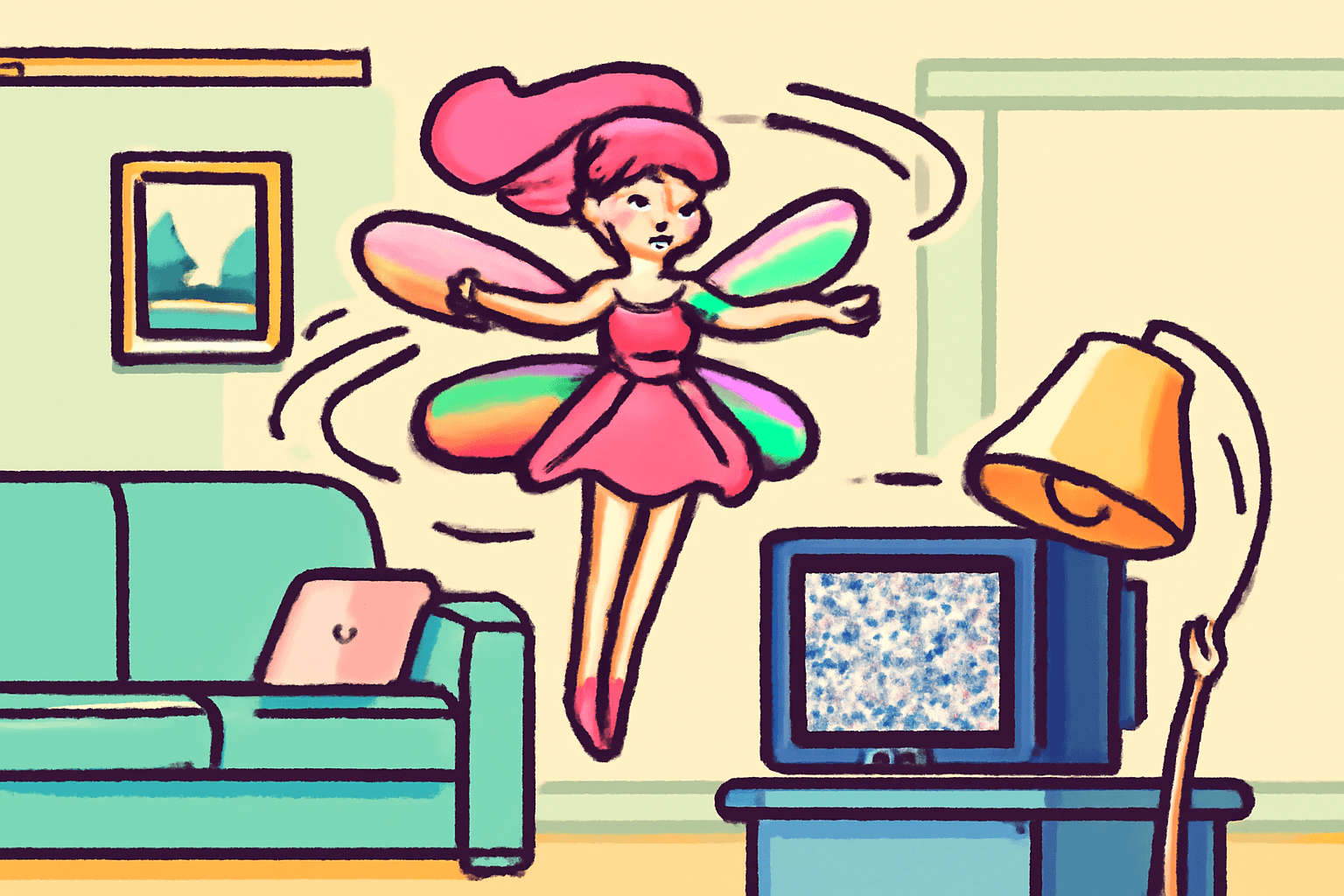
You'd kneel on the carpet with the launcher between your knees and the doll seated on top, wings folded down, hair tucked. The ripcord was a flat plastic strip with a little knob on the end. You'd hold the base steady with one hand. You'd grip the cord with the other. You'd look up, briefly, at the ceiling fan that was definitely on, and you'd think, probably fine. And then you'd pull.
What happened next was not a controlled flight. It was a coin flip with rotors.
The Mechanism
A Sky Dancer, if you took her apart - and you did, eventually, because by week two she had landed in something sticky and stopped working - was a geared spinner. The base had a horizontal flywheel inside it. The doll's torso ended in a slotted plastic stem that dropped into the flywheel like a key into a lock. The ripcord, when you yanked it, drove a rack-and-pinion that whipped the flywheel up to a few thousand RPM in about a tenth of a second.
The wings did the rest. Stiff foam. Pre-tilted at an angle. Once the body was spinning fast enough, the wings worked exactly like helicopter rotors, which is to say they generated lift, and lift is a vector, and the vector pointed up until it didn't.
The wings worked exactly like helicopter rotors, which is to say they generated lift, and lift is a vector, and the vector pointed up until it didn't.
There was no steering. There was no off switch. There was a doll that weighed about forty grams, spinning at autogyro speed, wearing a little pink dress, and the only thing keeping her on a vertical path was the symmetry of her own injection molding. Which, on a toy that had been stepped on twice and dropped down the stairs once, was generous.
The Trajectory
If you launched her in the middle of a perfectly empty room, with the ceiling fan off and the windows closed and no draft coming under the door, she would go more or less straight up, spin for two or three seconds, lose lift, and tumble back down to roughly where she started. This happened approximately never.
What actually happened was that she launched at a 12-degree lean nobody had noticed, climbed in a tight pink corkscrew toward the corner of the room, clipped a curtain rod, ricocheted off the ceiling, and came down behind the entertainment center, where she would remain for two days before anyone could fish her out with a broom handle.
Or she went into the ceiling fan. The ceiling fan was always on. The ceiling fan was the point. You said you weren't aiming for it. You were aiming for it.
You said you weren't aiming for it. You were aiming for it.
Or she came down on the floor lamp. The floor lamp had a fabric shade. The fabric shade was already crooked from the last time. Your mom had asked, twice, that you not do this in the living room. You had agreed, twice, that the living room was off limits. You were in the living room.
The Living Room Test Range
Here's a working model. Pull the cord, let go, see where she lands. The physics aren't fancy - just gravity, drag, and a coefficient of restitution that's a little too generous - but the outcome distribution is correct. Sometimes she'll wedge in the fan and stay there. Sometimes she'll come down on the couch and you'll feel briefly competent. Mostly she'll find something fragile.
The face strikes are real. The lamp going down is real. The framed elementary-school portrait of your sister cracking diagonally across her gap-toothed first-grade smile is real. None of this happened every time. It just happened enough.
The Recall
In April 2000, Galoob - who at that point was a subsidiary of Hasbro, who had presumably been watching this whole situation with mounting interest - voluntarily recalled the entire Sky Dancers product line. Roughly 8.9 million units. The Consumer Product Safety Commission had logged about 170 reports by then: scratched corneas, broken teeth, mild concussions, a temporary loss of consciousness, a broken rib. The recall offered a refund or a replacement toy.
The replacement toy was not a Sky Dancer. The replacement toy was something safe. We knew which one we wanted. The kids who sent theirs in were betrayed twice - once by the toy, once by its absence.
- The frosted glass shade on the dining room chandelier (one impact, hairline crack, never replaced)
- A school photo glued to the inside of a Trapper Keeper, partially deformed by hair sweat from the doll's head
- The lower lip of the kid two doors down, who took one to the mouth at a sleepover and bled into a paper towel for forty minutes
- The toy itself, which by month two would no longer launch but would whirr aggressively on the launcher like a small angry insect
- Your parents' patience, which was never very abundant about indoor flying objects to begin with
The 2014 reissue had soft foam wings. They didn't fly as well. That was the trade. Lift had been a feature; it had become, on review, a defect.
The Part Nobody Admits
Here's the thing. We knew. Not in a sophisticated way, not with words like projectile or kinetic energy, but in the body. You could feel it in your hand the first time you pulled the cord. The launcher kicked. The doll left at a speed that did not feel like a toy speed. You watched her go up and you held your breath, not because she was beautiful - though she was, in a glittery, pink-foam, bargain-aesthetic kind of way - but because you genuinely did not know where she was going to come down.
That was the appeal. That was the entire transaction. We had been given a small, rotating object with no guidance system, and we had been told that this was play, and it had felt - correctly - like a small experiment with a poorly-controlled variable. Most toys were a closed loop. You did the thing, the toy did the thing, you moved on. The Sky Dancer was an open loop. She might do the thing.
Most toys were a closed loop. The Sky Dancer was an open loop.
I don't think I'd give one to a kid today. I also don't know that I would not. I think the part of childhood that involved holding something that could hurt you and choosing to use it anyway was doing something we don't have a great replacement for. Risk was not a content category. It was the carpet you knelt on.
The last one I remember was at a friend's birthday party. Five of us in a finished basement, one Sky Dancer base, four dancers. We took turns. The ceiling was acoustic tile - the soft kind, with the little pinholes - and one of the dancers wedged herself between two panels, hair down, wings still spinning lazily. We could not get her out. The party moved on. Cake was served.
Three weeks later my friend's dad found her while replacing a smoke detector. He brought her downstairs with a look on his face that suggested he had been wondering for a long time why one corner of the basement made a faint whirr every time the central air came on.
She was retired. Honorably, I think.
I still don't trust ceiling fans.