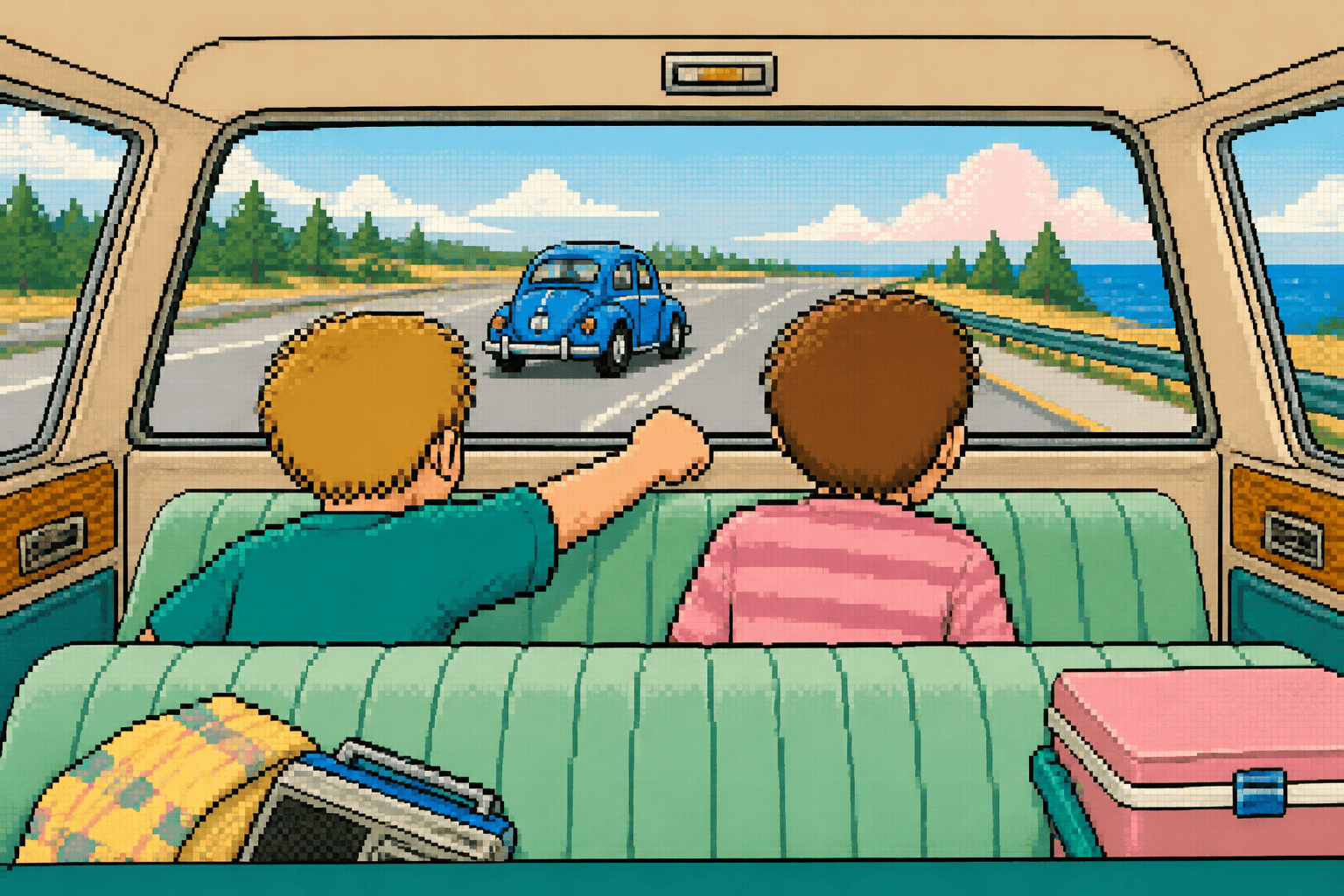
You were four hours into a six hour drive. The sun had rotated past the window twice. You had read the back of the Visine bottle. You had read the warning on the fire extinguisher. You had counted seventeen cows in a field and lost track at eighteen because your sister said that one doesn't count, it's a horse, and you argued about it for a mile and a half and then you both went back to staring out your respective windows.
Then it happened.
You saw a Volkswagen Beetle. The real one. The 1973 one, humped and dented, painted a shade of red that had not been available from the factory since the first Nixon administration. It was coming up in the right lane. You turned your head. Your sister had not seen it yet. You had, maybe, one full second.
You hit her in the shoulder.
"Slug bug red," you said. "No punch backs."
She looked at you. She looked at the car. She looked back at you. The Beetle, red and indifferent, passed on the right and continued west toward whatever red Beetles are going toward, and your mom in the passenger seat said, without turning around, do not hit your sister, and your dad, driving, said nothing, because your dad was from a generation that had grown up riding in the back of a pickup truck and considered a shoulder punch not only legal but structurally necessary to a long drive.
Your sister did not retaliate. She couldn't. You had said no punch backs. The game had rules. The rules were binding. She would get the next one, and she would hit you harder, because that was also the rule.
The Rules
There were three rules.
Rule one: see a Volkswagen Beetle before anyone else in the car.
Rule two: call it. The call had to include the word slug bug (or punch buggy, which was the same thing with a worse mouthfeel), and it had to include the color. "Slug bug blue." "Slug bug yellow." "Slug bug that specific shade of green they only made in 1968." The color was not optional. If you said slug bug without a color, your sister got to say it was a free punch for her, and she would say it was, every time, and your mom would not intervene, because your mom was not a judge, she was a passenger.
Rule three: punch the sibling nearest to you in the shoulder.
That was it. That was the whole game. Everything else was negotiated in real time.
The game had one adjudicator, which was whichever kid had been winning longer, and one appellate court, which was the front seat, and the front seat was not interested.
The Beetle Itself
Not every Volkswagen qualified.
The game, as it had been handed down to you, was about the original Beetle. The one shaped like a potato bug. Hunchback, round, air-cooled, loud, built between 1938 and 1979 in Germany and then in Mexico until 2003, though by 1995 the ones on American roads were all old, all patched, all owned by someone who was either a dentist with a sense of humor or a college student with a bumper sticker that said CO-EXIST.
There was a long-running backseat dispute about Volkswagen buses. Your cousin said buses counted. Your sister said they didn't. You said the bus was a bug but longer, which sounded scientific, and you lost, because your sister was older and the rules were made by whoever was older.
There was also a dispute about the Karmann Ghia, which looked like a Beetle wearing a sport coat, and which was legally a Volkswagen but was emotionally a sports car, and which nobody could agree on. It only mattered twice in your childhood, and both times, you called it, and both times, your sister disputed it, and both times, you had to re-hit her at half power as a compromise, which she accepted with suspicion.
- Original air-cooled Beetle (1938 to 1979). Yes. The whole point.
- Mexican-made Beetle (continued through 2003). Yes if you knew what it was, which you didn't, so yes anyway.
- Volkswagen Bus / Microbus. Disputed. Depended on who was winning.
- Karmann Ghia. No, usually. Yes, if you spotted it first.
- 1998 New Beetle (the rounded retro one). Contested. See below. Nobody was ready.
- A Volkswagen that was not any of these. No, but you tried.
- A beetle-shaped car that was not actually a Volkswagen. No, but your brother did it anyway, and you let him, because it was 2 PM in Kansas and nobody had the energy.
The Punch
The punch was to the shoulder.
Specifically, the deltoid. The specific muscle on the front-outside of the upper arm. Not the bicep. Not the collarbone. Not the back of the arm, which was what your brother did one time in 1996 and which you cried about and which your mom called not allowed and which became known thereafter as a dirty punch. There was case law.
The force of the punch was the subject of years of unwritten doctrine. It had to hurt. If it didn't hurt, your sister would say that wasn't a punch, and she would deliver her own at the next Beetle, calibrated to the amount that hers was supposed to have been plus a little extra interest. A punch that was too soft was an insult. A punch that was too hard was actionable. There was a window, and the window was about the force of a hardcover book being closed quickly, delivered with a closed fist through a seatbelt by a nine-year-old who had been sitting still for three hours.
You did not use your whole arm. You could not. You were belted in. You had, structurally, about eight inches of travel from your shoulder to your sister's shoulder, and the punch had to be delivered within that envelope, through the slack of the lap belt, past the plastic armrest if there was one, without hitting the car seat or the window or your own thigh on the backswing. It was an engineering constraint, and the result was a specific punch - a short, flat, elbow-anchored jab that ten thousand American children developed independently in ten thousand minivans.
The sibling shoulder punch was the most refined piece of upper-body technique a nine-year-old ever developed, and it was developed entirely for the purpose of hitting another nine-year-old in a parked Chevy Lumina.
No Punch Backs
The three most important words in the game were no punch backs.
You had to say them. If you did not say them, your sister had, under the rules, exactly one free punch she could deliver back, and she would deliver it, immediately, at full force, with a look on her face that said you forgot. There was no appeals process. There was no renegotiation. You had either said no punch backs or you had not. The entire architecture of the game rested on this three-syllable afterthought.
Some kids said no punch backs, no do-overs, which added an extra layer of legal protection, in case your sister tried to argue the punch had been invalid for a reason she would make up on the spot. Some kids said no punch backs, no takesies backsies, which meant the same thing but with more foundation.
The no punch backs defense extended, in some households, to the entire car. In others, only to the sibling on the same bench seat. In one documented case, in the summer of 1994, a cousin invoked no punch backs, car-wide, and nobody in the car had ever heard that formulation, but it was said with such confidence that it held, and he escaped unharmed to a rest stop in Oklahoma, where he bought a Big Red soda and a wooden snake that bent in the middle.
The Physics of Where You Sat
The person sitting on the right side of the car was going to win.
This was a simple fact. The Beetles were in the right lane, because the Beetles were slow, because the Beetles were being driven by dentists and college students, and the right lane is where slow cars live. If you were in the right-side seat, you had an unobstructed view of every slow car in America, and the Beetles presented themselves to you like gifts at a birthday party.
If you were in the left-side seat, you were looking at the median. You were looking at a Honda Accord. You were looking, occasionally, at the top of a red Beetle through the gap between the driver's seat and the window, and by the time you called it, your sister in the right seat had already called it, with a color, and had already punched you, and had already said no punch backs, and the game, for that Beetle, was over.
Siblings who understood this would fight for the right-side seat at every gas station. There was a rotation system in some families - you got the right side going there, I get the right side coming back - and in other families there was no system, and whoever got there first got the window, and the loser got the middle hump with the hot cup holder, and lost every Beetle for six hours.
- Right rear window. The throne. Beetles for days. Also the AC vent. Also the only side with a working window crank, because the left one had been broken since 1991.
- Left rear window. The opposition. You saw the median. You saw a Pontiac. You did not see a Beetle.
- Middle rear. The hump. Hot. Belted by a lap belt that did not quite reach. No view. No points. Occasionally hit by friendly fire.
- Way-back. Rear-facing. You saw Beetles after everyone else did, going the wrong direction, and you could not punch anyone, because nobody was in reach. You just watched. You narrated. You were the color commentator.
Spot one
Tap any Beetle before it exits. Everything else is a Camry. Miss a Beetle and you're the one taking the shoulder. The timer is forty-five seconds, which is roughly the stretch of I-70 between the Love's and the next Love's.
The 1998 New Beetle Problem
In 1998, Volkswagen introduced the New Beetle.
It was round. It was cute. It was the correct silhouette - the half-loaf, the dome. It was also, unmistakably, a new car. It had airbags. It had a dashboard-mounted bud vase, which was a thing we all noticed and nobody talked about. It had the Volkswagen logo on the hood, which the old Beetle also had but looked more official now. It was a Volkswagen Beetle, by every legal definition. It was made by Volkswagen. It was called the Beetle. It was shaped like a Beetle.
But it was not, in the courtroom of the back seat, the Beetle.
There was a crisis. There was a schism. There were families where the New Beetle counted and families where it didn't, and the families where it did split off into subfamilies where it counted at full value and subfamilies where it counted at half value and subfamilies where it counted only if you used the phrase new slug bug instead of slug bug, which nobody did, because it was ugly to say.
The first time you saw a New Beetle on the highway, you did not know what to do. It approached. You looked at your sister. She looked at you. Neither of you called it. It passed. Neither of you said anything. The rules had not yet been written for this one, and both of you, in a rare moment of mutual understanding, agreed by silence that the next time, after we figured out what the rule was, that one would count.
Volkswagen launched the New Beetle in 1998 and accidentally destabilized ten million American sibling rivalries. The rules were still being argued when the model was discontinued in 2019.
The Argument
I want to make the argument that this was a stupid game.
It was. It was a game about punching your brother in the shoulder every time a specific kind of car, mostly obsolete by the time you were playing, happened to pass by on a stretch of interstate where the only thing to do was look out the window. The payoff was, strictly, pain. You punched to score. You got punched when you lost. Nobody ever walked away from Slug Bug feeling like they had won. Winners had a sore hand. Losers had a sore shoulder. The game only existed to transfer bruises between siblings.
There is also the fact that it was, when you look at it squarely, a game whose core mechanic was assault, performed on a family member, with a parental shrug as the only possible intervention. In any other context - if you had done this to a kid at school - there would have been a phone call home. In the back seat of a Caravan on a Tuesday in August, it was legal, it was traditional, and it was the only thing happening for about ninety miles.
The Other Side
But here is the other side.
There was, in 1995, nothing else to do.
You had a Walkman with four AA batteries that had died in Kansas City. You had a book, which you had read, three times. You had the ceiling of the car, which had a water stain shaped like a rabbit. You had your sister. And you had a highway full of Beetles, which the game insisted you pay attention to.
Slug Bug was a game whose purpose was to make you look out the window. The punching was just a scoring mechanism for the thing you were already doing anyway.
The game tuned your eye. You got good at spotting Beetles. You could pick one out of a cluster of cars at six hundred yards. You could tell a Beetle from a Mini from a Fiat from a quarter mile away, at freeway speed, through a bug-spattered rear window. Your brain had been quietly trained to flag a specific car shape as point, and even now, as an adult, when a Beetle passes you on a highway, something in the back of your head still goes slug bug red. The call is reflex. It will never leave.
And the sibling, who you were not actually fighting - you were sharing a car with them for six hours, and the sibling was in the same position you were, which was the position of someone who did not want to be in a car for six hours, and the game gave you a way to touch each other, sort of, through the medium of a 1973 Volkswagen, in a way that did not require you to admit that you were spending time together. The punch was the only sanctioned physical contact between a nine-year-old and their eleven-year-old sister that did not involve someone crying. It was also, structurally, an argument about who was paying attention. Which was a kind of attention to each other. Delivered through a shoulder.
The Last Beetle
My sister and I played the last real game of Slug Bug in 1999, on a drive to our grandmother's house in Omaha. We were twelve and fourteen. We were too old for it. We played it anyway. She won, by a lot, because she was in the right-side seat and I was in the hump.
We stopped at a Love's. We ate gas station nachos out of the plastic tray with the compartment for the cheese. We got back in the car. My mom said we had another two hours. My sister, who had just beaten me by six Beetles to one, looked at me and said, we can switch sides. I remember that specifically. She did not have to. There were no rules about switching. She just did.
I took the right seat. I got the next three Beetles. She let me. She looked out her window at the median, and the Hondas, and the Pontiacs, and said nothing, and did not contest anything.
We stopped playing somewhere in Iowa. Not because we agreed to stop. We just both went quiet, and then we both fell asleep, and when we woke up we were pulling into the driveway, and the game was over, in the specific way games end when kids stop being kids - which is, nobody calls it. Nobody says the game is done. Everyone just stops saying slug bug, one day, and nobody remembers which day.
I still see them, though.
I saw one yesterday. A red one, parked at a hardware store in a town I was driving through. I was alone in the car. I did not say anything out loud. But my hand, I noticed, had made a small fist.