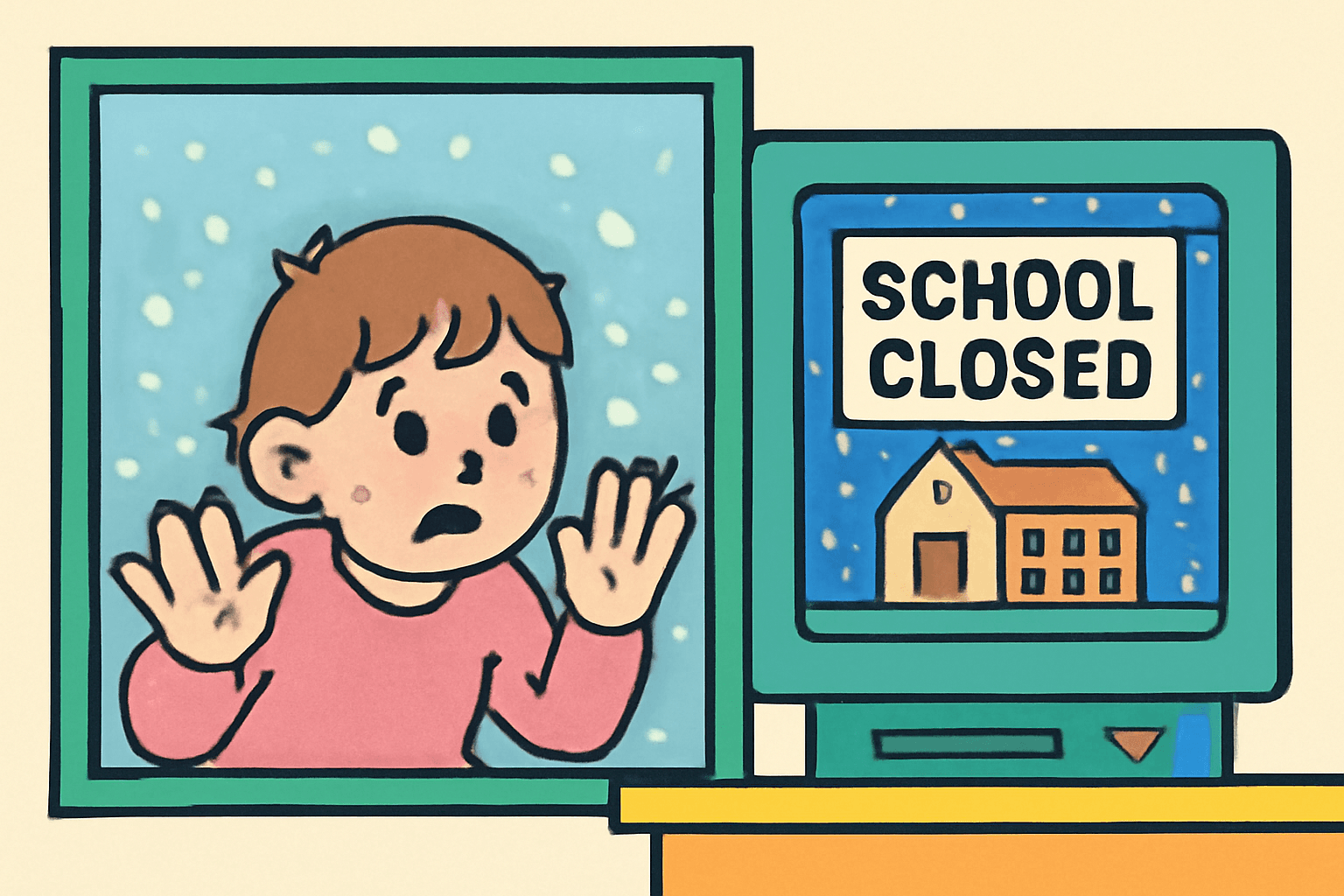
I woke up before my alarm. That was the first sign. Something about the light was wrong - too bright, too white, pressing against the blinds like a secret it couldn't keep. I pulled the curtain back and there it was. The whole world had been erased overnight and rebuilt in white. The street, the cars, the mailbox, the Hendersons' ugly fence - all of it gone, buried under six inches of possibility.
And then the thought hit like electricity: maybe.
Maybe today. Maybe no school. Maybe the most perfect, unexpected, unearned gift a kid could receive on a random Tuesday in February.
The Vigil
You couldn't just check your phone. There was no app, no push notification, no automated text from the school district. In the 90s, you had to earn your snow day confirmation, and the earning was half the experience.
First, the TV. You turned on the local news - Channel 5 or whatever your market had - and you waited. At the bottom of the screen, a ticker crawled. Alphabetical. School district names scrolling past in that tiny white font against a blue bar, moving at a speed specifically designed to destroy children. You'd watch the A's go by. Then the B's. If your district started with a letter past M, God help you. You were standing in the living room in your pajamas, cereal getting soggy, watching names you'd never heard of scroll past and feeling physically ill with anticipation.
There was no greater heartbreak than seeing the district right before yours scroll by - and then yours not appearing.
And the thing is, you couldn't look away. You couldn't leave the room for thirty seconds to use the bathroom because the one time you did, your district would scroll past and you'd have to wait through the entire loop again. So you stood there. Frozen. Eyes locked on a 27-inch Magnavox like it held the meaning of life.
Which, for a nine-year-old, it absolutely did.
The Phone Tree
The other channel of intelligence was the phone tree. If you're under thirty, this will sound like something from the Civil War, but it was real and it was critical. The principal would call two parents. Those two parents would each call two more. Those four would call four more. And so on, cascading outward through the district like the world's most important game of telephone.
The problem with the phone tree was that it was operated by humans, and humans are unreliable. Mrs. Patterson was supposed to call your mom, but Mrs. Patterson was a deep sleeper. Or Mrs. Patterson called but got a busy signal because your older sister was on the phone with her boyfriend at 6:45 in the morning for reasons that remain unclear to this day. The phone tree had failure points. It had drama. Sometimes the information just stopped three families before it reached you, and you'd find out about the snow day only when the bus didn't show up.
- How much snow was actually on the ground vs. how much was forecast
- Whether the neighboring district had already cancelled
- The general reputation of your superintendent (soft or hard-nosed)
- Whether it was still snowing
- The wind
- That one kid whose mom worked at the school board office
The Confirmation
But when it happened - when your district's name finally crawled across that blue bar, or when the phone rang and your mom hung up and said the words - something detonated inside your chest. Pure, uncut joy. The kind of happiness that has no equivalent in adult life. Not a promotion, not a tax refund, not a cancelled meeting. Nothing comes close.
You screamed. You literally screamed. And then you went back to bed, which was the most luxurious act a child could perform on a weekday morning. You crawled under the covers knowing that right now, right now, at this exact moment, you were supposed to be in Mrs. Donnelly's math class learning long division, and instead you were horizontal, free, and answerable to no one.
The snow day was a holiday with no obligations. No gifts to open, no relatives to visit, no dress clothes. Just a blank page of a day, handed to you by the weather.
The Rituals
Every snow day followed roughly the same liturgy, because snow days were holy days, and holy days have structure.
Phase One: Sleep. You went back to bed. Not because you were tired but because you could. Sleeping in on a school day was transgressive. It tasted like stolen time.
Phase Two: Television. You watched things you were never normally home to see. The Price is Right. Bob Barker asking a woman from Tucson to guess the price of a dinette set at 11 AM on a Wednesday. Daytime TV was a foreign country - soap operas, talk shows, infomercials for things no one needed. It felt illicit, like sneaking into an adults-only room. You half-expected someone to ask you to leave.
Phase Three: Gear up. This took twenty minutes minimum. Snow pants over jeans. Boots that were slightly too small from last year. Two pairs of socks. A coat, a hat, a scarf, gloves that would be soaked through in fifteen minutes. Your mom zipping you into so many layers you couldn't put your arms down. You looked like a tick about to pop.
Phase Four: Outside. And here was the cathedral. The whole neighborhood was out. Kids you only sort of knew from three streets over, suddenly your best friends for the day. The air tasted like metal and woodsmoke. Someone's dad had already shoveled the driveway into a massive pile that became a fort within the hour. Sleds appeared - the good plastic ones, the wooden ones with the rusted runners that could actually steer, and always one kid with a garbage can lid who claimed it worked great.
A snow day wasn't a day off. It was a day on - just aimed at everything that mattered.
You sledded until your jeans were soaked through the snow pants. You built forts with structural ambitions that far exceeded your engineering skills. You threw snowballs at each other with a ferocity that would concern modern parents. Someone always cried. Someone always went home early. Someone always ate snow they shouldn't have.
Phase Five: The Return. You came inside when you couldn't feel your fingers, which was always sooner than you wanted. Boots left in a pile by the door, snow melting into a puddle on the linoleum. Wet gloves draped over the heating vent. And then - then - the hot chocolate. Not from a coffee shop. From a packet. Swiss Miss with the tiny freeze-dried marshmallows that dissolved into a sweet slick on the surface. You wrapped your red hands around the mug and the heat almost hurt, that perfect pain of thawing out. You sat at the kitchen table and watched the steam rise and felt something you didn't have a word for yet.
Safe. Warm. Held by the day itself.
The Part Nobody Talks About
The best thing about a snow day was that it couldn't be planned. You couldn't schedule it, optimize it, put it in a Google Calendar. It arrived like grace - unearned, unexpected, transformative. One night you went to bed a regular kid with a regular tomorrow, and by morning the world had rearranged itself to give you a gift.
Kids now get automated texts at 5 AM. They know before they even open their eyes. Some districts do e-learning days, which is the spiritual equivalent of replacing Christmas with a PowerPoint presentation. The snow day, in many places, is dying. Being optimized out of existence.
But for those of us who lived through the golden age of the phone tree and the news ticker - we know what we had. We know that some things can only be sacred if they're uncertain. That the joy was inseparable from the waiting, the hoping, the not-knowing.
I still check the window every time it snows. I'm thirty-something years old and I still feel it - that little pulse of maybe. It never quite goes away.
Some rituals leave marks deeper than you'd think.