The booth was at the end of the carnival midway, next to the one where you shot water into a clown's mouth. It cost two tickets. There was a line.
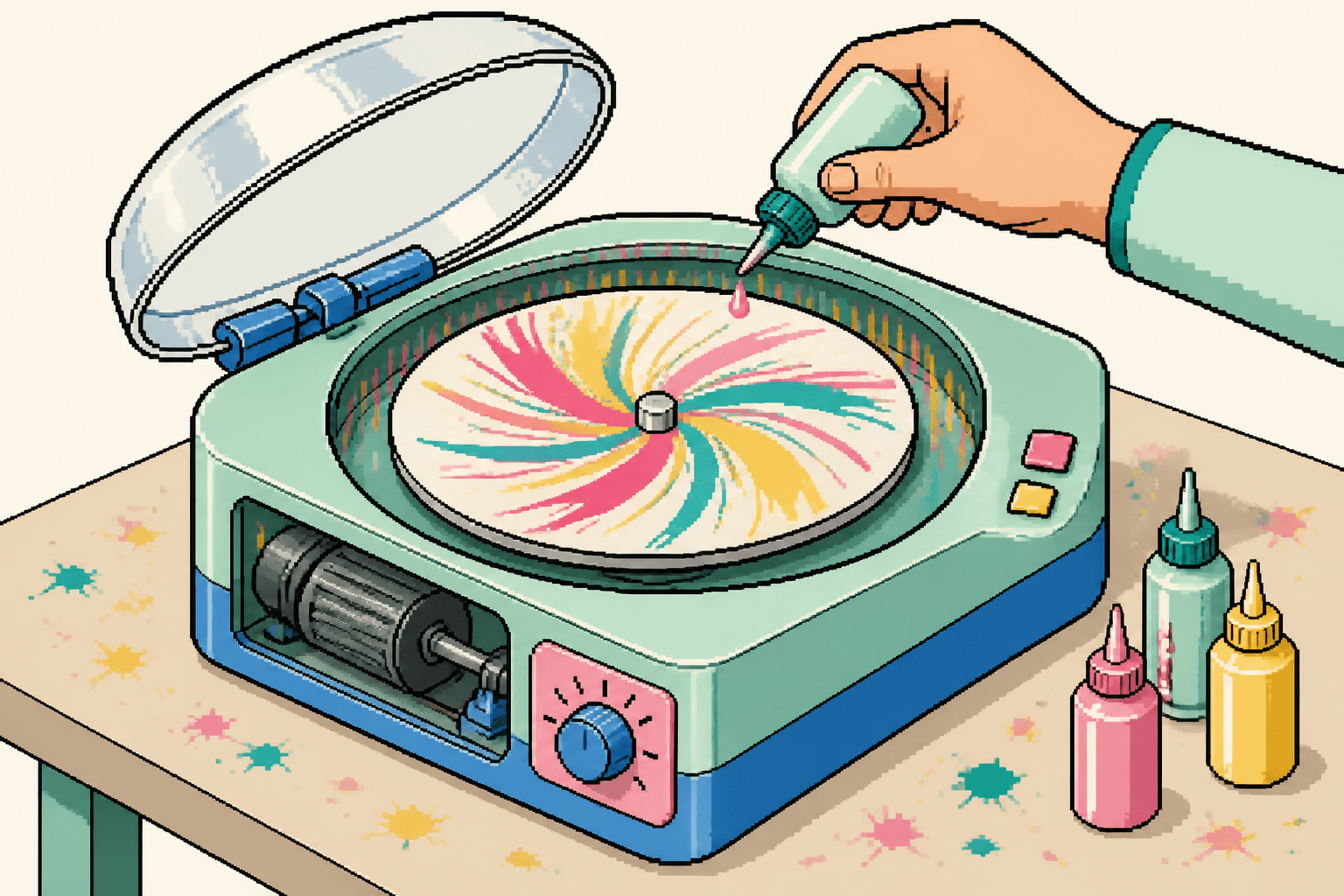
The booth was a card table. On the card table was a plastic box about the size of a shoebox, with a clear plastic dome on top, hinged on a cheap hinge. Inside the box was a motor, and above the motor was a small chuck, and in the chuck was a thumbtack, and on the thumbtack was a circle of white paper, about six inches across, cut by a man with a punch die in a warehouse in Toledo in 1987. Next to the box were four plastic ketchup bottles. The bottles did not contain ketchup. They contained acrylic paint, each a different color, each with a nozzle narrowed to a slit, each slightly crusted at the tip.
You handed over your two tickets. The man at the table pressed a foot pedal, which closed a circuit, and the motor started, and the paper began to spin. He handed you the first bottle. You squeezed. The paint hit the paper, which was now a disc of nothing moving at some rotational velocity you could not estimate. The paint did not land where you aimed. The paint did not know what landing was. The paint went somewhere else, in a line that curved, and you squeezed again, and he handed you the next bottle, and in about six seconds the paper was done, and he lifted the dome, and he peeled the paper off the thumbtack, and he handed it to you, wet.
That was the entire ride.
The Box
The box was not a toy. The box was a motor with a lid.
There were home versions. There was a Spin-Art Set from Ohio Art, the same company that made Etch A Sketch, and there was a Crayola one, and there was one that came with Discovery Zone party favors, and there were off-brand ones at Toys 'R' Us for twelve dollars that were made of a plastic so thin you could feel the motor through the base when it ran. All of them worked the same way. All of them had the thumbtack. All of them had the dome. All of them had the paint bottles with the slit nozzles.
The home version required batteries. Four C batteries, or six, depending on the brand, in a sprung metal compartment that was always slightly corroded. The motor was weak. If you leaned too hard on the lid, the motor slowed down. If you leaned too soft, the lid did not close, and the paint sprayed out through the gap, in a radial pattern, onto the carpet. You learned, within about two spins, exactly how hard to lean. This was the first skill the kit taught. There would not be a second.
The box was not a toy. The box was a motor with a lid. The paint bottles were ketchup bottles. The paper was a punch-out from a warehouse. The art was centrifugal force.
The Paint
The paint was four colors. The four colors were, in every kit, in every booth, in every church-basement craft fair in every state: red, yellow, blue, green.
You will note that this is a terrible palette. You will note that green is already a mixture of blue and yellow, and that if you had been given blue and yellow and had any room to mix them, you would have made green yourself and you would have gotten magenta or cyan or something else for the price. You will note that there is no purple, no orange, no white, no black, no pink. The palette was chosen by somebody who had never used it. The palette was chosen because the paint had to be cheap, and the bottles had to be refillable, and four was the maximum number of ketchup bottles that would fit on the card table without falling off.
The paint was not acrylic, exactly. It was something that acted like acrylic for about twenty minutes and like watercolor for the rest of its life. You could tell because the paper curled as it dried. The paper curled toward the paint-heavy side, which was always the side you had squeezed the hardest, which was always the first one. By the time you got home from the carnival, your spin art was a shallow bowl with a sun on it, and the sun had bled, slightly, at the edges, where the colors had run into each other during the drive.
The paint went into the paper fibers in a way that was permanent. You could not remove spin art paint from a t-shirt. You could not remove it from a car seat. You could not remove it from a kitchen table. You could remove it from skin, barely, with sustained effort and some soap. This was the paint's main virtue. Nothing else about it was virtuous.
Try It
Pick a color. Press SPIN. Then tap the paper. The motor is on. The paper is moving. The paint lands where you touched, and then it goes somewhere else, which is where it goes.
The paint did not know what landing was. The paint went somewhere else, in a line that curved, and you squeezed again, and in six seconds the paper was done.
The Physics
The physics of spin art is centrifugal force, which is not a real force, but is a shorthand for what the paint is doing from the paper's point of view.
Here is what is actually happening. The paper is spinning. A drop of paint lands on the paper at some radius from the center. The paint, by Newton's first law, wants to continue in a straight line. The paper, by Newton's third law, wants the paint to continue being on the paper. These two laws disagree. The paint is sticky, so for a moment, the paper wins, and the paint moves with the paper. But the paint also has mass, and the paper's grip on the paint is weak, so after a tiny delay, the paint slides, in a direction that from the paper's point of view looks outward, but which from a stationary observer's point of view is just the paint continuing to go the way it was already going.
The result is a line. The line is a smear in the direction opposite to the paper's rotation, extending outward from the drop point, because the paint falls behind as the paper spins out from under it, and also drifts away from the center because of the mass thing. The line is a curve, because the paint keeps sliding while the paper keeps spinning, and the paint's inertia keeps changing direction relative to the paper. The curve is close to a logarithmic spiral, which is the same curve a hurricane makes, and a nautilus shell, and a galaxy.
Nobody in the booth said any of this. The man took your two tickets.
The Art
The question of whether spin art was art is a question I did not ask at six. I asked it, obliquely, around twelve. I ask it, as a bit, now.
The counter-argument is that spin art was not art. The counter-argument is that you had made no decisions. You had chosen a color, from a palette of four, and you had squeezed a bottle, at some angle, for some duration, and the motor had done the rest. You had added paint and the paint had been smeared by physics. The physics made the pattern. The physics did not care who was holding the bottle. If you had replaced yourself with a different six-year-old, with the same two tickets, and the same four bottles, and the same motor, the result would have been different, but it would not have been your different. It would have been noise, and the noise would have been labeled with your name.
I agree with most of this.
But here is the thing. The lie of spin art was a useful lie. Spin art taught you, in six seconds, that something that looked like beauty could be produced by something that was not beauty. The motor was not an artist. The paint was not an artist. You were not an artist, either, in that moment, standing at the card table. But the paper went home with you, and it was pretty, and it was pretty in a way that was objectively pretty, in that your mother looked at it when she picked you up and said that's a nice one, and she wasn't lying. The paper was pretty. The paper was not art, exactly, but it was pretty, and the two were close enough that nobody at the carnival or in your family or in your Kindergarten class was going to make the distinction.
Spin art taught you, in six seconds, that something that looked like beauty could be produced by something that was not beauty. The motor was not an artist. The paint was not an artist. You were not an artist. The paper was pretty anyway.
This is a bigger lesson than I thought at the time. The lesson is that beauty is not a reliable signal of intention. The lesson is that random processes, given enough constraints, will produce output that your brain reads as composed, because your brain is pattern-hungry and will pattern-match on anything that is radially symmetric and bright. The entire history of generative art is a long and more serious version of the card table at the carnival. You can argue, if you want, that the current generation of image-synthesis software is just a very large spin art machine with better paint.
I am not going to make that argument. The booth was two tickets. The disc was six inches. The paint was four colors. The paint ran, on the drive home, and when you walked in the door your mom was already looking at it, and she said that's a nice one, and she put it on the fridge.
The Fridge
The fridge was the point.
The paper went on the fridge with a magnet from a pizza place. The magnet was round and said WE DELIVER. The paper was pinned under the magnet by one edge, and the rest of the paper curled away from the fridge, because of the paint-heavy side, which had still been wet when your mom took it from your hand. The paper would stay on the fridge for a number of months that varied by family. In my family it was three months. In some families it was until college.
While it was on the fridge, every adult who came through the kitchen looked at it. Every adult said something. The adults who did not know you well said is that one yours? The adults who did know you well said the specific color they liked. The green is really something. The green was something because the green was the color that had been squeezed first, by a six-year-old, before the kid had developed any theory of pressure control, and so the green had drowned the first third of the paper and had formed what was essentially a green hurricane. The green was something because the kid had made a mistake. The mistake was now the point of the paper.
This is also true of a lot of art, by the way. But I was not going to think about that until much later. At six I just liked that the adults liked the green.
- The green was first. Too much. Flooded a third of the paper. Formed the dominant pattern. Became the thing adults mentioned by name.
- The red was second. The kid had learned, in four seconds, to squeeze less. The red was a thinner spiral, maybe eight threads of it, that cut across the green at an angle.
- The yellow was third. The yellow was perfect. The yellow was six delicate curves that fanned out from a single point near the center. The yellow was the only part of the paper that showed any evidence of a human.
- The blue was last. The kid was being handed the bottle by the man and was no longer the one choosing when to squeeze. The blue went where the man wanted, which was wherever the paper still had white, which was almost nowhere.
- The thumb print. Was yours. Was from when you grabbed the paper too early. Was in a corner. Was gray, because it had hit all four colors on the way to your mom.
The Dome
The dome was always slightly flecked.
The dome never got clean. Every booth operator, every parent who had bought a kit for the kids' birthday party, every church volunteer who had set up a spin art station at the fall festival, they all meant to wipe out the dome after each use, with the paper towel that was sitting right there, and none of them did it enough. The paint accumulated. The dome went from clear to translucent to opaque. By the end of the carnival season the dome was its own piece of art, pointillist and dense, with every color the booth had used for six months layered on the inside of a hinged clear plastic hemisphere. If you had unscrewed the dome and framed it, you could have sold it in a gallery.
Nobody did that. The dome went back in the box. The box went back in the storage shed. The paint on the dome dried into a shell. The next summer, when the booth came back out, the shell was still there, and the operator didn't scrub it, because that would have been three hours of work, and so the dome got slightly worse. The dome, I think, is still like that, in a storage shed somewhere. The dome is probably the real record of American childhood from 1988 to 1999. Nobody is going to find it.
The Spiral
Here is the thing I noticed, later, as a grownup who was no longer six.
Every spin art paper, from every kid, from every booth, had the same shape. The shape was a spiral. The spiral always went the same way, because the motor always went the same way, because the motor was wired by somebody at a factory who had wired it the same way as the last motor. The shape was the signature of a specific gear ratio and a specific armature and a specific brand of plastic. The signature was identical on every paper from every booth in every state. We all thought we had each made a different thing. We had each made the same thing. We had each made a six-inch record of the same gear.
I think about this when I see things that look creative at scale. I think about it when I scroll. The spiral is doing what the spiral does. The gear is wired the way the gear is wired. The paper comes out of the machine looking like the sun, and your mom says that's a nice one, and the magnet from the pizza place holds it to the fridge, and you did not do anything, exactly, but your name is on the back of the paper, and the paper is pretty, and nobody is going to ask any further questions.
The booth is gone. The home kits are at Goodwill, missing the paint. The paint, if you can find it, has dried in the ketchup bottles into a plug the width of the nozzle. The dome, in a church basement in a town you have never been to, is still speckled. Somewhere, in a kitchen drawer, is a spin art paper you made in 1995, flattened under a stack of other papers you also made, and the paper is still slightly curled, and the green is still too much, and the thumb print is still in the corner. Your mom kept it. You did not ask her to. She just did.