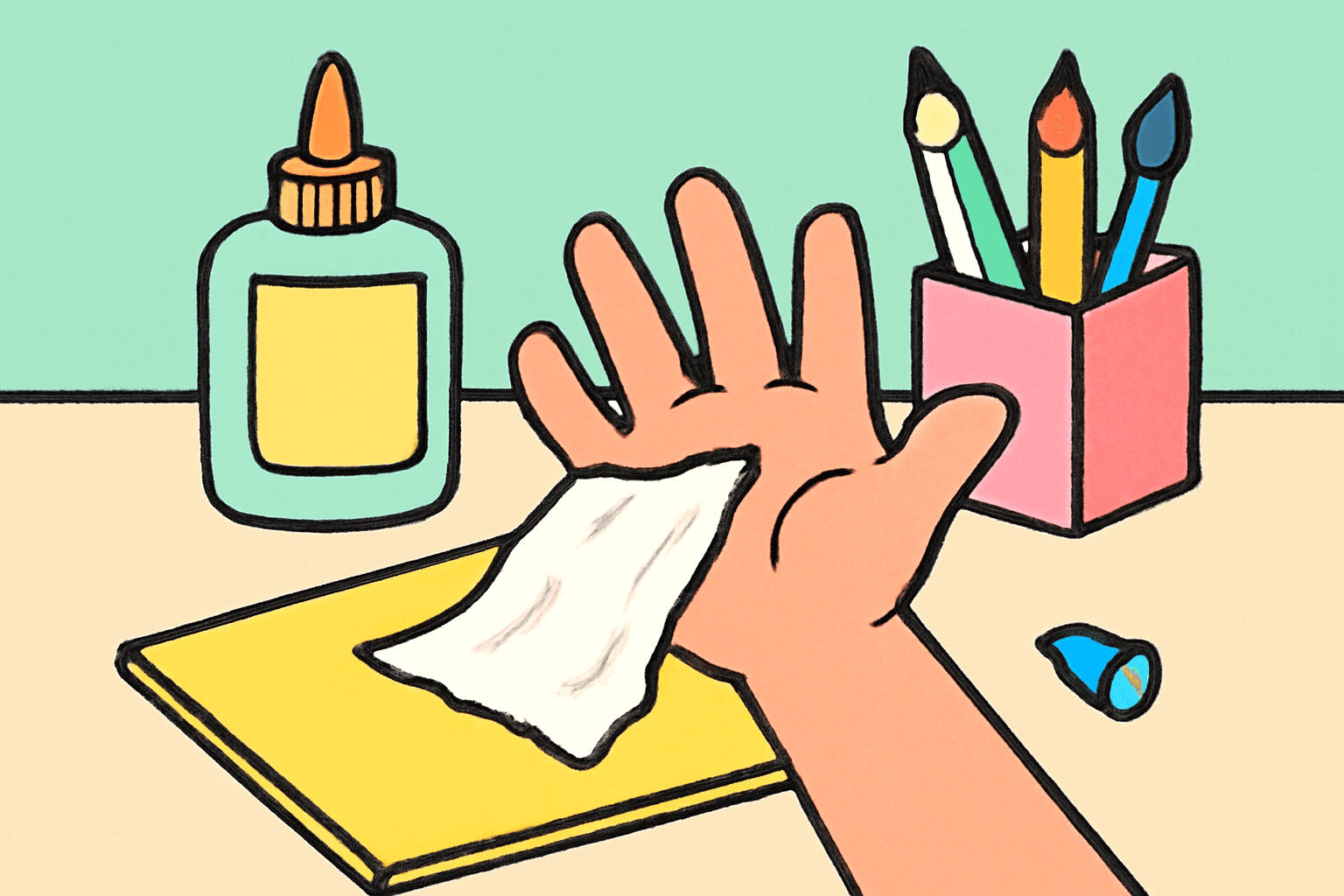
You didn't learn it from anyone. That's the part that still gets me. Nobody pulled you aside in second grade and said, "Hey, spread a thick layer of white glue on your palm, wait seven to ten minutes, and then peel it off in one perfect sheet." There was no instruction manual. No kid-to-kid oral tradition. You just - at some point between the ages of six and eleven, in an art class or at a craft table during indoor recess - looked down at the Elmer's glue bottle in your hand and thought, what if I just put this directly on my skin?
And then you did. And then you waited. And then you peeled.
And nothing was ever the same.
The Application
There was a technique, even if nobody taught it. You figured it out through trial and error, like a tiny scientist with no grants and no oversight.
First: the layer had to be thick enough. Too thin and it would dry invisible and flaky, coming off in sad little crumbles that weren't satisfying at all. You needed coverage. A generous, opaque, white layer across the entire palm, maybe up into the fingers if you were feeling ambitious. The pros went all the way to the fingertips. The truly unhinged did both hands, which meant you had to sit there with your palms up like you were meditating or receiving a blessing, unable to touch anything, for the entire drying period.
The application itself was half the ritual. That orange cap twisted off to reveal the rubber slit - the little rubber mouth that you had to squeeze to open. The glue came out cool and wet and smelled like - what did it smell like? Not quite plastic, not quite milk. Something chemical but gentle. Something that said I am technically non-toxic but please don't test that.
Nobody pulled you aside and taught you this. There was no instruction manual. You just looked at the glue bottle one day and thought, "what if I just put this directly on my skin?"
You'd spread it around with a finger, evening out the layer, filling in the gaps. Maybe you'd use the bottle itself as a squeegee, dragging it across your palm in slow passes. The goal was uniformity. The goal was a single unbroken plane of Elmer's, edge to edge, no thin spots, no bubbles.
Then you waited.
The Wait
This was the hard part. This was where character was built.
The glue started white and wet and slowly - so slowly - became clear and tight. You could feel it happening. The edges dried first, pulling slightly at the skin of your palm, creating a faint tug that was somehow both uncomfortable and deeply pleasant. You'd hold your hand up and watch the white recede toward the center like a tiny glacier in reverse, the dried parts going shiny and translucent while the middle stayed stubbornly opaque.
The temptation to start peeling early was enormous. Every few seconds you'd test an edge with your other hand, gently lifting a corner, checking. Not yet. Too wet in the middle. You'd press it back down and keep waiting.
The kids who started too early got a ragged, half-wet peel that tore into pieces. Unsatisfying. Incomplete. The equivalent of pulling a bandage off slowly. You learned fast that patience was everything. The peel had to be earned.
And somewhere in your brain, in whatever region handles delayed gratification, a little neural pathway was being built. One that said: if you wait, the reward is better. This may have been the most important lesson of your entire elementary education and it came from a bottle of craft glue, not a teacher.
The Peel
When the moment was right - when the whole surface had gone clear and tight and dry - you'd find a starting edge. Usually at the heel of the palm or along one side, where the layer was thinnest and easiest to lift.
You'd work a fingernail under it. Gently. Gently. And then you'd start to pull.
If you'd done everything right - the thickness, the coverage, the patience - the glue would come off in one single, glorious, translucent sheet. A perfect mold of your palm. You could see your skin lines in it. Your fingerprints. The little creases and whorls that made your hand yours, pressed into a thin film of dried adhesive like a death mask for your hand that was very much alive.
You'd hold it up. You'd look at it. You'd stretch it slightly between your fingers, feeling how thin and papery it was. And in that moment, you experienced something that no toy, no video game, no Saturday morning cartoon could provide: the pure, inexplicable satisfaction of removing something from your own body that you had put there on purpose.
You experienced something that no toy, no video game, no Saturday morning cartoon could provide: the pure satisfaction of removing something from your own body that you had put there on purpose.
It wasn't gross. It wasn't weird. Okay - it was a little weird. But it was yours. You'd made a thing, and the thing was a copy of your hand, and you'd made it from glue and patience and the decision to ignore whatever the actual art project was supposed to be about.
The Variations
Because of course there were variations. Once you'd mastered the basic palm peel, you started pushing boundaries.
The back of the hand, which was harder because the skin was less smooth and the glue tended to pool in the valleys between your knuckles. The forearm, if you were bold and had enough glue and a teacher who wasn't paying close attention. The single-finger peel, where you'd coat one finger and try to get a perfect little finger-sleeve of dried glue, like a shed snake skin in miniature.
Some kids layered. Let one coat dry, applied another on top, let that dry. A double-thick peel. A luxury peel. The kind of peel that came off with a satisfying weight to it, that you could stretch further without tearing, that felt less like a skin and more like a material.
And then there were the artists. The ones who'd squeeze glue directly onto the desk in shapes - their initials, a star, a crude picture of something - and let it dry into a sticker. A homemade, lumpy, translucent sticker that stuck to nothing and looked like evidence from a crime scene, but was technically art and therefore protected under the unwritten laws of the craft table.
What Were We Doing?
I've thought about this more than any adult should.
Here's my theory: we were playing with transformation. You put something wet on your skin and it became something dry. Something liquid became something solid. Something white became something clear. And then you peeled it off and you had made a thing - a fragile, temporary, useless thing - out of nothing but time and adhesive.
In a day full of being told what to do, where to sit, when to talk, and how to hold your pencil, the glue peel was yours. Nobody assigned it. Nobody graded it. Nobody said "good job" when you held up your translucent palm-sheet, because honestly most teachers were pretending not to see what you were doing with the glue that was supposed to be for the construction paper turkeys.
I bought a bottle of Elmer's last year. Same white bottle, same orange cap, same rubber slit you have to squeeze open. I don't remember why I bought it - some household repair, some picture frame thing. But it sat on the counter for a week, and one night I picked it up and squeezed a line across my palm.
I don't know what I expected. I think I expected to feel nothing. To feel like a grown adult who had outgrown a pointless childhood ritual and could now appreciate it only as a memory, a fun anecdote, a thing I used to do.
But the glue was cool and wet and it smelled exactly the same. And I spread it around with my finger, evening out the layer, filling in the gaps. And I sat on the couch with my palm up, waiting. Feeling the edges tighten. Testing corners that weren't ready yet.
And when I finally peeled it off - one clean, unbroken sheet, my skin lines perfectly pressed into it like a little ghost of my hand - I felt the same thing I felt when I was eight. That small, weird, private satisfaction. Like I'd gotten away with something. Like I'd made something that mattered, even though it didn't.
I held it up to the light. I could see through it. I threw it away. But I sat there for a while after, looking at my palm, thinking about what it felt like to have nothing to do and all the glue in the world to do it with.