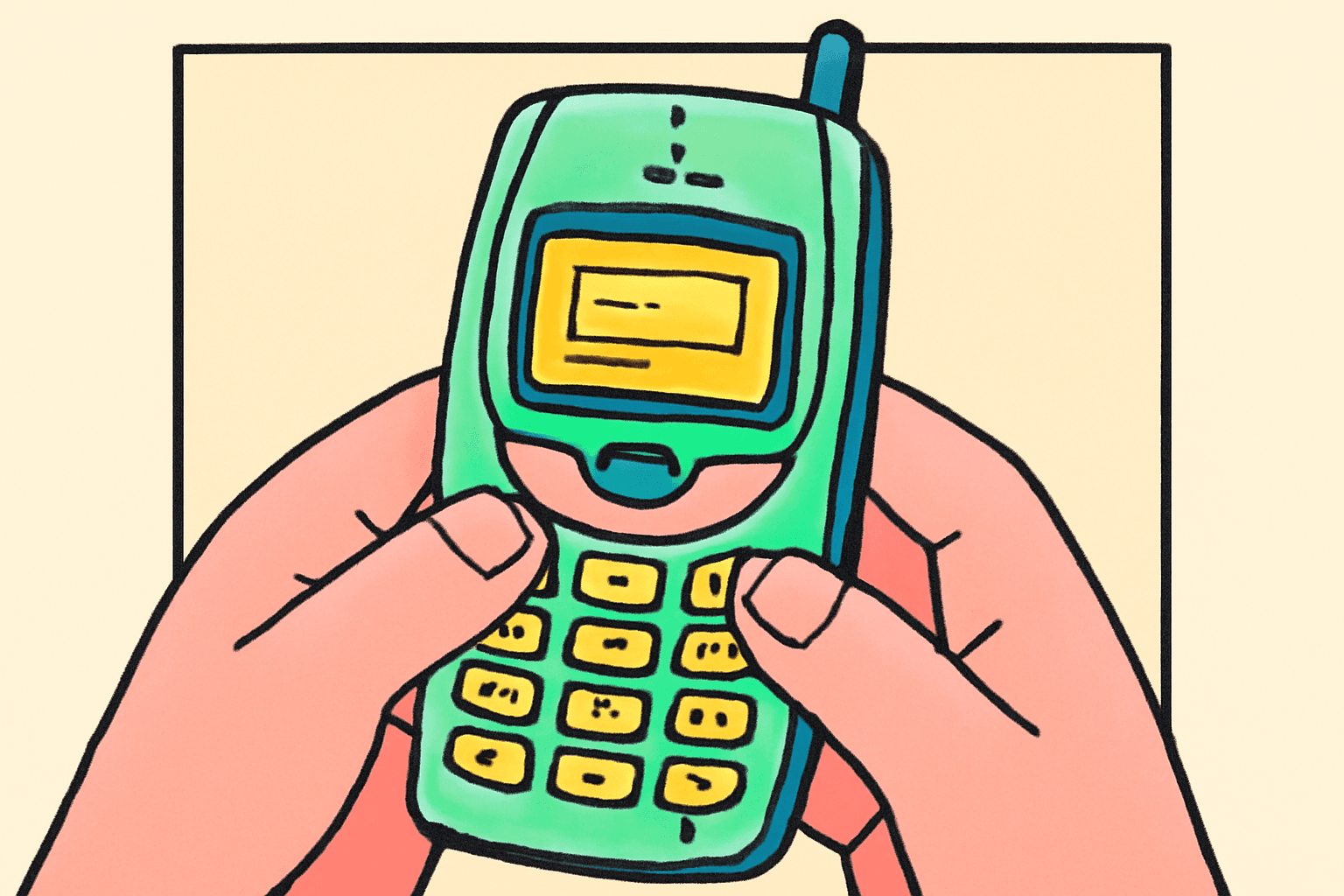
The 7 key. You had to hit the 7 key four times to get the letter S.
Four times. On a physical button the size of a Tic Tac. And you did this dozens of times a day, hundreds of times a week, thousands of times across the span of your adolescence, and you never once thought of it as difficult. It was just how you talked to people. Thumb down, plastic click, thumb down, plastic click. Four times for S. Three times for R. Twice for B. You knew this the way you knew the alphabet. Better than you knew the alphabet, actually, because the alphabet never had stakes. The alphabet never had to be typed under a desk while Mrs. Patterson was explaining the Missouri Compromise.
The Nokia 3310 Was Not a Phone
Let's get something straight. The Nokia 3310 was not a phone. It was a survival tool that happened to make calls. It was a brick of blue-gray plastic that weighed about six ounces and could survive a fall from a second-story window onto concrete. I know this because someone in my sophomore class tested it. The battery popped out, the faceplate went skittering across the sidewalk, and when he snapped it all back together, the thing powered on like nothing happened. No cracked screen. No genius bar appointment. No $200 deductible. Just a phone that did not care about your drama.
The Nokia didn't break when you dropped it. It broke whatever you dropped it on.
You could go three, maybe four days on a single charge. A full school week if you weren't playing Snake. Which you were. You were always playing Snake.
The Thumb Alphabet
There were two ways to text on a Nokia. Multi-tap and T9. Multi-tap was for beginners - you pressed each number key multiple times to cycle through letters. 2-2-2 for C. 7-7-7-7 for S. The word "yes" required nine button presses. The word "cool" required twelve.
T9 was the upgrade. T9 was predictive. You pressed each number once and the phone guessed what word you meant. Press 4-3-5-5-6 and it knew you meant "hello." Most of the time. Sometimes it thought you meant "gejlo" and you had to scroll through options with the star key, which was its own small humiliation.
But here's the thing nobody talks about. The real masters didn't use T9 or multi-tap in any conscious way. They used muscle memory. Pure, unthinking, thumb-driven reflex. The way a pianist doesn't think about which finger hits which key. You thought of a word and your thumb produced it. The phone was an extension of your hand, which was an extension of your brain, and the whole system operated below the level of language.
This was the martial art. Not the typing itself - the typing without looking.
Under the Desk
Every classroom in America between 1999 and 2005 contained at least three kids texting under their desks at any given moment. This was a known fact. Teachers knew it. Students knew it. It was an open secret maintained by a mutual agreement to pretend it wasn't happening, as long as you were subtle about it.
Subtle meant no looking down. Subtle meant keeping your eyes on the chalkboard while your right thumb navigated a keypad you'd memorized by touch. The raised bump on the 5 key was your home position - your anchor point. From there, everything was spatial. One key up and left for 1. One key down and right for 9. You could type "where r u" in about four seconds without breaking eye contact with your teacher. That was power. That was real power.
The pocket texters were the elite. They'd have their hand in their hoodie pocket, phone open, thumb working, and they'd send a complete message without the phone ever seeing daylight. You'd feel your own Nokia vibrate in your pocket thirty seconds later and know exactly who it was from.
160 Characters of Pure Discipline
Here's what kids today will never understand: a text message was 160 characters. That was the limit. Not a suggestion. A wall. And if you went over 160 characters, you didn't just keep typing. The message split into two texts. And two texts cost twice as much.
Which brings us to money.
Your parents got the Cingular bill at the end of the month. Maybe it was AT&T Wireless, maybe it was some regional carrier that got swallowed up in the great telecom mergers. Didn't matter. What mattered was this: your plan included 200 text messages per month. Maybe 500 if your parents were generous. And every text beyond that cost ten cents.
Ten cents doesn't sound like much until you're fifteen and you've sent 847 texts in October and your dad is standing in the kitchen holding a phone bill for $64.70 in overage charges and looking at you like you've committed a federal crime.
This is why abbreviations existed. Not because they were fun. Not because they were trendy. Because every character you saved was a hedge against financial ruin.
"u" wasn't laziness. It was economics.
"U" instead of "you." "R" instead of "are." "2" instead of "to" or "too" or "two." "Gr8" instead of "great." "Ur" instead of "your." "Msg" instead of "message." "Pls" instead of "please." "Bc" instead of "because." We compressed English like a zip file. We stripped the vowels. We murdered grammar. And we did it because Cingular was charging us a dime every time we hit send, and we were not about to waste three characters spelling out Y-O-U when the recipient knew exactly what we meant.
Snake
You could play Snake on a Nokia 3310 and honestly, you didn't need anything else.
A line of black pixels moved across a tiny green-gray screen. You ate a dot. The line got longer. You ate another dot. The line got longer. You tried not to run into yourself or the walls. That was the entire game. It had no levels, no bosses, no cutscenes, no downloadable content, no season passes. It was just you and a growing line and the slow, creeping certainty that you were about to mess up.
The high score screen was the only social media that mattered. You'd hand your phone to someone and say "beat that" and they'd try for twenty minutes during study hall and hand it back with a look of either triumph or defeat and that was a complete social interaction. No likes. No comments. No screenshots. Just a number on a screen and the respect of your peers.
Choosing Your Ringtone
Monophonic. Then polyphonic. Then actual songs you could buy for $2.99 from some sketchy service that charged recurring fees to your phone bill until your mom called to cancel it three months later.
But before all that, there were the built-in ringtones. The Nokia ringtone. You know the one. Da-da-da-daa, da-da-da-daa, da-da-da-daa, da-da. The "Nokia Tune," which was apparently based on a 19th-century Spanish guitar piece, but to you it was just the sound of someone's mom getting a call at the grocery store.
You scrolled through all the options. "Mosquito." "Jumping." "Charleston." "Samba." You'd sit there listening to each one, trying to find the ringtone that captured your personality, as if a two-second MIDI loop could convey the complexity of being fourteen.
The Weight of It
I still remember what a Nokia felt like in my hand. The heft of it. The solidity. It felt like something that existed in the world, not a sheet of glass pretending to be everything at once. It did four things: calls, texts, Snake, and an alarm clock that could wake the dead. That was plenty.
Sometimes I think about the kid I was, sitting in the back of seventh period, thumb working the keypad in my pocket, composing a message to my friend three rows up. Something urgent. Something that couldn't wait. Probably "this class is so boring lol." Seven words. Twelve button presses with T9. Sent blind, without looking, without thinking.
My thumb knew the way.
It still does, probably. Somewhere in the muscle memory, buried under years of touchscreen swiping. If you put a Nokia 3310 in my hand right now, I bet I could still type without looking. Some things you don't forget. Some things your body just knows.
The 7 key. Four times. S.
I could do it in my sleep.