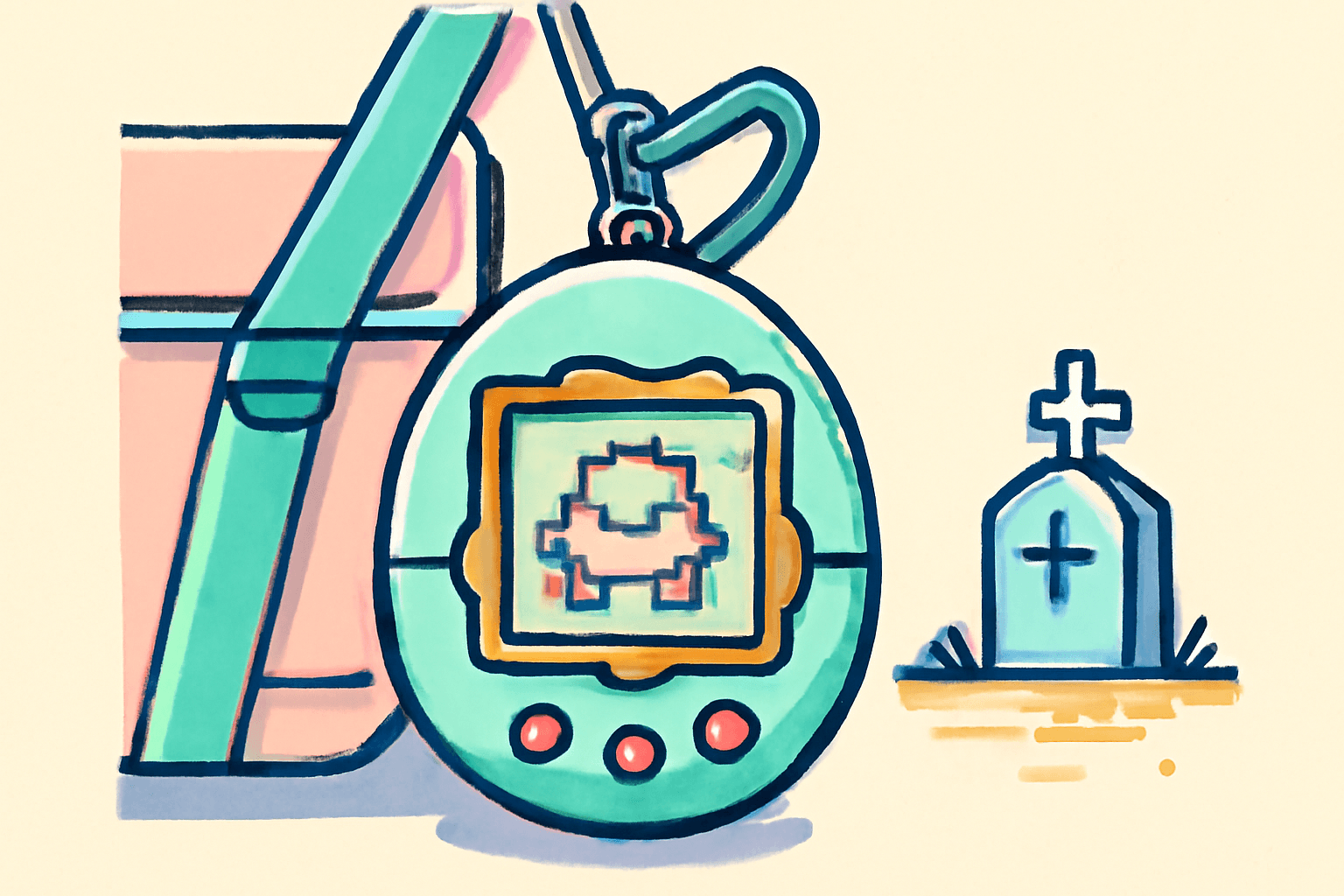
The screen was the size of a postage stamp. Smaller, maybe. And on it, a tiny blob with eyes was waiting for you to feed it. It had been beeping in your backpack for the last forty minutes of fourth-period social studies, and Mrs. Kendrick had already given you one warning. The blob didn't care about Mrs. Kendrick. The blob was hungry now.
That was the deal with the Tamagotchi. It didn't work on your schedule. You worked on its.
The Egg
It came on a keychain, which implied it was a casual thing. A novelty. Something you'd clip to your JanSport and forget about. Bandai really undersold what they were handing us. This wasn't a toy. It was an obligation shaped like an egg.
The egg was plastic, about two inches tall, with a tiny LCD screen and three buttons along the bottom. That was it. Three buttons to manage the entire life cycle of a digital creature. You could feed it, play with it, clean up its waste, give it medicine, turn the lights off when it slept, and discipline it when it misbehaved. All with three buttons and a screen that showed maybe thirty-two pixels of anything.
This wasn't a toy. It was an obligation shaped like an egg.
When you pulled the plastic tab out of the back, an egg appeared on screen. It hatched. And suddenly you were responsible for something. You were eight, maybe nine, and you had never kept anything alive that didn't meow loudly enough for your parents to step in. But this thing - this little round pixel creature bouncing on the screen - it was yours and yours alone.
The Routine
You'd wake up and check on it before school. Feed it rice or a piece of candy. Play the little guessing game to make it happy. Clean up the little piles it left behind, which were represented by something that looked exactly like what they were supposed to represent. Then you'd clip it to your backpack or your belt loop - if you were bold enough for the belt loop - and head out.
At school, it would beep. It always beeped. The Tamagotchi had no concept of multiplication tables or the Missouri Compromise. It needed attention on a biological clock that happened to peak right around 10:45 AM, every single day.
Teachers figured this out fast. By spring of 1997, Tamagotchis were being confiscated in elementary schools across the country like contraband. Mrs. Kendrick had a desk drawer full of them by March. A dozen little eggs, all beeping at different intervals, all slowly dying of neglect in a wooden drawer next to the rubber bands and the overhead projector markers. She'd give them back at the end of the day, and you'd press the button to find your pet in critical condition, surrounded by its own waste, a tiny skull icon flashing on the screen.
You had left it in the care of a woman who did not care.
The Guilt
Here's what nobody warned you about: the guilt was real. Like, actually real. You knew it was a toy. You knew the thing on the screen wasn't alive. You knew that intellectually, in the same way you knew Santa wasn't real but still felt weird about it. But when you forgot to check on your Tamagotchi for a whole afternoon and came back to find it sick, something in your chest tightened.
And when it died? When the screen showed that little grave marker and the angel floating upward?
You felt it.
It always died. That was the thing. No matter how attentive you were, no matter how carefully you managed the feeding schedule and the happiness meter and the discipline, the Tamagotchi had a lifespan. A few days if you were careless. A couple of weeks if you were diligent. Eventually the screen went to that angel, and your pet was gone, and you were holding a silent plastic egg on a keychain.
The game - if you could call it a game - was about delay. You were never going to save it. You were just trying to keep it alive a little longer than last time. Which is either a really dark lesson for a third grader or a really honest one.
The Reset
There was a button on the back. A tiny recessed button you had to press with the tip of a pen or a paperclip. The reset button. You'd push it, and a new egg would appear, and the whole cycle started over. New creature. Clean slate. No memory of the one that came before.
You were never going to save it. You were just trying to keep it alive a little longer than last time.
And you'd do it again. Immediately. Without hesitation. Because the alternative was carrying around a dead egg on your keychain, and that was somehow worse than starting over. The grief lasted about ninety seconds. Then you were back to feeding and cleaning and playing the guessing game, bonding with a brand-new blob that looked exactly like the old one.
I don't know what that teaches a kid. Resilience, maybe. Or compartmentalization. Probably compartmentalization.
The Knockoffs
The Tamagotchi was everywhere in 1997, which meant the knockoffs showed up by 1998. Giga Pets. Nano Pets. Those weird off-brand ones you'd find at the checkout at Walgreens that were shaped like a dog or a cat instead of an egg, as if the shape was the problem.
Giga Pets were the main competitor, and they had licensed versions - a Looney Tunes one, a 101 Dalmatians tie-in. They were slightly bigger, slightly louder, and somehow even more demanding than the Tamagotchi. The Nano Pets were the budget option, the ones you'd get at the dollar store or in a birthday party goody bag. They worked the same way but felt cheaper, like a photocopy of a photocopy.
None of them solved the fundamental design problem, which was that they needed you more than you needed them. You couldn't pause them. You couldn't put them on silent. You couldn't tell them to wait until after math class. They existed in real time, demanding real attention, and if you couldn't give it to them, they suffered and died.
What It Actually Was
I've seen people write about Tamagotchis as a precursor to smartphone addiction, and I get the comparison, but it misses the point. Your phone doesn't die if you ignore it. Your phone doesn't guilt you with a tiny grave. The Tamagotchi wasn't training us to stare at screens. It was training us to care about something that depended on us.
It was the first time a lot of us experienced the weight of that. Real pets have parents as backup. Real pets make noise that other humans can hear and respond to. The Tamagotchi was silent except for its beep, and the beep was only for you, and if you didn't answer it, nobody else would.
I think about my kids and their relationship to digital things - their iPad games that save automatically, their apps that wait patiently for them to come back, their everything designed to be frictionless and consequence-free. And I think about that plastic egg on my keychain in 1997, beeping in Mrs. Kendrick's desk drawer, dying slowly while I learned about westward expansion.
It was a terrible product, honestly. A tiny screen with three buttons that made you feel bad. It cost $17.99 at Toys "R" Us and it guaranteed you a small, quiet grief every couple of weeks.
We bought millions of them. And every single one of them died. And we pressed the reset button and did it all over again, because even at nine years old, we understood something that's hard to put into words. That caring about something that won't last is not a design flaw. It's the whole point.