The first website I ever made had a black background, green text, a MIDI file that autoplayed the X-Files theme, and an animated GIF of a skull with rotating eyeballs. I was twelve. I thought it was the greatest thing anyone had ever created. I was not entirely wrong.
It lived on GeoCities. Of course it did. Everything lived on GeoCities. And if you're reading this page right now - if you're looking at these colors, this layout, this beautifully janky aesthetic - then you already know exactly what I'm talking about. You've been here before. Maybe not here, but somewhere like it. Somewhere with a hit counter at the bottom and a guestbook nobody signed and a background tile that made your eyes bleed in the best possible way.
Welcome home.
The Neighborhoods
GeoCities had this idea that the internet should be organized like a city. You didn't just get a URL. You got an address. A neighborhood. And each neighborhood had a theme, a vibe, a whole little identity.
Area51 was for sci-fi and paranormal stuff. This was where you found fan pages for The X-Files and Babylon 5 and deeply earnest analyses of whether aliens had actually visited Roswell. EnchantedForest was for kids and families and pet pages. SunsetStrip was for music - which in 1997 meant pages dedicated to Metallica or Smashing Pumpkins with every lyric transcribed by hand, probably with a few wrong words nobody ever corrected. Hollywood was for entertainment. SiliconValley was for tech. CapitolHill was for politics, and yes, it was exactly as unhinged as you'd expect.
- Area51 - Aliens, sci-fi, conspiracy theories, X-Files shrines
- EnchantedForest - Kids' pages, pet tributes, Neopets fan sites
- SunsetStrip - Music pages with every lyric ever written (some of them correct)
- TimesSquare - Gaming, which meant a lot of Quake and Doom fan pages
- Hollywood - Movies and TV, 90% of which were Buffy pages
- CapitolHill - Politics, or at least what passed for political discourse in 1998
- Heartland - Families, religion, and a surprising number of quilting pages
Your address was something like geocities.com/Area51/Vault/7294. That was your place on the internet. Your little plot of digital land. And you could do anything with it.
Anything.
Under Construction (Forever)
Every page on GeoCities was under construction. Every single one. Not because people were lazy, but because the whole point was that you were always building, always tinkering, always adding another page about your favorite Simpsons episodes or your theories about the Bermuda Triangle.
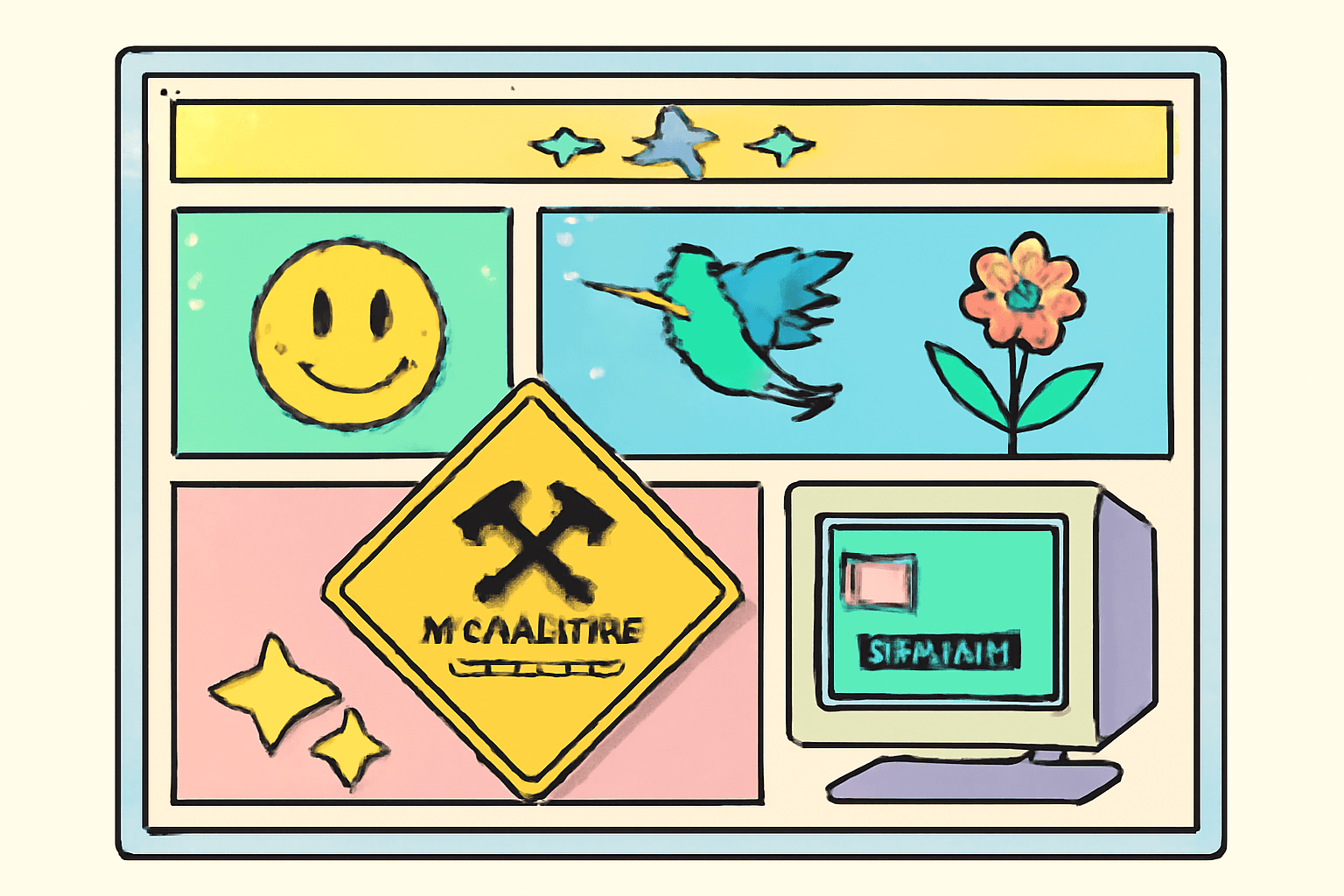
And you announced this fact with a GIF. The under construction GIF. A little animated hard hat, or a stick figure digging, or a flashing yellow road sign. Sometimes all three on the same page. You put it right there at the top, or maybe at the bottom, next to your hit counter and your "Best Viewed in Netscape Navigator at 800x600" badge. It was a promise. I'm not done yet. I'm working on this. Come back later.
Nobody ever came back later. That was fine. The building was the point.
Every page was under construction. Nobody ever finished. The building was the point.
You learned HTML by viewing source. That was the whole education system. You'd see something cool on someone else's page - a scrolling marquee, a table layout, a font tag that made text shimmer - and you'd right-click, View Source, and just stare at it until you figured out how it worked. Then you'd copy it. Then you'd break it. Then you'd fix it at 11 PM on a school night and feel like a wizard.
The Web Ring
Here's something that will sound completely insane to anyone under twenty-five: we organized the internet by hand.
Web rings. A web ring was exactly what it sounded like - a ring of websites, linked together in a circle, all about the same topic. You'd find a Buffy the Vampire Slayer fan page, and at the bottom there'd be a little navigation bar. Previous. Random. Next. And you'd click Next and land on another Buffy fan page. And another. And another. Just an endless loop of people who loved the same weird thing you loved, all voluntarily connected, all handmade.
There was no algorithm deciding what you should see. No recommendation engine. No feed. Just people linking to other people because they thought their page was cool. That was the whole system. Human beings pointing at other human beings and saying hey, look at this.
It worked. It worked beautifully.
Sign My Guestbook
You had a guestbook. Everyone had a guestbook. It was a page on your site where visitors could leave a message, like a comments section except somehow more innocent and more unhinged at the same time.
Most entries were from your friends. "Cool page!!!!" with about nine exclamation points. Sometimes you'd get a stranger, someone who'd wandered in from a web ring, and they'd leave something like "Hey, nice Dragon Ball Z page, check out mine" with a link. And you would. And it would be terrible. And you'd sign their guestbook. And now you were friends, sort of, in the loosest possible definition of the word.
The guestbook was proof that someone had been there. That your little corner of the internet wasn't just you shouting into the void. Someone saw it. Someone cared enough to type "cool page" and hit submit. That mattered more than any like or follow ever could.
The Weird Stuff
The 90s internet had this incredible capacity for things that were just weird. Not viral, not content, not engagement. Just weird.
The dancing baby. You remember the dancing baby. A grotesque, half-rendered 3D infant doing the cha-cha on a black background. It showed up on Ally McBeal. It showed up in your email inbox, forwarded by your aunt, forwarded by her coworker, forwarded by someone named Debra. Nobody knew where it came from. Nobody knew why it existed. It just was, and for about six months in 1998 it was the most famous thing on the internet.
Hamster Dance. A page full of animated hamster GIFs bouncing to a sped-up version of "Whistle Stop" from Robin Hood. That's it. That was the whole page. It got millions of hits. Millions. Because someone sent the link to someone who sent it to someone who sent it to everyone in their address book. That was how things spread. Not through an algorithm. Through people actively deciding to share something dumb and delightful with other people.
Nobody was trying to build a brand. Nobody was optimizing for engagement. People were just making things because making things on the internet felt like a miracle.
And then there was "You've got mail." Three words. A robot voice. And your heart would jump every single time because email was still exciting. Someone wrote to you. A real message, from a real person, sitting in your AOL inbox between a chain letter threatening seven years of bad luck and a joke forward from your uncle. You've got mail. They made a whole movie about it. It starred Tom Hanks. That's how much it mattered.
The Internet as Frontier
Here is the thing I keep coming back to. The 90s internet felt like a place you could explore. Not scroll. Explore. There was a difference, and the difference was everything.
You didn't open an app and let it feed you content. You went looking. You typed a URL. You followed a link. You clicked Next on a web ring and had absolutely no idea where you'd end up. Maybe a page about medieval swords. Maybe someone's poetry. Maybe a conspiracy theory about the Denver airport. You never knew. That was the thrill of it.
It felt like a frontier. Vast and weird and mostly empty and full of possibility. Every page was handmade by a person - not a team, not a company, just a person - who had learned enough HTML to make their thoughts visible and then did it. They didn't need anyone's permission. They didn't need a platform. They needed a text editor and a free hosting account and something to say.
And what they had to say was usually pretty strange. And their pages were ugly. Tiled backgrounds that clashed with the text. Font colors that shouldn't exist. Autoplay MIDIs that assaulted you the moment the page loaded. Animated GIFs everywhere - flames, spinning globes, waving flags, those little email icons that bounced. It was a mess. A gorgeous, chaotic, deeply human mess.
The Mall
Look at the internet now. Go ahead. Open a new tab. Tell me what you see.
You see a mall. A clean, optimized, algorithmic mall. Five or six major websites that everyone visits. Everything looks the same because everything is built on the same templates, the same frameworks, the same design systems that prioritize conversion rates over self-expression. Your Instagram page looks like my Instagram page looks like everyone's Instagram page. The only variable is the content, and even that is being shaped by what the algorithm wants to promote.
Nobody's homepage is ugly anymore because nobody has a homepage. You have a profile. A profile on someone else's platform, governed by someone else's rules, designed to keep you scrolling so they can sell your attention to advertisers. The internet didn't become a mall by accident. Somebody built the mall on purpose, and then they bulldozed the weird little neighborhoods to make room for the parking lot.
The Point
Every GeoCities page was terrible. I want to be clear about that. They were ugly and slow and hard to navigate and full of broken links and spelling errors and opinions that didn't hold up. The HTML was a disaster. The design choices were criminal.
And that was the whole point.
They were made. By hand. By people who didn't know what they were doing and did it anyway. A thirteen-year-old in Topeka who loved Final Fantasy VII and spent two weeks figuring out how to make a table layout so she could organize her fan fiction. A dad in Phoenix who built a page about his model trains with a guestbook that had exactly four entries, all from family members. A kid in my seventh-grade class who had an Area51 page about UFOs that cited sources he clearly made up.
None of them were trying to build a brand. None of them were optimizing for anything. They were just there, making things, because the internet was new and making things on it felt like a small miracle.
I miss that. I miss the mess of it. I miss web rings and guestbooks and under construction GIFs. I miss the dancing baby and the Hamster Dance and the sound of a modem connecting. I miss the internet before it became a job, a marketplace, a surveillance apparatus, a place where the primary purpose of your presence is to generate data for someone else's profit model.
The 90s internet was weird and ugly and perfect.
You're looking at it right now.
Sign the guestbook on your way out.