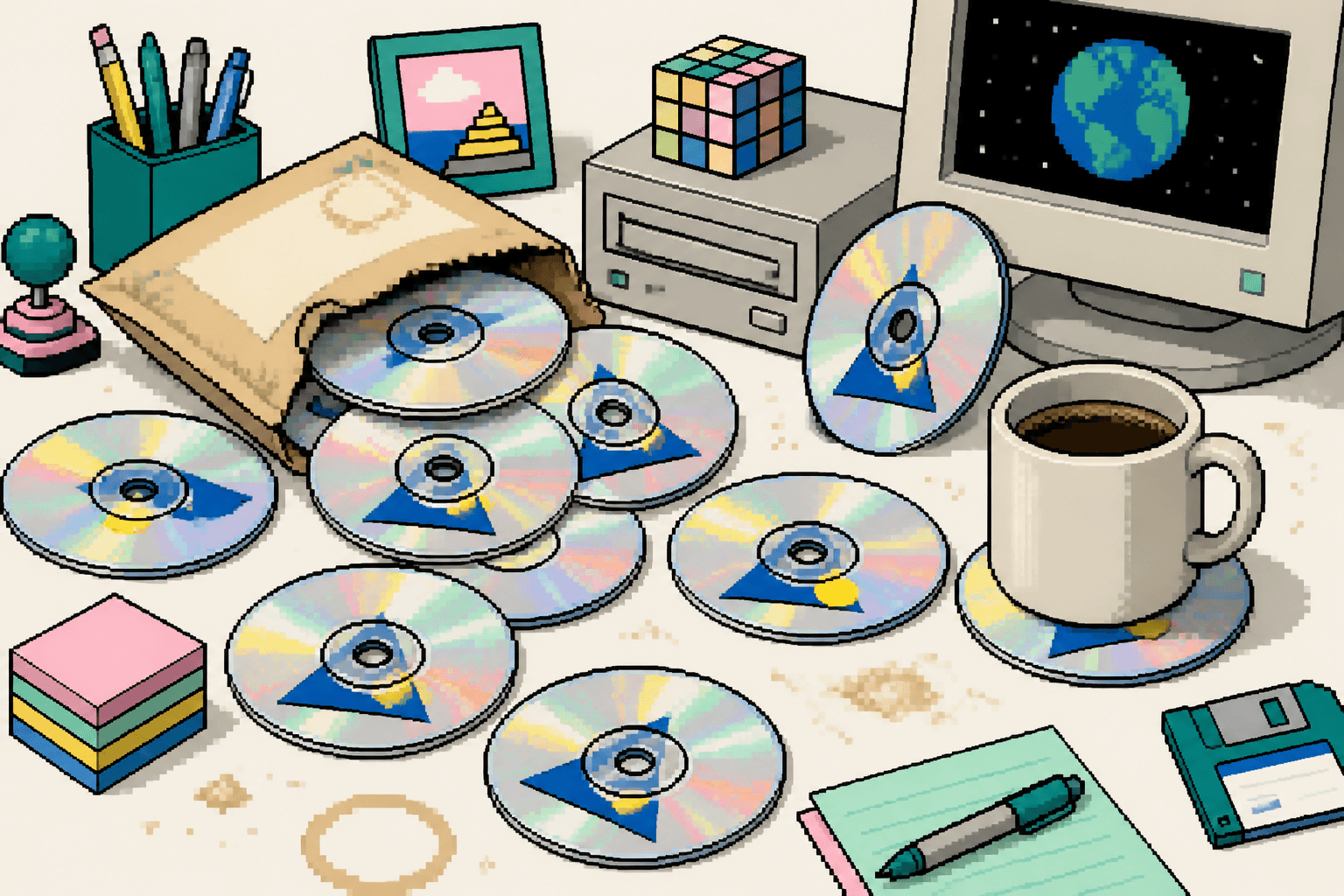
The mailer was brown. Sometimes yellow.
It was six inches square, made of cardstock the same weight as a cereal box, and it was flat except for the small round bulge in the middle where the CD lived. There was no letter inside. There was no coupon. There was a single silver disc, in a paper sleeve, with the AOL logo printed on the front and a number on it that always sounded made up. Seven hundred hours. One thousand hours. One thousand and forty-five hours, free.
You had already been on AOL for two years. You did not need the disc. You put it on the pile.
The Object
The disc was a 120-millimeter CD-ROM containing an installer for AOL software. The installer was, depending on the year, about 30 to 90 megabytes, which was a tremendous amount of software in 1998 and a whimsical amount to send someone in the mail. If you actually inserted the CD, the installer would launch itself with an autorun file, and a friendly wizard would walk you through creating an account, and at the end of the wizard you would be online, and the phone line would be busy, and your mom would yell down the stairs.
But you were not going to insert the CD. You already had an account. You had been mailed the CD anyway. This was the entire premise.
The physical packaging changed constantly. Some months the mailer was a plain white envelope. Some months it was a cardboard tin the size of a hockey puck. There was a stretch in 1999 when they came in metal tins, like Altoids, and the CD was gold-colored, and the tin had a hinge, and the hinge was small enough that if you were seven you would eventually pinch a fingernail on it. There was a stretch in 2001 when they came in tall cardboard boxes disguised as some kind of gift, and you would tear off the tape, expecting a birthday, and instead find a CD with the number 1025 on it.
The disc was a 120-millimeter CD-ROM containing an installer for AOL software, and the installer was, depending on the year, about 30 to 90 megabytes, which was a tremendous amount of software in 1998 and a whimsical amount to send someone in the mail.
The disc itself never really changed. It was silver on the underside, printed on top, and the print was almost always yellow, and it almost always had the number of free hours in a large blocky font. The number was the whole product. If the number was 500, you were being offered less than you had been offered last week, which was 700, which was less than what your neighbor said he had gotten yesterday, which was 1045. The numbers escalated without meaning. Nobody was going to use a thousand hours of the internet. Nobody had a thousand hours.
The Volume
The math on this is genuinely difficult to hold in your head.
AOL sent out, at their peak, roughly a billion CDs. This is not a metaphor. This is a real, disclosed, on-the-record number. At various points in the late 90s, AOL was, by some estimates, responsible for half of all CDs produced in the world. There was a warehouse in Virginia. There were trucks. Somebody, at a company in Sterling, was in charge of making sure that every household in America received an unrequested silver disc, on a rolling basis, forever.
If you were a kid, you understood this vaguely. You noticed the pile grew. You did not do the math. You did not know that the company had, at one point, calculated that the cost of manufacturing and mailing a CD was recouped if roughly one recipient out of every fifty actually signed up, which meant that the other forty-nine CDs were priced into the fiftieth, which meant that in a real sense you were paying, with your subscription, for forty-nine other people's junk mail. You were also, somehow, one of the forty-nine.
- On top of the microwave
- Under a coaster on the coffee table, so that you had a coaster under your coaster
- In the junk drawer, on top of the takeout menus, wedged between the twist ties and a battery
- In the car door pocket, warped by a summer
- In a plastic Kroger bag with three other AOL CDs and a phone book
- On the mantel, because someone had put it down there and forgotten and it had become part of the mantel now
- On your desk, propping up the short leg of the desk
- In your dad's tool shed, being used as a small mirror for something he was doing under the sink
The Pile
Here is what nobody talks about. The pile was not just yours.
The pile was on top of the fridge at your grandmother's house. It was in the entryway at your friend Kevin's house, where his mom had a wicker basket by the door specifically for mail, and the wicker basket was, by 1999, more than half AOL CDs. It was at every relative's house you visited that year. It was at the dentist. It was in the break room at the place where your mom worked, on a small side table, next to the coffee maker, in a wire rack that had been intended for magazines. The AOL CD was, briefly, a piece of American home furniture. Every kitchen contained one. Every desk contained one. You could not, in the year 2000, walk into a suburban house in the United States without being within twelve feet of an AOL CD.
Nobody was collecting them on purpose. They just were not being thrown away. Throwing them away felt somehow wrong, because the CD was clearly a real object, made of real plastic, and it clearly cost real money to make, and the disc had a number on it that seemed like it might be worth something, and the whole assembly had shown up at your door for free. You would not throw away a free thing without at least considering it. You considered it. You put it on the pile.
The Uses
Because the pile grew faster than anyone was disposing of it, the CDs began, culturally, to acquire second lives.
They were coasters. This was the first and most obvious use, and it was excellent. An AOL CD is exactly the right diameter for a mug, has a shiny reflective side that mostly repels moisture, and is basically indestructible. Every desk I sat at between 1997 and 2003 had at least one AOL CD under a Coke can. If you spilled the Coke the disc caught it. If you got the disc wet you wiped it on your shirt and put it back. It was the most useful thing that had ever come free in the mail.
They were art. Someone in your class in fourth grade did the science fair project where you glued sixty AOL CDs to a piece of plywood to make a mosaic, and it looked, from across the room, like a small disco ball had exploded on a piece of plywood, and their parents had, in retrospect, saved fifteen dollars on materials by having the science fair project be mostly free discs. They were bird deterrents. They were Christmas ornaments. They were, in one specific case my uncle told me about, glued to the underside of a lawnmower deck to keep the moles away, which did not work but was, my uncle believed, a rational thing to try.
Every desk I sat at between 1997 and 2003 had at least one AOL CD under a Coke can. If you spilled the Coke the disc caught it. If you got the disc wet you wiped it on your shirt and put it back. It was the most useful thing that had ever come free in the mail.
They were the material of a whole generation of small, useless craft projects. Wind chimes. Fridge magnets, after you snapped one in half and glued a magnet to the back and pretended you had made something. Frisbees, briefly, until you discovered that a CD-ROM has almost no aerodynamic profile and about half the mass of a real frisbee, and the first throw would go, invariably, into a rose bush. Nobody stopped receiving the CDs. Nobody stopped inventing uses.
The Argument For
The AOL CD was, if you squint, one of the most successful pieces of marketing in the history of American consumer software.
By the year 2000, AOL had thirty million subscribers. Something like half of American households with an internet connection had one through AOL. This did not happen by accident. It happened because a company decided that the fastest way to get you online was to physically deliver the software to your door, over and over, until you cracked and used one of the discs, and then you were an AOL subscriber, and then you were, from the company's perspective, worth every disc they had ever mailed to your entire zip code. The CD was a Trojan horse dressed as a coaster.
It was also, weirdly, a public service. If you were a person who did not own a computer with a modem, and you wanted to try the internet, the mail brought you the internet, for free. Not the concept of the internet. The actual physical means. You put the disc in the drive and the internet arrived and you did not need to know anything else. There was no store you had to visit. There was no clerk to talk to. There was no purchase. There was just the pile, in every kitchen in the country, waiting to be tried.
The Argument Against
The AOL CD was also a small ecological horror.
You do not need to do the math on a billion CDs to know that this was a lot of polycarbonate to press, print, package, ship, and eventually throw away. Some of them got used. Most of them got thrown away. Some of them are still in landfills, presumably intact, presumably legible, presumably still offering a thousand and forty-five free hours of AOL 6.0. In a hundred years, when archaeologists dig up the remains of the late twentieth century, they are going to find a lot of small silver discs, printed with a number, and they are going to have to decide, without any surrounding context, what the number meant.
The correct answer is that the number did not mean anything. The number was a promise about a service that did not really work that way. Nobody was going to use a thousand hours of AOL in a month, because nobody had a thousand hours in a month, because a month has 720 hours in it and you have to sleep and eat and go to sixth grade during some of them. The number was there because bigger numbers made you pick up the disc and look at it, and picking up the disc and looking at it was the entire first step in becoming a subscriber, and the first step was, statistically, the hardest step. Everything after was a formality. So the number went up every quarter, and the disc got shinier, and eventually somewhere in a warehouse in Virginia, a machine was pressing CDs at a rate faster than most human beings could conceive of, and the mail was heavy.
- 50 hours. The early, honest offer. You would use these.
- 250 hours. Aspirational but plausible.
- 500 hours. Now they are just showing off.
- 700 hours. The cardboard tin era.
- 1000 hours. Marketing has jumped the shark.
- 1025 hours. A number, chosen by nobody, to feel specific and therefore credible.
- 1045 hours. Please. Please stop.
The Interface
There is a version of this essay where I try to argue that the AOL CD taught us something about the shape of technology. That it was the first time software was mass-mailed to your house, unrequested, in physical form, and that this was somehow prophetic. That every app icon on your phone today is, in some way, a small silver disc waiting to be installed. I could try to make that argument. I do not think it is quite true.
The AOL CD was not prophetic. It was a specific solution to a specific problem, which was that most people did not know how to acquire internet-access software, and the cheapest way to get it to them was to physically deliver it. The solution was silly. It was also correct. It did not scale to the future, because the future had broadband and the future had an app store, and you did not need a CD to install anything, and you certainly did not need a metal tin. The AOL CD was a bridge. You walked across it. You did not need it after you were on the other side.
The Pile at the End
The last AOL CD I remember arriving at my parents' house came sometime in 2004, in a plain white sleeve, with no number on it. I think it just said AOL and Try Us Free and had a version number in a corner. I do not think I opened the sleeve. I do not think I moved the disc off the counter. It sat there for maybe a month, and then it went in the trash, along with the credit card offers and the coupons for a car wash, and there was no ceremony for that either.
The pile is gone now. The wicker basket by Kevin's front door was thrown out sometime in the mid-2000s, when Kevin's mom moved apartments. The coaster on my dad's desk was replaced by a real coaster he bought at a craft fair. The CD in the car door pocket warped so badly one summer that it had to be pried out with a screwdriver, and my dad, mildly furious, threw it into a hedge, and to my knowledge it is still there. That is where a certain number of AOL CDs went. They went into hedges. They went into the walls of storage sheds. They went, unceremoniously, into the trash. There is no monument.
But if you are old enough, and you close your eyes, and you think about the specific weight of an AOL CD in its little cardstock sleeve, and the specific way the sleeve tore when you opened it, and the specific way the disc slid out and sat, silver and printed and vaguely accusatory, on the kitchen counter next to a bill from the electric company, you can still feel it. You will remember the number. You will remember that you did not need the disc. You will remember the pile.
You never used a single one of the free hours. Nobody did. That was not what the CDs were for.