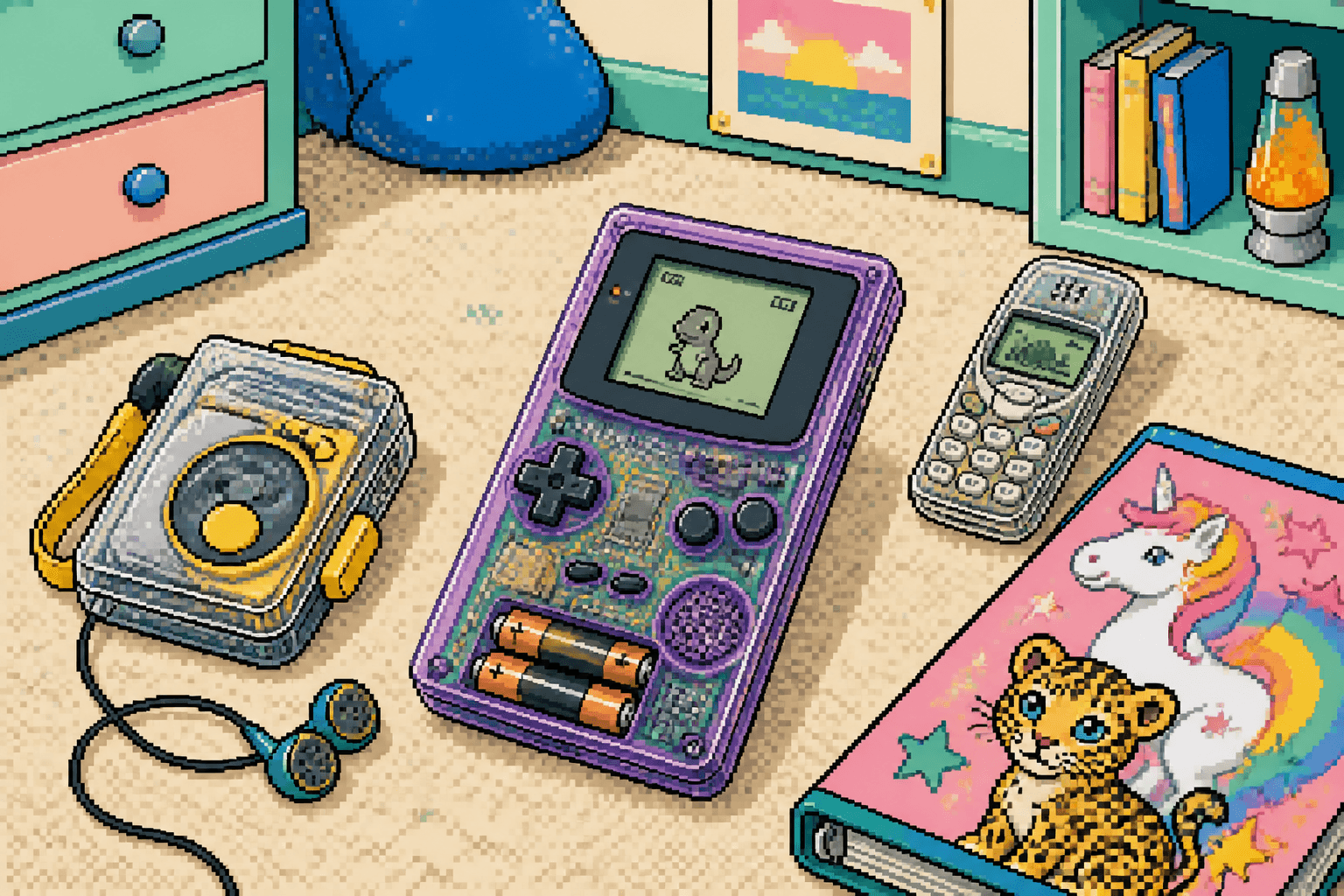
There were six colors on the Toys R Us display. Berry, grape, kiwi, dandelion, teal, and the one everyone was there for: atomic purple.
The other five were solid plastic. Honest about being plastic. Grape looked like grape. Kiwi looked like kiwi. They were the colors a four-year-old crayon set calls colors.
Atomic Purple was something else. Atomic Purple was clear.
You could see the circuit board. You could see the green motherboard with little gold traces running between chips. You could see the round brown speaker cone. You could see the two AA batteries sitting in their compartment like they'd been caught doing something. You could see the ribbon cable that went from the main board up to the screen, and the tiny solder points that held it there, and the slot in the top where the Pokemon cartridge locked in with a small click.
It was the same Game Boy as the other five. It just had its skin off.
The Choice at the Display
I want to be clear about what happened at the store. You were ten. Your mom had said one Game Boy. You walked up to the display and there were six of the same thing, each one $69.99, each one with the same cartridge slot and the same four face buttons and the same D-pad.
Grape was fine. Grape was purple. Nothing was wrong with grape.
Nobody picked grape.
Everyone picked atomic purple. The whole rack of atomic purple would be gone by Saturday and the manager would get a shipment on Tuesday and that rack would be gone by Thursday. Berry hung on for weeks. Grape was a lifer. Atomic purple moved like a drug.
The reason was simple and it was embarrassingly true: you could see the inside. That was the whole pitch. That was the whole product. Nintendo had made a thing you could watch work.
You could see the circuit board. That was the whole product.
Everything Was See-Through for Eighteen Months
It wasn't just the Game Boy. For roughly 1998 through early 2000, every object in a kid's bedroom got a clear-plastic sibling.
The N64 came in a see-through Jungle Green and a Grape and an Ice Blue, and inside each one you could see the little cartridge connector bending its pins under the slot cover. Nokia did see-through phones that let you watch the backlight bleed through the keypad. Sony made a Sports Walkman in a yellow-and-clear case where you could watch the tape itself spin. There was a see-through iron. A see-through stapler. The iMac G3 was the grown-up version of the same impulse, parked on your parents' desk looking like a tinted scoop of jelly.
Even the trapper keeper got a clear vinyl pocket on the front, and you were supposed to slide a picture in there, but most kids just left the pocket empty because the point was the pocket.
For a year and a half, everything confessed.
Why It Worked
I think about this more than I should. The clear-plastic phase was a marketing gimmick. It was. Let's not pretend. Someone at Nintendo of America saw the sales numbers on the iMac and said we should do that too, and within six months there was atomic purple on a shelf.
But it worked because it was flattering a specific idea a ten-year-old already had about machines, which was: these are made out of things. You knew, dimly, that your Game Boy had a chip in it. You knew it ran on batteries and had a speaker and did math somehow. The clear shell was a reward for already suspecting this. It confirmed you. The circuit board was there. The thing you were playing was a real object with parts.
The opaque version was a slab. The atomic purple version was a diagram.
The Part the Blog Has to Argue With
Here's where I'm supposed to make the turn, because this is a blog that argues with itself.
The clear-plastic phase lasted about eighteen months and then quietly ended, and it ended for a reason, which is that it wasn't actually that useful to see your batteries all the time. The circuit board was a backdrop, not a feature. Nobody ever repaired an atomic purple Game Boy because it was atomic purple. You couldn't change the chip. You couldn't fix the ribbon cable. You weren't going to swap anything. The transparency was aesthetic, not practical, and the aesthetic got tired.
The 2000s showed up and everything went back to being a slab. The iPod was a white slab. The RAZR was a silver slab. The iPhone was a glass slab. The MacBook Air was a slab that got thinner every year until it was almost a slab of nothing. And the slabs were better. They didn't scratch the same way. They felt more serious. They aged more gracefully.
Nobody in 2008 wanted their phone to show its wires. Nobody in 2015 wanted their laptop to confess. The confession had been a phase.
The Part You're Not Going to Miss
Something did go missing, though. I don't want to be dramatic about it, but I do think about it.
The atomic purple Game Boy was not a better Game Boy. But it was a Game Boy that admitted it was a thing. You could open it with a tri-wing screwdriver, you could replace the screen, you could pop the shell off and put it on another one, and people did. There are still people on the internet restoring Game Boy Colors with new atomic purple shells because the original ones yellowed. The thing was fixable. The thing had, visibly, parts.
Your phone does not have visible parts. Your phone does not have replaceable parts in any sense the atomic purple Game Boy did. Your phone is sealed with glue, and the glue is a design choice. You are not meant to look at the circuit board. You are not meant to see the battery. The battery is a surprise under glass and if it swells you take it to someone with a heat gun.
The slab won. The slab is maybe correct. But there was an eighteen-month window where we got sold the opposite idea on purpose, and some of us picked atomic purple over grape not because we liked the color but because we liked the honesty.
Nobody in 2008 wanted their phone to show its wires. The confession had been a phase.
The Carpet, the Cartridge, the Light
I had an atomic purple Game Boy Color. I played Pokemon Silver on it, holding it up to the light fixture in the back seat of a Taurus so I could see the screen, because the Color wasn't actually backlit. That was the other joke about the Game Boy Color. The Color was in the sprites, not the screen. You still needed a lamp.
I would sometimes, at night, turn the Game Boy sideways and look at the inside. Not the screen. The inside. The circuit board. The chip that said CPU on it in letters smaller than a grain of rice. The two AA batteries that I bought at CVS in a four-pack and burned through in a weekend. The little speaker, which played Pokemon music the way a fly plays music.
I wasn't going to fix anything. I didn't know what any of the components did. The chip said CPU and I knew CPU meant brain, and that was the end of my understanding. But I liked that it said CPU. I liked that the thing in my hand was willing to say so.
Nothing in my hand says so anymore.
The slab is probably correct. But for about eighteen months we were allowed to see.