You heard it before you saw it.
A rolling sound. Metallic. Specific. The sound of four small hard-plastic wheels on a tile floor, carrying something heavy. A kid in the hallway seat looked up first. Then the kid next to him. Then, slowly, every head in every third-row seat turned toward the door, because everyone knew what that sound was, and everyone knew what it meant.
It meant the AV cart was coming.
It meant the lights were about to go off.
It meant you had, structurally, nothing to do for the next thirty-five minutes.
The Cart
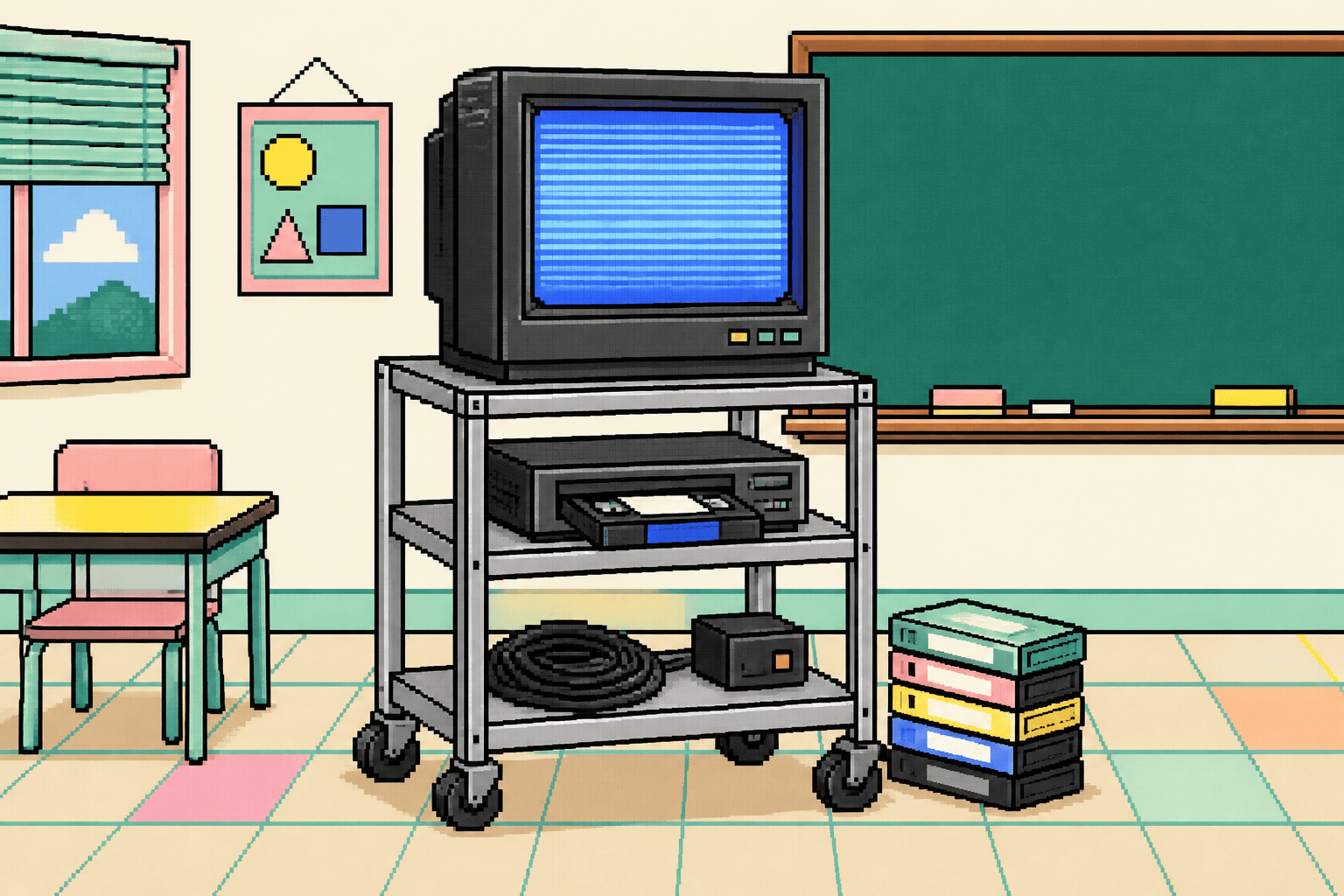
The cart was five feet tall and the color of a battleship. It had a square metal frame, four wheels that locked individually, and three shelves. On the top shelf was a television. Not a modern television. A television. A Panasonic or a Zenith, nineteen inches diagonal, weighing somewhere between forty and sixty pounds, bolted to the cart with a steel strap that nobody at your school had the tool to remove. The strap was there because, at some point in 1992, a cart had tipped over on a kid at a school in another district, and now every TV at every public school in America was strapped down like a convict.
On the middle shelf was a VCR. A VCR was a slab of plastic the size of a loaf of bread with a slot in the front that a tape went into. It had buttons. It had a clock on it that always, always flashed 12:00 because no adult in the building knew how to set it and no kid was going to admit they did. The VCR was connected to the TV by a loop of cables that nobody had coiled properly, and the whole arrangement was precariously balanced by the fact that it had been precariously balanced for years and was somehow still working.
On the bottom shelf were three tapes. Sometimes two. Once, twice if the year was good, there was a pile. Each tape was in a cardboard sleeve with a title typed on a label and stuck to the spine. The sleeves were always worn at the corners.
The strap was there because, at some point in 1992, a cart had tipped over on a kid at a school in another district, and now every TV at every public school in America was strapped down like a convict.
The Sound Was the Thing
I want to stay with the sound for a second.
It was a distinct sound. It was not quiet. It was not loud. It was a mid-register rumble, four wheels on tile, with a specific trembly rattle from the TV shifting on the shelf as the cart changed direction. It was a sound you could tell from across the building, through a closed classroom door, through the murmur of your own class trying to pretend they were listening to a lecture about longitude and latitude.
The sound said: somebody's getting a movie.
The sound said: maybe us.
The sound said: maybe the room across the hall, and we're going to have to keep doing longitude.
You held your breath, structurally, for the thirty seconds it took the cart to get close enough to figure out which door it was turning into. You listened for it to pass. You listened for it to not pass. You watched the shadow of the handle of the cart come up under the pebbled-glass door window. You watched it stop. You watched the handle turn.
And then your teacher, who had known this was coming, who had scheduled it, who had signed up for the cart two weeks ago on the AV sign-out sheet in the library, pretended to be surprised.
Oh, she said, flatly. Looks like we have the cart today.
As if she had not pre-cued the tape.
Who Pushed It
The cart was almost always pushed by Mr. Tetlow, the AV guy, which was one person in each school who was either a teacher with a free period or a janitor or, at my school, a retired Navy guy who had been hired specifically to be the AV guy. He wore khakis and a polo and he smelled like coffee.
Sometimes the cart was pushed by two seventh-graders who had been pulled out of their own class to be AV helpers, which was the single highest-status job a middle schooler could have. The two kids got a laminated hall pass on a lanyard. They got to roam the halls while everyone else was in class. They got to push the cart. They got to turn the TV on with a tiny gray remote that no teacher could find. They got to ask the teacher, in a flat professional voice, do you want it on channel three, and the teacher would nod, and the two seventh-graders would, briefly, be adults.
I wanted to be an AV helper. I was never an AV helper. The AV helpers were always eighth-grade boys who had, somehow, in some meeting I was not part of, been identified as responsible.
- The quiet kid who was good at math
- The band kid whose dad was an electrician
- The kid whose mom was on the PTA
- Exactly one girl, once, in 1997, and she was better than all the boys combined
- Not me
- Not, I suspect, you
The Tracking
Here is the part I want you to remember.
The cart arrived. The TV got rolled into position at the front of the room. The teacher turned off the lights. There was a small collective sound from the class, a half-second of settling-in. Everyone adjusted. A kid in the back put his head down on the desk and pretended, loudly, that he was ready. Everyone else relaxed in a way that was almost embarrassing. Our shoulders came down. Our hands uncurled. Our pens went into the little gutter of the desk. This was not learning time. This was watching time. The physics of our bodies had changed.
The teacher put in the tape. The TV flickered. And then, for the first ten to ninety seconds of every single movie, the picture was wrong.
This was not learning time. This was watching time. The physics of our bodies had changed.
The tracking was bad.
The picture had a rolling horizontal band across it, moving upward, every few seconds, like a wave. The audio was muffled. The colors were slightly off. The teacher stood up and walked over to the VCR and pressed a button labeled TRACKING and the picture did nothing. She pressed it again. The picture did something, but not better. A boy in the front named Kyle, who always knew the technical thing nobody asked him to know, said you have to hold it. The teacher held it. The band got smaller. The band got bigger. The band stopped. The picture settled.
The whole class watched this happen in silence.
I want to be clear about the silence. It was not bored silence. It was not impatient silence. It was the silence of a group of kids who understood that this was part of the deal. The tracking adjustment was the price of the movie. It was the overture. It was the AV equivalent of the Pledge of Allegiance. Nobody made fun of the teacher. Nobody sighed. We watched her adjust the tracking because we knew that in ninety seconds we were going to be watching something, anything, that was not a worksheet.
Try It
Pick a tape. The picture comes in wrong. Fix the tracking. Wait for the FBI warning. Then the movie starts and a teacher will, at some point, pause it to ask you a question.
The FBI Warning
Then, on every tape, always, the FBI warning.
You have forgotten this but you have not forgotten this. A screen came up that was pure black with white or yellow text and it said, WARNING. FEDERAL LAW PROVIDES SEVERE CIVIL AND CRIMINAL PENALTIES FOR THE UNAUTHORIZED REPRODUCTION, DISTRIBUTION, OR EXHIBITION OF COPYRIGHTED MOTION PICTURES. TITLE 17 UNITED STATES CODE, SECTION 501 AND 506.
Nobody read it. Nobody had ever read it. It sat there for what seemed like six minutes but was actually four seconds. It was the same on every tape. The FBI warning was the dress code of the VHS era. It appeared, it loomed, nobody engaged with it, it faded.
I sometimes wonder if, somewhere, there is a kid who actually read the FBI warning every single time. Who took in the words. Who understood what exhibition of copyrighted motion pictures meant. Who thought, in a Catholic-school fifth grade classroom in 1995, am I committing a federal crime right now, because the teacher is clearly exhibiting this motion picture to twenty-six children. That kid is now a lawyer.
The Movie
The movie was always one of five categories.
Category 1 was educational. A fifteen-minute instructional film about the water cycle, or the three branches of government, or how a bill becomes a law. It was almost always from the Seventies. The clothes were wrong. The hair was wrong. The narrator was a middle-aged man with the voice of a car commercial. The reenactments were produced on a budget of approximately four hundred dollars. A guy in a powdered wig was signing a document with a feather pen. A drop of water with a cartoon face was explaining evaporation to a cartoon sun. You did not learn anything. You did not need to learn anything. The teacher was going to re-teach all of it next class.
Category 2 was a Disney movie. Not a new Disney movie. An old Disney movie, taped off TV years ago by a teacher who still had the tape, with occasional static where the commercials had been edited out badly. Robin Hood, the fox one. The Sword in the Stone. A single VHS copy of Fantasia that everyone's class had seen three times.
Category 3 was The Magic School Bus or Reading Rainbow or Bill Nye the Science Guy. These were the good ones. You cheered when the teacher put in Bill Nye. You cheered as a room. Bill Nye on the AV cart was, no joke, a cultural event.
Category 4 was something the teacher had taped off PBS at home over the weekend because it tied in to the lesson. These were always slightly off. The commercials had not been edited out. The pledge drive for the local station appeared at minute seventeen. A tote bag was being given away for a hundred and twenty dollars.
Category 5, the rarest, the holiest, the one that made the class go dead silent with disbelief: the teacher had put in a real movie. A full-length movie. Something like October Sky or Rudy or Apollo 13, because the teacher had given up, or because it was the last week of school, or because there was a substitute and the cart was the substitute's first and only idea. When category 5 happened, you held very still, because if you moved, you were afraid the teacher would notice she had put in a real movie and change her mind.
Bill Nye on the AV cart was, no joke, a cultural event.
The Pause
Twenty minutes into every category-1 movie, the teacher would pause it.
She would stand up. She would walk to the front of the room. She would say, okay, so, what do we think about what she just said, and the kid she was pointing at would have no idea what the lady on TV had just said because the kid had been drawing a skeleton in the margin of his notebook for the last nineteen minutes, and the kid would say, um, and the teacher would wait, and the kid would say the thing about the water, and the teacher would say, right, exactly, the thing about the water, who can tell me more about the thing about the water, and we would all understand that the pause had been theater.
The pause had never been for us. The pause had been for the administrator who might, hypothetically, walk by the classroom door at this exact moment and need to see the teacher engaging with the material. The pause was defensive. The pause was the teacher saying, to an imaginary observer, I am not using this tape as a babysitter, I am using it as a teaching tool.
The teacher was absolutely using it as a babysitter.
This was fine. This was good, actually. The teacher had been teaching this same lesson for eleven years. The teacher had a stack of papers to grade. The teacher was a human person who had been standing up in front of children for three hours already and was going to be standing up in front of children for three hours more. The teacher deserved to put in the water cycle tape and sit at her desk for fourteen minutes and grade quizzes. We knew. She knew we knew. We did not care. We had our thirty-five minutes.
What Was Actually Happening
Here is what was actually happening in those thirty-five minutes.
Three kids were asleep. I mean actually asleep, head-down, drool on the desk. One of them was always the kid who had a paper route.
Four kids were reading something under the desk. A Goosebumps book, a wrinkled issue of YM, the sports section their dad had left on the kitchen table. Four kids were reading something they had chosen, which is, structurally, a thing that was not happening to them the rest of the day.
Two kids were doing homework for a different class. One kid was doing homework for the same class. This kid was unknowable.
Six kids were drawing. Two were drawing in their notebooks. One was drawing on his hand. One was drawing a tattoo on his desk with a pen, which would, next period, get him sent to the office. One was drawing a very detailed sword. One was drawing, with an attention and dedication that was almost religious, a cheat code to a Super Nintendo game he did not own.
The rest of us were watching the movie. Or watching the back of the head of the person we had a crush on, who was watching the movie. Or watching the dust visible in the light of the TV, because the projector light of a nineteen-inch CRT in a dark classroom lit up every speck of chalk dust in the room, and the air in a classroom in 1995 had a lot of chalk dust, and watching it was, I am telling you, not nothing. I remember the chalk dust. I remember that I could see the air.
- 35 minutes of a teacher reading aloud from a textbook
- 35 minutes of a worksheet on vocabulary
- 35 minutes of someone else doing a presentation
- 35 minutes of the kid next to you talking under his breath
- 35 minutes of looking at the classroom clock
- Something you cannot name that had been building up all week
The Argument
There is an argument that the AV cart was bad.
The argument goes: the AV cart was educational malpractice. The AV cart was a teacher who had stopped caring. The AV cart was thirty-five minutes a week, aggregated across a school year, that added up to something like a full week of instruction time lost to watching a copy of Bill Nye on the Hydrologic Cycle that we had seen four times already. The AV cart was the first wave of what is now a tablet in a kid's hand all day and we should see it for what it was.
I want to give this argument its due. Some of those tapes were bad. Some of the teachers were coasting. Some days we got a movie because the teacher was hungover, not because the material called for it.
But I also want to say that thirty-five minutes a week of sitting in a dark room, watching something that was not a worksheet, not being asked to perform, not being called on, not being graded in real time, with other kids, in silence, under the weird dim light of a nineteen-inch screen, was not nothing. It was a kind of rest we did not get anywhere else in the school day. Lunch was not rest. Recess was not rest. Lunch was a pressure situation and recess was politics. The AV cart was the only thirty-five minutes a week where we were allowed to be in a group and not be watched.
Lunch was not rest. Recess was not rest. Lunch was a pressure situation and recess was politics. The AV cart was the only thirty-five minutes a week where we were allowed to be in a group and not be watched.
I think about that now. I think about how much of the school day was performance. I think about how little space a kid got, in a public school in 1995, to just sit in the dark with other kids and look at something and not have an opinion about it.
I am not going to defend the water cycle tape. The water cycle tape was mediocre.
I am going to defend the dark room.
What Replaced It
The AV cart is gone.
Every classroom has a projector now. Or a smart board. Or a monitor on the wall. The teacher presses a button and the lesson plan for the day appears instantly, in HD, streamed from the district's digital library, with embedded quiz questions that students have to answer on their Chromebooks before they can watch the next segment. There is no cart. There is no strap. There is no VCR clock blinking 12:00. There is no tracking band. There is no FBI warning. There is no Mr. Tetlow.
I want to be clear that this is probably better. The content is more accessible. The lessons are more targeted. The educational outcomes are, probably, measurably improved. A superintendent somewhere has a spreadsheet that proves it.
But there is a thing that is gone that nobody is counting.
The sound is gone. The metal rumble in the hall that said maybe us. The ten seconds before anyone knew which door it was going to turn into. The small shared exhale of a room. The ritual of the tracking adjustment, the kid in the front row who always knew the technical thing, the teacher who pretended to be surprised. The dark. The chalk dust in the beam. The thirty-five minutes.
The kids now have content. They did not have a cart.
The Last Cart
Somewhere in the storage closet of a public middle school in America, right now, there is one AV cart left. It has not been pushed in twelve years. The TV is strapped down. The VCR clock is blinking. The bottom shelf has three tapes on it, in cardboard sleeves, labels peeling. The sleeves read: WATER CYCLE, WESTWARD HO!, and one that is just a strip of masking tape with the word SUB written on it in a teacher's handwriting, meaning the substitute puts this one in, and they all agreed, years ago, not to specify what was on it. Nobody remembers anymore. One day a custodian is going to clear out that closet, and the cart is going to go to a recycling center, and the TV is going to be unbolted from the strap for the first time in twenty-five years, and the strap is going to snap back against the metal frame and make a sound, and nobody is going to be there to hear it.