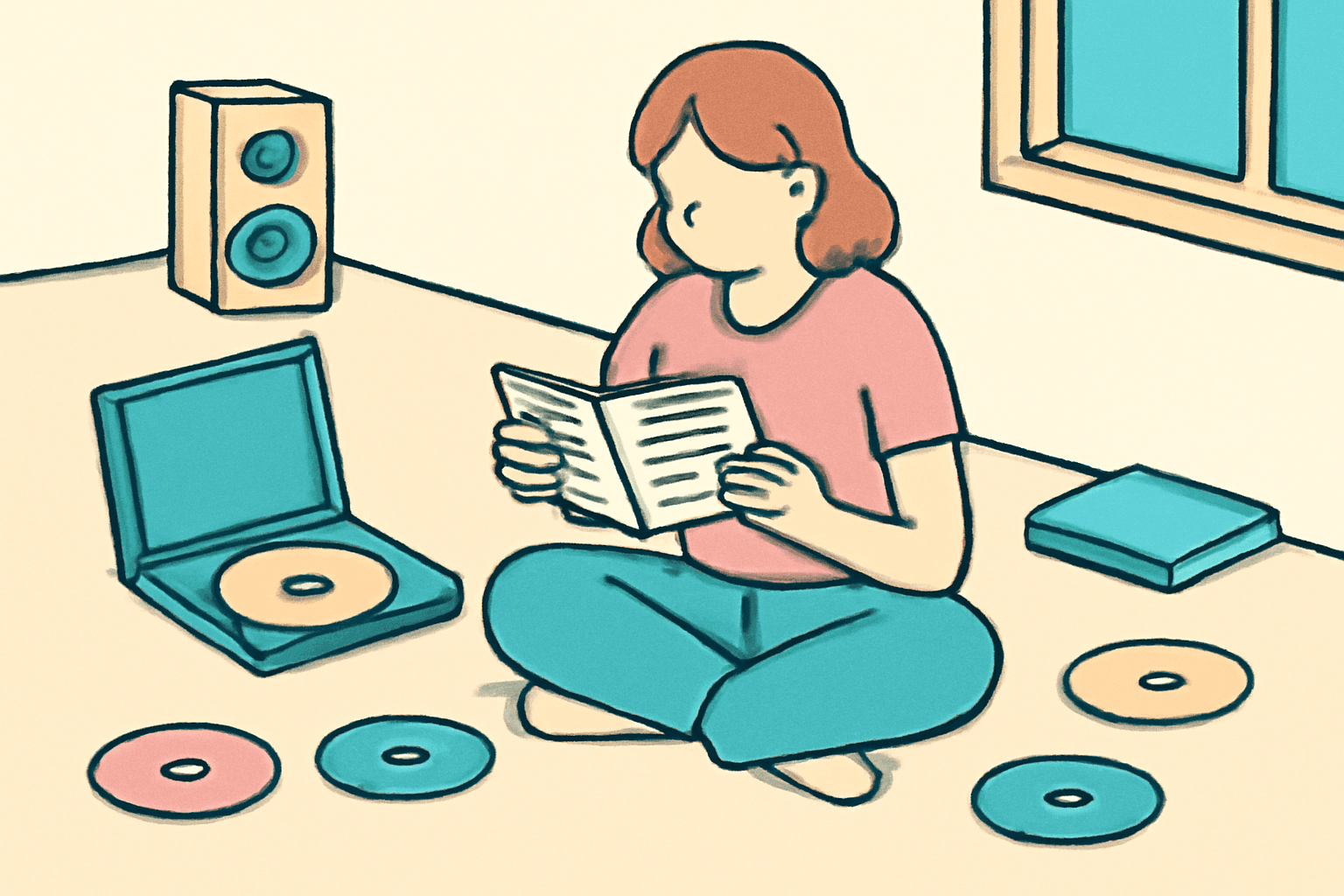
The lyric sheet for Jagged Little Pill was printed in this tiny, cramped font on paper so thin you could almost see through it. Dark blue ink on white. No paragraph breaks. Just words and words and words, crammed edge to edge like Alanis Morissette had too much to say and not enough paper to say it on. I sat on my bedroom floor with the booklet unfolded in my lap, the CD spinning in my boombox on the dresser, and I followed along word by word like it was scripture. I was twelve. I didn't know what half the lyrics meant. I read every single one.
That was the ritual. You bought an album - or someone bought it for you, or you got it from Columbia House under a name that wasn't quite yours - and the first thing you did was crack the jewel case and pull out the booklet. Not later. Not eventually. First. Before you even heard the music, you held the liner notes in your hands and started reading.
The Booklet
The booklet was its own object. A tiny, perfect magazine that lived inside the jewel case, held in place by those little plastic teeth at the center. You'd press the button and the teeth would release and the booklet would come free and suddenly you had this thing - eight pages, twelve pages, sometimes twenty - that told you everything the album wanted you to know about itself.
The lyrics were the main event, obviously. But they weren't the only thing. There was the album art, spread across the pages, sometimes abstract, sometimes photographs of the band looking moody in an alley or a field or an empty swimming pool. There were production credits in tiny type. There was the name of the recording studio, usually in some city you'd never been to. There was the mastering engineer, which was a job you didn't understand but whose name you memorized anyway because it was there and you read everything.
You didn't just listen to an album. You studied it. The booklet was your textbook and the music was the lecture and your bedroom floor was the classroom.
And then there was the back of the jewel case itself. The track listing. The record label logo. The copyright information. The runtime of each song, printed in small gray numbers. You'd scan that list and try to guess which songs would be your favorites based on the titles alone. A song called "Bullet with Butterfly Wings" had to be amazing. A song called "Porcelain" could go either way. You'd make predictions and then test them, one track at a time, and the booklet was open in your hands the whole time.
The Thank-You Section
This was the part that felt like eavesdropping.
Every album had a thank-you section, usually on the last page, sometimes spilling onto the inside of the back cover. It was a wall of text - names and names and names, separated by commas, written in the first person by the band members. And you read it all. Every name. Every inside joke. Every cryptic reference you didn't understand.
- God (always first, or suspiciously absent)
- The band's parents, by first name
- Roadies and tour managers you'd never heard of
- Other bands, which told you who was friends with who
- A girlfriend or boyfriend, described in language that was either sweet or suspiciously vague
- "Everyone who believed in us when nobody else did"
- A dead person, acknowledged quietly in the middle of the list
- An inside joke in ALL CAPS that clearly meant something to three people on earth
You'd study the thank-you section like it was a social map. If the singer from Green Day thanked the guys in Rancid, that meant something. It meant they knew each other. It meant there was a world out there, a network of people who made music together and toured together and crashed on each other's couches. You were thirteen and you lived in the suburbs and you'd never been to a punk show in your life, but reading the liner notes for Dookie made you feel like you had a window into that world. A small one. But it was enough.
The Nirvana liner notes were their own whole thing. Kurt Cobain's handwriting on In Utero - scratchy and uneven, like he wrote it on his knee in the back of a van. The collage art. The way the lyrics were sometimes printed wrong on purpose, or crossed out, or buried in the visual noise of the layout. You'd hold the booklet up to the light trying to read something half-hidden behind an image, convinced there was a secret message you were supposed to find.
The Hidden Stuff
Because sometimes there were secret messages.
Bands hid things in liner notes the way kids hid things in their lockers - for the thrill of it, for the people who cared enough to look. Backwards text. Messages printed on the inside of the tray card, under the part you had to pop out to see. Lyrics that didn't match what was actually sung, making you wonder which version was real. The whole thing rewarded obsession. It rewarded the kid who didn't just listen to the album but took the jewel case apart and examined every surface.
And then there were hidden tracks. The phantom song at the end of the album, separated from the last real track by minutes of silence. You'd be lying on your bed, eyes closed, the album finished, and then - three minutes, five minutes, sometimes ten minutes of nothing later - music would start again. Quiet at first. Then louder. A whole song you weren't expecting, playing in your dark bedroom like a ghost had turned on the radio.
Nevermind had one. So did Jagged Little Pill. So did CrazySexyCool. You'd sit through the silence on purpose, every time, because finding it felt like being in on a secret. Some albums listed it as an extra track number. Track 13 on a 12-song album, with a runtime of 14 minutes, the first 10 of which were dead air. Other albums didn't list it at all. You just had to know. And you knew because you'd read about it in a magazine, or a friend told you, or you accidentally left the CD playing while you were doing homework and suddenly there was music again and you nearly fell out of your chair.
The hidden track rewarded patience. It rewarded the people who didn't press stop. It was a gift for the ones who stayed.
Reading While Listening
The real ritual was this: you put the album on, you opened the booklet to page one, and you read the lyrics while the songs played. Word by word. Line by line. You'd lose your place and have to catch up. You'd find a word in the booklet that didn't match what you were hearing and you'd rewind and listen again, closer, and realize you'd been singing it wrong for weeks.
TLC's CrazySexyCool had liner notes that felt like a world. The photography. The styling. The way each member had her own visual identity across the pages. You didn't just read those liner notes - you inhabited them. You understood the album differently because of how it looked. The music and the images and the words on the page all fused into one thing, one experience, and that experience only existed when you were holding the booklet in your hands.
Green Day's Dookie had the lyrics printed over this chaotic mural - hundreds of tiny characters and explosions and jokes packed into a single sprawling illustration. You could look at that artwork for an hour and still find something new. The lyrics were almost secondary to the visual experience of the booklet itself. Almost. But not quite.
What Streaming Took
Here is what I think about sometimes. When I open Spotify and play an album, I get the music. I get it instantly, perfectly, at whatever volume I want, in whatever order I want. I can skip tracks. I can shuffle. I can add songs to playlists and share them with people on the other side of the planet. The music is better served than it has ever been.
But the booklet is gone. The lyrics are on some website now, crowd-sourced, sometimes wrong, displayed in plain text next to an ad for car insurance. The album art is a thumbnail. The thank-you section doesn't exist. The hidden track doesn't exist - streaming services don't do ten minutes of silence followed by a bonus song, because the algorithm would punish it. The production credits are buried in a metadata menu that nobody clicks.
The relationship is what's gone. The physical, tactile, time-consuming relationship between you and an album. The thing that made you sit on your floor for forty-five minutes and read every word and study every image and feel like you knew this album, not just its songs but its entire being. Its thank-you section. Its inside jokes. Its hidden messages. The name of the studio where it was recorded and the mastering engineer whose job you never understood.
You can't hold a stream. You can't unfold it in your lap. You can't pop out the tray card and find a message printed on the plastic underneath.
I still have a shelf of jewel cases in my closet. I don't play them. I haven't owned a CD player in years. But sometimes I pull one out and open it and hold the booklet and read the thank-you section, and for a minute I'm back on my bedroom floor, twelve years old, following the lyrics word by word while the music plays, convinced that if I read carefully enough I'll find something hidden in the margins. Something meant just for me. Something the band left there for the kid who stayed until the silence ended and the secret song began.